

India's Diplomatic Balancing Act: Navigating Russian Oil and US Pressure
US President Donald Trump's recent announcement of an India-US trade deal included a contentious claim on Truth Social that Prime Minister Narendra Modi had "agreed to stop buying Russian oil." This statement has placed India in a diplomatically precarious position, compelling New Delhi to carefully manage its deep-rooted alliance with Russia while maintaining productive engagement with the Trump administration.
Historical Foundations of India-Russia Ties
The relationship between India and Russia, originally with the Soviet Union, flourished significantly in the 1970s. During the 1971 India-Pakistan war, Moscow provided crucial support as a counterbalance to the United States. Defence cooperation became the cornerstone of this partnership, with Soviet-manufactured equipment constituting over 80% of India's weapons arsenal at that time.
Even after the Soviet Union's collapse in 1991, defence remained the backbone of bilateral relations. While India diversified its sources to include Israel, the US, France, and other European nations, Russia continued to be the primary supplier of defence equipment and essential spares for legacy systems. This dependency persisted at approximately 60-70% until recent years.

The Ukraine War and Energy Trade Dynamics
Following Russia's invasion of Ukraine in February 2022, the US-led Western bloc imposed sanctions on Moscow. India emerged as a willing buyer of Russian oil, purchasing at substantial discounts. Prior to the invasion, Russia accounted for just 2% of India's energy imports; this figure surged to over 32% in subsequent years.
Bilateral trade between India and Russia reached a record $68.7 billion in FY 2024-25, with Russian oil imports dominating at $63.8 billion, while India's exports to Russia were a modest $4.9 billion. The US initially overlooked this trade, and Western European nations eventually acquiesced, recognizing that India adhered to price caps on Russian oil and helped stabilize global energy supply chains, preventing price spikes.
India justified its actions based on commercial interests, aiming to mitigate inflationary pressures from crude price hikes by sourcing from the most cost-effective suppliers. The government emphasized that oil purchases were driven by corporate decisions, not state intervention.
Trump's Tariffs and India's Strategic Adjustments
This arrangement functioned smoothly until Trump assumed office last year. He imposed punitive 25% tariffs specifically on India for buying Russian oil, exempting European buyers and even China. In response, India has gradually reduced its Russian oil imports since September 2025, maintaining that its decisions are guided by commercial logic and energy requirements.
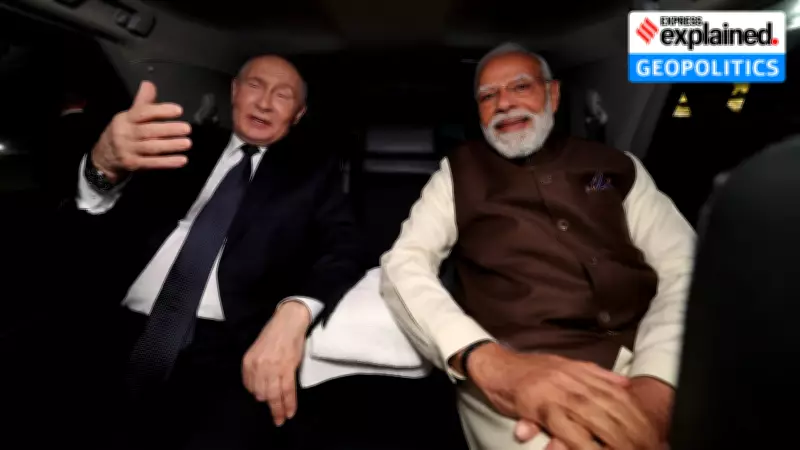
Despite scaling back oil purchases, India has reinforced its ties with Russia through high-level diplomacy. Prime Minister Modi has engaged in multiple phone conversations and two prominent meetings with Russian President Vladimir Putin in Tianjin and Delhi. These interactions have allowed discussions on the new challenges posed by the Trump administration, particularly the tariffs framed as a 'Russian penalty.'
India expects Moscow to comprehend its strategic shift, as New Delhi has kept Russian officials informed about the political and economic pressures from the US. The Kremlin has downplayed Trump's statement, with spokesman Dmitry Peskov noting, "We, along with all other international energy experts, are well aware that Russia is not the only supplier of oil and petroleum products to India. India has always purchased these products from other countries. Therefore, we see nothing new here."
India's Official Stance and Energy Security
India is unlikely to officially confirm the cessation of Russian oil imports, similar to its discreet phasing out of Iranian and Venezuelan oil under previous US pressure. The government asserts that national interests, including energy security, will dictate its actions.

Ministry of External Affairs spokesperson Randhir Jaiswal clarified, "Insofar as India's energy sourcing is concerned, the government has stated publicly on several occasions that ensuring the energy security of 1.4 billion Indians is the supreme priority of the government. Diversifying our energy sourcing in keeping with objective market conditions and evolving international dynamics is at the core of our strategy to ensure this. All of India's actions are taken and will be taken with this in mind."
The China Factor and Defence Considerations
Returning to defence, India's reliance on new Russian equipment has decreased to below 40%, with challenges arising from sanctions affecting high-tech transfers to Russia. However, India remains cautious about Russian sensitivities, especially given Moscow's proximity to China, India's strategic rival.
With approximately 50,000 Indian troops stationed along the India-China border for nearly six years, India is keen to avoid jeopardizing its relationship with Russia. Consequently, New Delhi must diplomatically navigate the delicate terrain of declining oil imports while sustaining its defence partnership with Moscow.
In summary, India faces a complex diplomatic landscape, balancing historical alliances with Russia against new economic realities imposed by the US. The nation's approach will continue to prioritize energy security and strategic autonomy, guided by pragmatic considerations in an evolving global order.





