

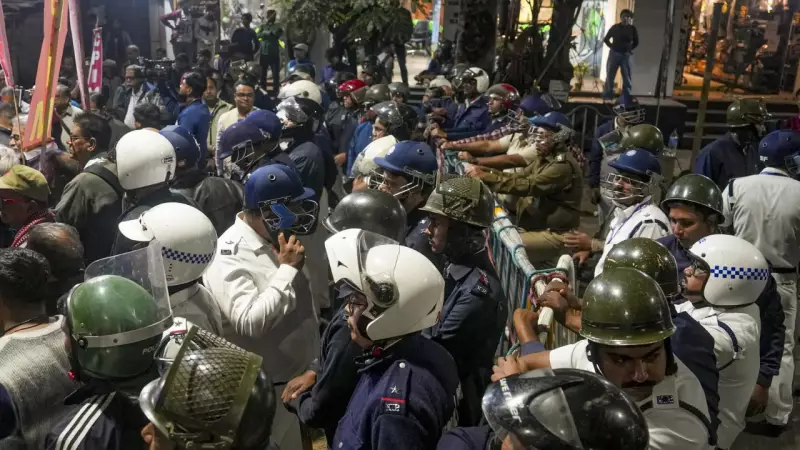
Widespread protests condemning violence against Hindus in Bangladesh swept through multiple Indian cities on Tuesday, December 19, triggering a sharp diplomatic row between the two neighbouring nations. The unrest was sparked by the brutal lynching of a Hindu man in Bangladesh and coincided with parallel political protests in Dhaka.
Lynching in Mymensingh Ignites Outrage
The immediate catalyst for the demonstrations in India was the killing of Dipu Chandra Das, a 27-year-old Hindu factory worker, in Mymensingh, Bangladesh, on December 18. According to reports, Das was allegedly beaten to death by a mob over accusations of blasphemy, after which his body was set on fire. The incident renewed serious concerns about the safety of religious minorities in Bangladesh and prompted immediate condemnation.
Protests Erupt Across Indian Cities, Police Respond
In Kolkata, members of Bangiyo Hindu Jagran and other Hindu organisations staged a protest near the Deputy High Commission of Bangladesh. The situation turned volatile as crowds gathered, leading police to conduct a lathi charge to prevent a breach of law and order.

Simultaneously, in Mumbai and Delhi, activists from the Vishva Hindu Parishad (VHP) and other groups were detained by police. In the national capital, protesters pushed barricades near the Bangladesh High Commission, leading to detentions. Heavy security was deployed, and demonstrators were taken away in police buses while chanting slogans.
In Hyderabad's Kothapet area, VHP-led protests raised concerns about minority safety in Bangladesh and alleged infiltration issues within the city. VHP National Spokesperson Shashidhar warned of escalated agitation if no concrete steps were taken.
Diplomatic Fallout and Government Responses
The protests led to significant diplomatic repercussions. India summoned Bangladesh High Commissioner Riaz Hamidullah on Tuesday. This move came after Bangladesh's Foreign Ministry had earlier summoned Indian High Commissioner Pranay Verma to express "grave concern" over the security of its missions in India.
In response to the security threats, Bangladesh suspended consular and visa services in New Delhi and Agartala. During the protests in India, effigies of Bangladesh's Chief Adviser Muhammad Yunus and the Bangladeshi national flag were burned, with slogans directed against the Dhaka administration.
On the Bangladeshi side, the interim government, led by Chief Adviser Muhammad Yunus, condemned the killing of Dipu Chandra Das and called for peace, assuring justice. Education Adviser Professor C R Abrar visited the victim's family to convey government sympathy.
Bangladesh's Law Adviser Asif Nazrul stated the murder case would be transferred to a Speedy Trial Tribunal, requiring completion within 90 days of the police report. Home Adviser Lt Gen (retd) Jahangir Alam Chowdhury confirmed that joint forces had arrested 10 people, including relatives of the prime accused, Faisal Karim Masud.
Parallel Unrest in Dhaka Over Political Killing
While India reacted to the lynching, Bangladesh itself was grappling with protests following the killing of Sharif Osman Hadi, a convenor and spokesperson for the Inqilab Moncho group. Hadi was shot at close range in Dhaka's Bijoynagar area on December 12 and later succumbed to his injuries in Singapore on December 18.
Hadi, a prominent leader in the July uprising that led to the fall of former Prime Minister Sheikh Hasina's government, was a potential candidate for the Dhaka-8 constituency in the February 2026 national elections. His death prompted Inqilab Moncho to demand justice and warn of a mass movement, leading the interim government to declare December 20 a national day of mourning.
The confluence of these two sensitive incidents—one communal and one political—has created a complex crisis for Bangladesh's interim government and tested diplomatic ties with India ahead of crucial elections.






