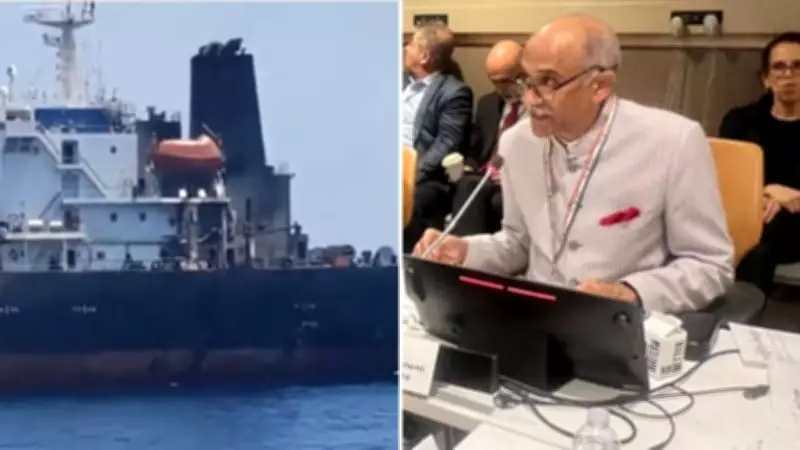
India has voiced strong opposition to attacks on merchant vessels at the United Nations Security Council, highlighting that several Indian nationals have either lost their lives or gone missing in incidents linked to the ongoing Middle East conflict.
India's Stance at the UNSC
Speaking at the UN Security Council on Wednesday, India's Permanent Representative to the UN, Ambassador P Harish Parvathaneni, expressed deep concern over the conflict in Iran and the Gulf region, which unfortunately began during the holy month of Ramadan. He urged all parties to exercise restraint, avoid escalation, and prioritize civilian safety.
"Many Indian nationals have lost their lives or are missing as a result of attacks against countries of the region and against merchant vessels and sea lanes of communication," Parvathaneni stated.

Recent Attack on Settebello Tanker
The remarks came shortly after India lodged a strong protest with the US Embassy in New Delhi over an attack on the Palau-flagged tanker Settebello off the coast of Oman. The vessel carried 24 Indian crew members. While 21 have been rescued, two Indian nationals have been confirmed dead, and one remains missing. The three were initially reported missing following the attack.
India's Ministry of External Affairs condemned the attack, confirming that 21 Indian crew members had been rescued and three were missing. The Indian Embassy in Muscat is coordinating with Omani authorities in the ongoing search and rescue operation. According to the United Kingdom Maritime Trade Operations, the tanker reported an engine-room fire approximately 20 nautical miles northeast of Oman's Sohar port.
Strategic Concerns for India
Parvathaneni noted that nearly 10 million Indian citizens live and work in the Gulf region, making their safety a top priority for New Delhi. "Our trade and energy supply chains are dependent on stability in the region, and any major disruption has serious consequences for the Indian economy," he said.
He added that the intensification of the Iran conflict and its spread to other nations have caused great anxiety. The ongoing violence has directly impacted India due to its geographical proximity and strategic interests. "The mounting destruction, deaths, and cessation of normal life and economic activities have deeply impacted India, a proximate neighbor with critical stakes in the security and stability of the region," Parvathaneni emphasized.
Call for Diplomacy
India strongly reiterated its call for dialogue and diplomacy, urging all parties to avoid impeding freedom of navigation and commerce, refrain from military targeting of commercial shipping, avoid targeting civilian populations and infrastructure, and seek an early end to the conflict.
The diplomatic intervention followed a US strike on the chemical and oil products tanker Settebello in the Gulf of Oman. India summoned US Charge d'Affaires Jason Meeks and lodged a formal protest. Unlike a previous vessel, Settebello was not listed under sanctions imposed by the US Office of Foreign Assets Control, a point reportedly highlighted by Indian officials during discussions with the American side.
Broader Context
The attack on Settebello occurred just two days after another Palau-flagged vessel carrying 24 Indian crew members was disabled by US forces while attempting to breach the American blockade on Iranian ports. All crew members from that vessel were later rescued with assistance from Omani authorities.
This comes as the US imposed a maritime blockade on April 13 in response to Iranian restrictions on shipping through the Strait of Hormuz. US Central Command stated that its forces had targeted vessels that failed to comply with instructions issued by American forces.