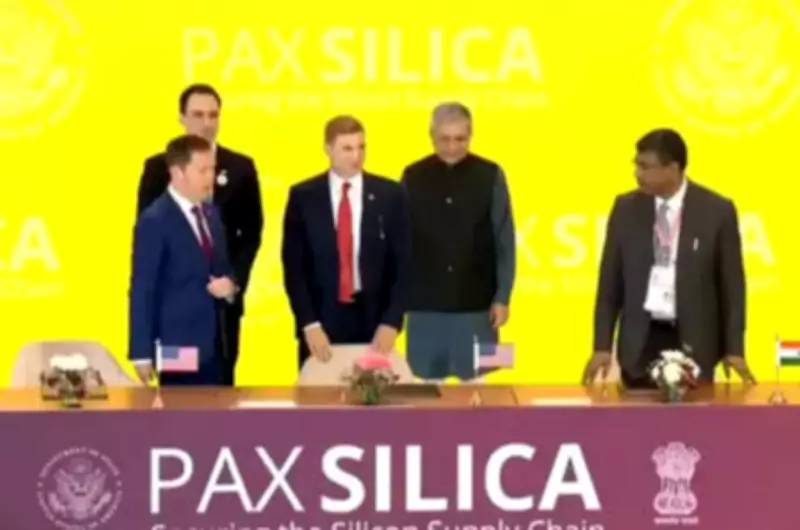
India Formally Joins US-Led Pax Silica Alliance at AI Summit in New Delhi
In a significant move that underscores the shifting dynamics of global technology power, India has officially signed the Pax Silica declaration at the India AI Impact Summit held in New Delhi. Union Minister Ashwini Vaishnaw inked the document alongside US Ambassador Sergio Gor and US Under Secretary of State for Economic Affairs Jacob Helberg, who traveled to the capital specifically for this pivotal ceremony. The signing event, which carried substantial diplomatic weight beyond mere formalities, coincided with a day when New Delhi was already abuzz with top global tech leaders, including Google CEO Sundar Pichai, marking one of the most consequential moments in India's artificial intelligence diplomacy to date.
Strategic Reversal: From Exclusion to Inclusion in Tech Alliance
This development represents a sharp reversal for India, which was notably absent from the founding member list of Pax Silica just two months ago. By becoming the tenth full member of this alliance, India now joins a coalition designed to establish a trusted alternative to China's control over the minerals, chips, and infrastructure that will fuel the AI economy for decades. The move sends a clear signal that Washington is now serious about anchoring New Delhi within its technology orbit, reflecting a deepening strategic partnership between the two nations.
Understanding Pax Silica: An Economic Security Bloc for the AI Age
So what exactly is Pax Silica? Think of it as an economic security bloc built around the silicon supply chain. Launched at a summit in Washington on December 12, 2025, Pax Silica is a US-orchestrated coalition aimed at creating trusted, resilient supply chains for all components that power the AI economy—from rare earth minerals extracted from the ground to the frontier AI models operating in data centers.

The name itself is telling. "Pax" is Latin for peace and prosperity, drawing from historical concepts like Pax Americana or Pax Romana. "Silica" refers to silicon dioxide, the raw precursor to semiconductor chips that enable modern computing. Together, the message is unequivocal: a stable, prosperous future hinges on securing the silicon supply chain.
Under Secretary Helberg, the Trump administration's point person on economic security, has described it as "an economic security coalition built for the AI age." The initiative encompasses the entire technology stack, including:
- Minerals and energy resources
- Chip fabrication processes
- Data center infrastructure
- Fibre-optic networks
- Frontier AI models
The China Factor: Driving Force Behind the Coalition
Pax Silica did not emerge in a vacuum. It is largely a direct response to China's stranglehold over critical minerals, particularly rare earth elements (REEs), which are essential for everything from electric vehicle motors to the magnets inside smartphones. China currently produces approximately 270,000 tonnes of rare earths annually and controls an even larger share of global processing and refining.
When US-China trade tensions escalated last year, Beijing suspended REE exports, and India felt the impact directly. Indian automakers had to cut production and eliminate features because rare earth magnets simply stopped arriving. Supply was restored only after Indian companies agreed to stringent Chinese licensing conditions, including an undertaking that the imported magnets would not be used for defense purposes.
This episode starkly illustrated the costs of concentrated supply chains. The coalition's stated aim is to reduce these dependencies by pooling the strengths of trusted partners—Australia's mineral wealth, the Netherlands' ASML lithography machines, South Korea's memory chip expertise, and now India's rare earth reserves and engineering depth.
India's Strategic Entry and Potential Gains
India's inclusion in Pax Silica was not a foregone conclusion. When the alliance launched in December, India was conspicuously absent from the founding member list—a diplomatic omission that raised eyebrows, especially given the otherwise warming tone of bilateral relations. The initial roster primarily consisted of US treaty allies and high-income nations.

The situation changed after Ambassador Gor arrived and began actively courting New Delhi. A broad framework for a bilateral trade deal has since been agreed upon, and Friday's signing represents the most visible outcome of that renewed momentum.
So what does India bring to the table? Quite a bit. India holds an estimated 8.52 million tonnes of rare earth reserves—one of the largest deposits globally—though domestic production remains below potential. The country boasts a rapidly growing semiconductor design ecosystem, with Qualcomm recently taping out a 2-nanometer chip design from its India centers. Minister Vaishnaw noted that ten semiconductor fabrication plants are already established or under development in India, with the first set to begin commercial production soon.
In return, India stands to gain:
- Faster access to process know-how and advanced manufacturing equipment
- GPU infrastructure that has been in tight global supply
- Closer integration with coalition members like ASML and Micron, potentially boosting India's chip ambitions
This move aligns with India's National Critical Mineral Mission and the India Semiconductor Mission, both currently underway. The presence of tech luminaries like Google's Sundar Pichai and OpenAI's Sam Altman at the summit itself indicates how seriously the global tech industry now views India as a destination. Pax Silica membership could further reduce friction for the deep-tech investment India needs to bridge existing gaps.
As Minister Vaishnaw stated after signing: "The world trusts India." Pax Silica represents, in part, a strategic bet on precisely that trust, positioning India at the forefront of the global AI economy while strengthening its technological sovereignty and international partnerships.