

India's Strategic Focus on Bangladesh's Pivotal February 12 Elections
India is maintaining a vigilant watch over the upcoming Bangladesh national elections scheduled for February 12, unfolding against a backdrop of significant economic and political turbulence in its neighboring nation. The political landscape has been fundamentally reshaped following the ouster of former Prime Minister Sheikh Hasina, raising persistent questions in New Delhi about whether the incoming administration will continue a pro-India foreign policy orientation.
Electoral Landscape and Key Contenders
Recent pre-poll surveys and opinion analyses indicate the Bangladesh Nationalist Party (BNP) holds a lead over the Jamaat-e-Islami, positioning these two entities as the primary contenders in the imminent electoral battle. Both political formations have established separate alliances to consolidate their voter bases. Notably, the National Citizen Party (NCP), which played a central role in the 2024 uprising against Sheikh Hasina, has aligned itself with Jamaat-e-Islami.
The bilateral relationship between Bangladesh and India is deeply intertwined, characterized by their status as crucial trading partners. The two nations share the world's longest contiguous border, stretching 4,096 kilometers, and are connected by 54 transboundary rivers, underscoring the multifaceted nature of their engagement.

BNP's Historical and Contemporary Stance Towards India
The BNP, historically led by former Prime Minister Khaleda Zia, has experienced what analysts from the Institute of South Asian Studies in Singapore term a "prickly engagement" with India. Zia's tenure, spanning three separate periods between 1991 and 2006, was marked by a notably more skeptical view of Indian initiatives.
According to ISAS analysis, the BNP's rhetoric often portrayed Indian projects as hegemonic and inequitable, with vocal opposition to transit arrangements and emphasized unresolved disputes concerning water sharing and trade imbalances. More critically, during Zia's rule, Dhaka was reportedly providing sanctuary, training, and logistical support to insurgent groups operating against India, including the United Liberation Front of Asom (ULFA) and the NSCN (IM). Khaleda Zia controversially referred to these Northeastern separatist movements as "freedom fighters," as noted in a report by the Manohar Parrikar Institute for Defence Studies and Analysis.
BNP's Evolving Foreign Policy Framework
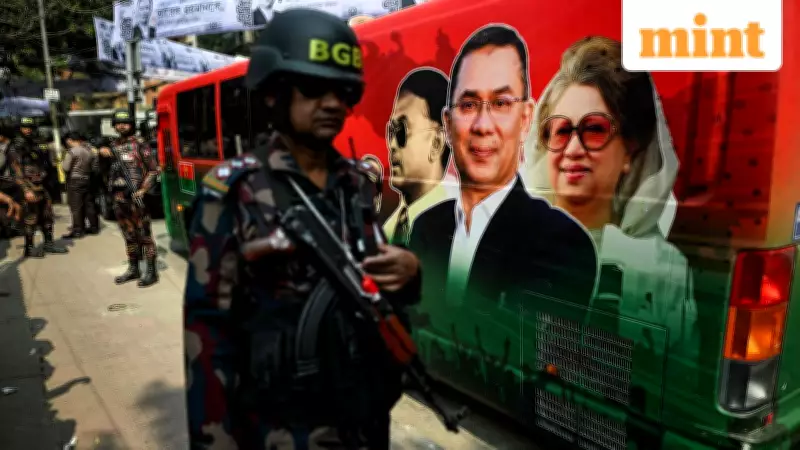
With the BNP poised for a potential return to power, as suggested by recent surveys, the party's contemporary foreign policy outlook becomes paramount. Tarique Rahman, son of Khaleda Zia and a recent returnee from self-imposed exile, is a prime ministerial candidate. The BNP has released a detailed vision document outlining its goals for 2030.
The document firmly asserts the party's commitment to upholding Bangladesh's independence, sovereignty, and dignity. It explicitly states that the BNP will refrain from interfering in the internal affairs of other nations and will not pose security threats to any country. However, it also warns of "strong resistance" against any external interference or threats to Bangladesh's state security. A key phrase encapsulates this stance: "Bangladesh have friends and no master." The policy prioritizes national interest, seeks to build special relations with the Muslim Ummah and neighboring countries, and emphasizes balanced diplomacy.
Jamaat-e-Islami's Position and Alliances
Jamaat-e-Islami, the prominent Islamist party, has historically been at sharp odds with India. Ahead of the elections, its Ameer, Dr. Shafiqur Rahman, made statements interpreted as indirect messages to India, speaking of showing "a red card to the slaves of hegemony." Its ally, the National Citizen Party (NCP), demonstrated an explicitly anti-India stance during the 2024 uprising. NCP leader Hasnat Abdullah issued warnings about reciprocal support for separatist movements in India's Northeast if Bangladesh faced destabilization.
However, in a recent clarification, Dr. Shafiqur Rahman reiterated Jamaat's commitment to maintaining equal and respectful relations with all countries, focusing on national interest, sovereignty, and development, while engaging on global issues like climate change.

Strategic Implications and Expert Analysis
Experts highlight that a new government in Dhaka will likely seek to normalize relations with Pakistan without fundamentally undermining its crucial partnership with India. Praveen Donthi, a Senior Analyst at the International Crisis Group, notes that New Delhi pursues a pragmatic foreign policy, though reorientation may require time. He suggests that with the Awami League out of contention, India will work to restore and sustain ties with whichever party assumes power.
Donthi further elaborates that Bangladesh will likely aim to balance its engagements between Beijing and New Delhi, with potential outreach to Islamabad as well. "India and China will try to outdo each other in this race for influence, and Bangladesh will try to make the most out of it," he observes. This delicate balancing act is central to Dhaka's future foreign policy trajectory.
Former Indian diplomat Dilip Sinha, who served as Deputy High Commissioner in Bangladesh, provides a nuanced perspective on the economic dimensions. He points out that while China excels in delivering large-scale infrastructure projects, India provides critical inputs Bangladesh desperately needs, such as electrical power and yarn for its massive garment industry. This complementary economic relationship remains a cornerstone of bilateral engagement.
The February 12 election represents a historic moment as the first national poll since the student-led uprising that toppled Sheikh Hasina's government in August 2024. As Bangladesh stands at this political crossroads, India's diplomatic establishment is meticulously preparing to engage with the new regime, aiming to forge and sustain robust diplomatic ties that secure mutual interests and regional stability.





