

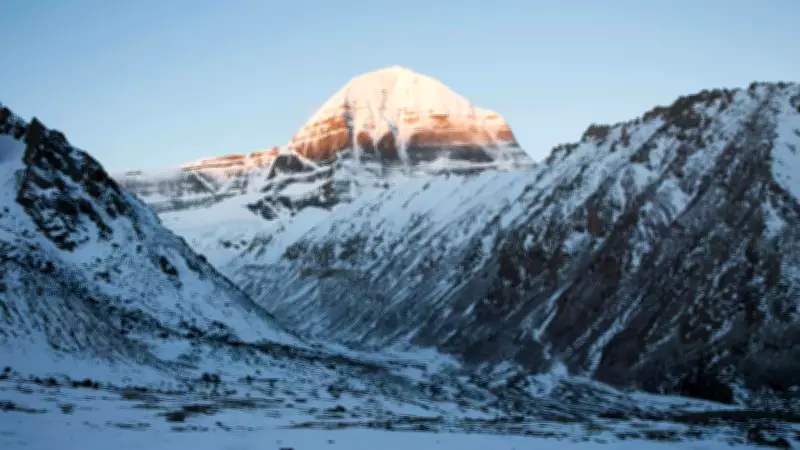
NEW DELHI: The India-Nepal border dispute could witness renewed tensions as Kathmandu's new government formally objected to India's decision to resume the Kailash Mansarovar Yatra through the Lipulekh Pass in Uttarakhand, a route Nepal claims as its own. The yatra is being conducted with support from China.
India Rejects Nepal's Claims
The Indian government dismissed Nepal's territorial assertions, stating that such claims are neither justified nor based on historical facts and evidence. In response to a statement by Nepal's foreign ministry, India said, "Such unilateral artificial enlargement of territorial claims is untenable."
Nepal earlier in the day stated that it had raised the issue diplomatically with both India and China, informing them of its "clear stance and concern" about the planned pilgrimage through what it called "Nepali territory Lipulekh."

India's Consistent Position
The external affairs ministry responded by emphasizing India's consistent and clear position. "Lipulekh Pass has been a long-standing route for Kailash Manasarovar Yatra since 1954 and the yatra through this route has been going on for decades," it said, adding that this was not a new development.
Nepal's foreign ministry countered, "Govt of Nepal is fully clear and firm on the fact that, according to Sugauli Treaty of 1816, Limpiyadhura, Lipulekh and Kalapani — located east of Mahakali river — are integral parts of Nepal." India has previously urged Nepal to refrain from unjustified cartographic assertions and to respect India's sovereignty and territorial integrity.
Potential Test for Bilateral Ties
The border issue may be the first major test for relations between the two countries as Prime Minister Balendra Shah's government familiarizes itself with foreign policy. Both sides are currently discussing a visit by Indian Foreign Secretary Vikram Misri to Kathmandu next week to finalize the bilateral cooperation agenda.
Lipulekh, located in the Kalapani area of western Nepal, is one of two tri-junctions Nepal shares with India and China. For India, the Kalapani area, including Limpiyadhura and Lipulekh, remains part of Uttarakhand. Nepal had previously objected to India and China's decision to expand trade through the strategic Lipulekh Pass.
Nepal's Previous Objections
The Nepal statement recalled that it had continuously urged India "not to carry out any activities in that area, such as road construction or expansion, border trade, or pilgrimage tourism." It added, "Furthermore, it is clarified that friendly nation of China has also been officially informed that Lipulekh region is Nepali territory."
Nepal reiterated its commitment to resolving border issues through diplomatic means, stating, "In line with the spirit and sentiment of close and friendly relations between Nepal and India, Govt of Nepal remains committed to solving border issues through diplomatic means based on historical treaties, agreements, facts, maps, and evidence."
India responded by saying it remains open to constructive interaction with Nepal on all bilateral issues, including resolving agreed outstanding boundary issues through dialogue and diplomacy.






