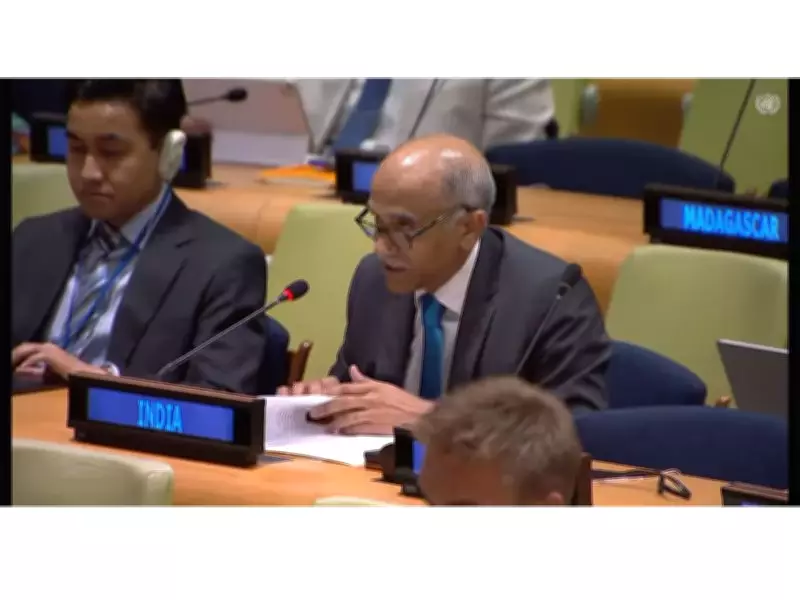
India's Permanent Representative to the United Nations, Parvathaneni Harish, has called for text-based negotiations on United Nations Security Council (UNSC) reforms, arguing that the current Intergovernmental Negotiations (IGN) framework should follow the same approach as other UN processes. Speaking at an IGN meeting on Security Council reforms in New York on Monday, Harish criticized the co-chairs' Elements Paper for not accurately reflecting the strong support among member states for expanding the Council's permanent membership.
Call for Text-Based Negotiations
Harish emphasized that the IGN process cannot be fundamentally different from other UN negotiations, which are conducted on the basis of a written text. He urged that the IGN should adopt a similar text-based approach to ensure clarity and progress.
Objection to 'Permanency' Clarification
The Indian envoy objected to the Elements Paper's suggestion that the concept of 'permanency' requires further discussion and clarification. He stated that the UN Charter already provides a clear distinction between permanent and non-permanent members. Article 23 of the Charter categorizes UNSC members into two types: permanent and non-permanent. Therefore, the definition of a permanent seat needs no further elaboration, as there is no room for ambiguity.

Support for Permanent Membership
Harish noted that groups and member states, including the African Group, the G4, and the L69 Group, recognize permanent membership in accordance with the provisions of the UN Charter. These groups treat a permanent member, whether serving or future, strictly according to the Charter's provisions.
Concerns Over Regional Representation
Raising concerns about regional representation, Harish said the Elements Paper does not adequately reflect the broad support for increasing African representation in the Security Council. He pointed out that the IGN meeting focusing on the African model had made the supportive views of all key stakeholders known, yet the document fails to mention this.
Understated Support for Expansion
Harish further argued that the Elements Paper understates the level of support among member states for expanding the permanent category of Security Council membership. He noted that the support of a majority for expansion in the permanent category has been reduced to 'a significant number of delegations' in the document. Despite the categorical position of a majority of member states in favor of expanding the permanent category, as reflected in national statements at the IGN or through association with groups such as L69, G4, and CARICOM, this has not been depicted accurately.
India's Consistent Advocacy
India has consistently advocated for comprehensive reforms of the UN Security Council, including expansion in both permanent and non-permanent categories. India argues that the current structure no longer reflects contemporary global realities and the aspirations of developing countries.