

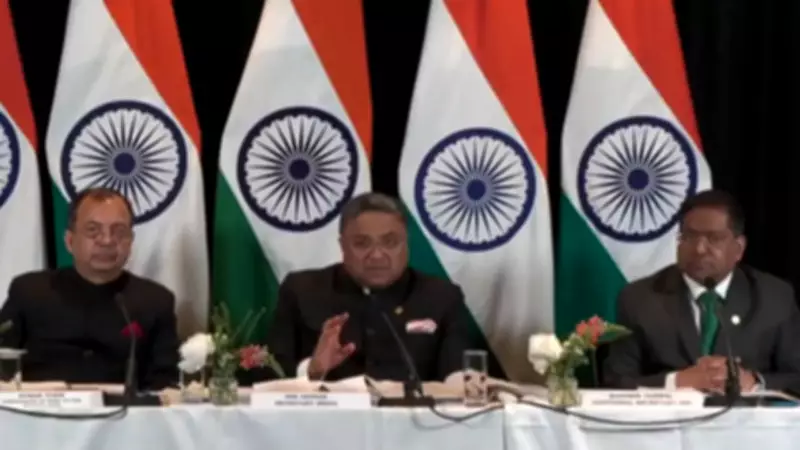
At a press briefing in The Netherlands, Ministry of External Affairs Secretary (West) Sibi George strongly rejected concerns about minority rights and press freedom in India. Responding to questions, George defended India's democratic and social framework, asserting that the country's strength lies in its diversity, religious coexistence, and democratic freedoms.
Lack of Understanding
Addressing foreign journalists and observers in The Hague, George said concerns raised on these issues stem from a 'lack of understanding' about India's history, institutions, and social fabric. 'India is a country of 1.4 billion people, the largest populated country in the world. A country of civilisation of more than 5,000 years old. It's a diverse country,' George said, describing India as a society where multiple religions, cultures, languages, and communities continue to coexist peacefully.
Vibrant Democracy
Calling India a 'vibrant democracy', the senior diplomat said freedom of expression and press freedom remain deeply embedded in the country's democratic culture. 'You know how many of these are in India? The smartphones? 900 million of them. And these are very important weapons,' he said while referring to public participation and freedom of communication in India. 'Everyone has the freedom of expression, freedom of press in the country. And that makes our democracy a very noisy democracy. And we are proud of that,' he added.

George highlighted India's recent elections as an example of democratic participation, saying more than 90 percent of the electorate voted. 'This is the beauty of India. It's a vibrant democracy,' he said.
Minority Population Growth
The MEA official also pushed back against criticism regarding minorities in India, arguing that religious and linguistic communities continue to flourish in the country. 'When we became independent, the minority population in India was 11%. Now it is more than 20%. Name a country where the population of minorities have gone up. You won't find it other than India,' he said.
George pointed to India's long history of hosting and protecting diverse faiths, noting that Hinduism, Buddhism, Jainism, and Sikhism all originated in India and continue to thrive there. He also referenced the historical presence of Jewish, Christian, and Muslim communities in the country. 'Jewish religion was in India for more than 2,500 years, continuously coexisted. India is only one of those very few countries where the Jewish population never faced a persecution,' he said.
On Christianity, George noted that 'Christianity came to India immediately after the resurrection of Jesus Christ' and added that the religion 'came to India much before it came to Europe'. Speaking about Islam, he said, 'Islam came to India during the time of Prophet Muhammad himself and flourished in India.'
He repeatedly described India's multicultural coexistence as 'the beauty of India', arguing that persecuted communities from different parts of the world historically found refuge in the country.
Linguistic Diversity
George also highlighted India's linguistic diversity, saying all major languages continue to flourish. 'There are 22 official languages. If you take an Indian currency, there are 22 languages written in it,' he said.
Economic Growth without Compromising Democracy
The diplomat linked India's democratic structure to its economic rise, saying the country achieved sustained growth without compromising democratic principles. 'Today we are the largest, fastest growing large economy in the world. 8% growth for the last 25 years. And how did we achieve it? Without compromising on our democratic principles,' he said. 'We did not go for violence to eliminate poverty. We went a democratic process of elimination of poverty,' George added.
Concluding his remarks, George invited critics and foreign observers to visit India and experience its diversity and democratic environment firsthand. 'So I would invite also you to visit India and see for yourself how India lives, how thriving an economy it is, how vibrant a democracy it is,' he said.






