

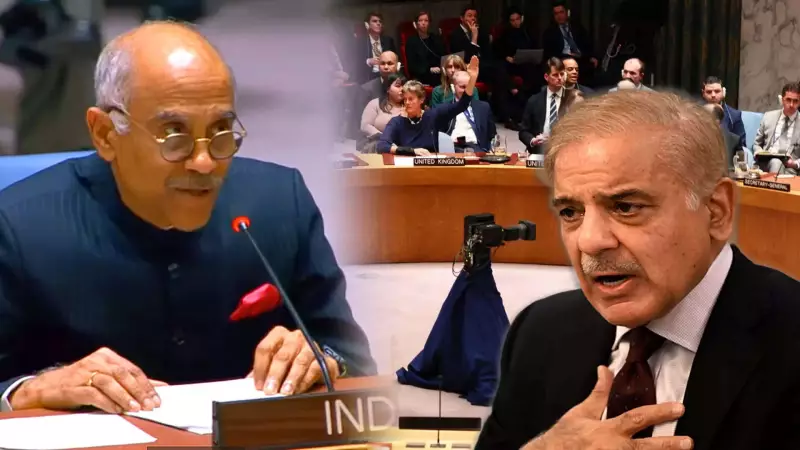
In a powerful and unequivocal rebuttal at the United Nations, India has labelled Pakistan as the 'global epicentre of terror' while firmly rejecting its neighbour's claims over Jammu and Kashmir. The strong remarks were delivered during the UN Security Council Open Debate on 'Leadership for Peace' on December 16, 2025.
India's Firm Rejection of Pakistan's Kashmir Claims
Ambassador Harish Parvathaneni, India's permanent representative, left no room for ambiguity regarding the status of the country's northern territories. He reaffirmed that the Union Territories of Jammu & Kashmir and Ladakh are integral and inalienable parts of India. The envoy stated with conviction that these regions "were, are, and will always remain" so, directly countering the narrative pushed by Pakistan on the international platform.
Parvathaneni accused Pakistan of consistently using the United Nations as a stage to promote a divisive agenda. He highlighted the country's long and documented record of sponsoring and supporting terrorism, which he argued fundamentally undermines its responsibilities as a member of the UN Security Council.

Defending the Indus Waters Treaty Decision
A significant part of India's statement addressed the recent and contentious decision regarding the Indus Waters Treaty (IWT). The Indian envoy defended New Delhi's move to place the decades-old water-sharing pact in abeyance. He urged the international community to recognize what he described as Pakistan's 'obsession with harming India'.
This decision, which has major implications for bilateral relations and regional water security, was framed as a necessary response to Pakistan's sustained hostile actions. The Indian position presented it as a measure taken in light of the neighbouring country's continued support for cross-border terrorism and its refusal to engage constructively.
Broader Implications and International Message
The sharp diplomatic exchange underscores the persistently frosty relations between the two nuclear-armed neighbours. By taking its case to the UNSC Open Debate, India aimed to internationally isolate Pakistan on the issues of terrorism and territorial sovereignty.
The Indian ambassador's speech served a dual purpose: it was a direct rebuttal to Pakistani allegations and a broader message to the global community. It called for a clear-eyed view of Pakistan's actions, linking its internal policies with regional instability. The characterization of Pakistan as the central hub of global terrorism is one of the strongest indictments issued by Indian diplomacy in recent years at such a high-profile forum.
This event marks another chapter in the long-standing diplomatic feud, with India leveraging the UN platform to assert its geopolitical stance and challenge Pakistan's credibility on the world stage.






