

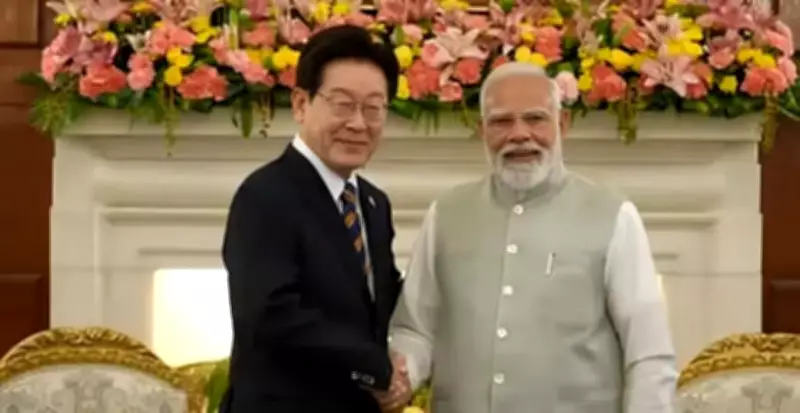
India and South Korea Elevate Strategic Partnership in High-Level Summit
Prime Minister Narendra Modi and South Korean President Lee Jae Myung engaged in comprehensive high-level discussions on Monday at Hyderabad House in New Delhi, with a strong emphasis on deepening and expanding bilateral ties between the two nations. The landmark meeting was characterized by a shared vision to transform the existing trusted partnership into a dynamic and futuristic alliance.
Exchange of Agreements and Memorandums of Understanding
The summit witnessed the formal exchange of several Memorandums of Understanding (MoUs) between Indian and South Korean officials, symbolizing the concrete steps being taken to bolster cooperation. External Affairs Minister S. Jaishankar and his South Korean counterpart, Cho Hyun, participated in the exchange ceremony during a joint press interaction, underscoring the multi-faceted nature of the engagement.
Visionary Statements from Both Leaders
Prime Minister Modi highlighted the profound significance of President Lee's state visit, stating, "This visit of the President of Korea to India is extremely important. Democratic values, market economy, and respect for the rule of law are in the DNA of both our countries. We also have a common outlook in the Indo-Pacific region." He elaborated on the evolution of bilateral relations, noting that over the past decade, ties have become more dynamic and comprehensive.

Modi further articulated an ambitious roadmap for future collaboration, declaring, "Today, with President Lee's visit, we are going to transform this trusted partnership into a futuristic partnership. We will realise new opportunities for cooperation in every field, from chips to ships, talent to technology, environment to energy, and together ensure the progress and prosperity of both countries."
In his remarks, South Korean President Lee Jae Myung acknowledged the depth of the discussions, saying, "Today, the PM and I had in-depth discussions on ways to further promote our relations and exchanged views on global and regional affairs." He praised India's global stature, noting, "With the world's largest population and the world's fourth largest economy, India has emerged as a leader in the global south. Under your 'Viksit Bharat 2047' vision, India is achieving remarkable development." President Lee also highlighted South Korea's leadership in semiconductors and cultural industries.
Expanding Cooperation Across Strategic Sectors
President Lee emphasized the critical need to enhance collaboration in securing stable supply chains for critical minerals. He proposed a innovative model, stating, "By moving beyond the traditional model of importing raw material and combining Korea's technology with India's mining and refining industries, we can work together to establish stable critical-mineral supply chains." This approach aims to leverage the complementary strengths of both economies.
The bilateral agenda for the talks was extensive, covering a wide array of strategic domains:
- Trade and Investment: Enhancing economic linkages and market access.
- Technology and Innovation: Cooperation in semiconductors, artificial intelligence (AI), and emerging technologies.
- Defence and Security: Strengthening partnerships in defence manufacturing and strategic areas.
- Infrastructure and Industry: Collaboration in shipbuilding, shipping, and energy sectors.
- Cultural and People-to-People Exchanges: Promoting mutual understanding through cultural diplomacy.
Ceremonial Events and Symbolic Gestures
The state visit was marked by several ceremonial and symbolic events that reinforced the warmth of bilateral relations. Earlier in the day, President Lee, accompanied by First Lady Kim Hea-kyung, paid solemn homage to Mahatma Gandhi at Rajghat by laying a wreath at the memorial, honoring India's iconic leader.

President Lee received a grand ceremonial welcome at the forecourt of Rashtrapati Bhavan, where he was formally received by President Droupadi Murmu and Prime Minister Modi. The reception featured children dressed in traditional attire waving the national flags of both India and South Korea, creating a vibrant and welcoming atmosphere.
In a gesture symbolizing growth and enduring friendship, Prime Minister Modi and President Lee jointly planted a tree, reflecting their commitment to a sustainable and flourishing partnership.
Diplomatic Preparations and Official Assessments
Ahead of the formal talks, External Affairs Minister S. Jaishankar met with President Lee, expressing honor at the opportunity. Jaishankar stated, "I was honoured to call on President Lee Jae-myung of the Republic of Korea as he begins his State Visit to India." He valued President Lee's commitment to deepening relations across multiple domains and expressed confidence that the discussions with PM Modi would further strengthen the Special Strategic Partnership.
The Ministry of External Affairs described the visit as a pivotal development in bilateral ties, marking an "important milestone" in advancing the India-South Korea Special Strategic Partnership. In a social media post, the ministry confirmed, "President Lee was received by Shri Harsh Malhotra, MoS, Ministry of Corporate Affairs and Ministry of Road Transport and Highways. The visit marks an important milestone in advancing the India-South Korea Special Strategic Partnership."
Arrival and Itinerary
President Lee Jae Myung arrived in New Delhi on Sunday for a three-day state visit, accompanied by the First Lady. Upon arrival at the airport, he was received by Union Minister of State Harsh Malhotra, setting the stage for the series of high-level engagements that followed. The visit underscores the mutual desire to elevate bilateral relations to new heights, with a focus on shared democratic values, economic complementarities, and strategic convergence in the Indo-Pacific region.





