

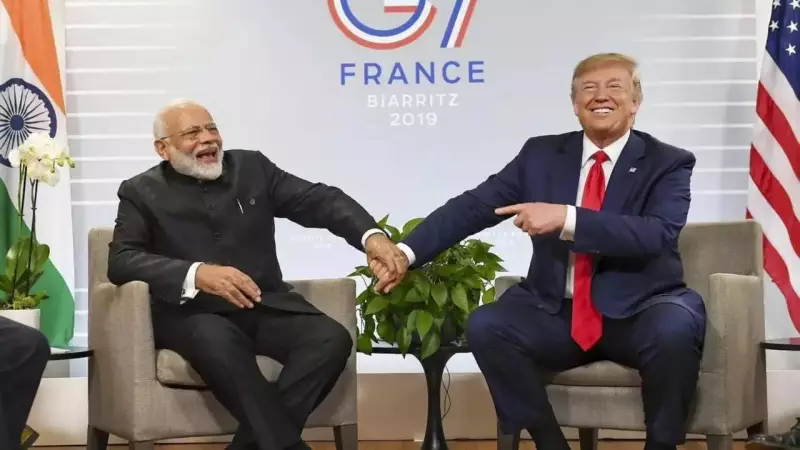
The relationship between India and the United States currently resembles a complex puzzle, full of contradictory signals and unpredictable mood swings. Once celebrated as a natural alliance between the world's two largest democracies, the partnership now appears querulous and hostage to the fluctuating temperament of US President Donald Trump. The strategic bonhomie of recent years is increasingly overshadowed by transactional politics and personal ego.
From Houston Hugs to Tariff Hammer Blows
The stark contrast in the relationship's trajectory is dramatic. In September 2024, a crowd of over 50,000 cheered as President Trump and Prime Minister Narendra Modi shared the stage at the "Howdy Modi" rally in Houston. Trump called India a loyal friend, while Modi praised him as a "true friend in the White House." The chemistry seemed genuine and the optics perfect.
Fast forward to August 2025, and the two nations were locked in a bruising trade war. The US administration imposed a staggering 50 per cent tariff on Indian exports, marking one of the highest tariff rates in history for a US partner. The journey from those warm embraces in Texas to the harsh reality of economic protectionism is a sobering tale of clashing egos and hardened positions.

The Unraveling: Trade, Pakistan, and Presidential Ego
The warning signs had been flashing for years. In 2018, Trump denounced India's import duties on Harley-Davidson motorcycles. "America First" tariffs on steel and aluminium followed. In March 2024, India lost its preferential trade status under the US Generalized System of Preferences, affecting billions in exports.
A more sensitive flashpoint emerged regarding Pakistan. Following an attack in Pahalgam on April 22, 2024, Trump repeatedly claimed credit for brokering a ceasefire between the nuclear-armed neighbours, stating the US had mediated talks. India's response was unequivocal. Foreign Secretary Vikram Misri clarified that Prime Minister Modi told President Trump clearly there was no discussion on US mediation, emphasizing that India has never and will never accept third-party mediation on Kashmir.
Experts like Professor Rajan Kumar of JNU argue this rejection deeply upset Trump. "His tariff is not as much about economics... as much as it is for the ego of President Trump," he stated, connecting the punitive trade measures to India's refusal to let him take credit for the ceasefire.
Despite early optimism in 2025 after Modi's White House visit on February 12 and talks of a $500 billion trade deal, Trump derailed negotiations. On July 30, he announced an additional 25% tariff, soon followed by a trade deal with Pakistan. By August 6, he signed the order raising tariffs on India to 50%.
Mixed Messages and Strategic Imperatives
The public messaging from Washington has been wildly inconsistent. On September 5, 2025, Trump posted a cryptic message alongside a photo of Modi with Xi Jinping and Vladimir Putin, suggesting, "Looks like we've lost India and Russia to deepest, darkest, China." Yet, within a day, he emphasized the "special" relationship and his personal friendship with Modi, stating, "There's nothing to worry about. We just have moments on occasion."
This oscillation continues. Trump has since threatened additional tariffs on Indian rice, accusing India of dumping, while the US Embassy quotes him praising Modi as "a great friend" and highlighting India as a "very important strategic partner."
Analysts like Vivek Mishra of the Observer Research Foundation point to the underlying strategic tension. The US sees India as an indispensable counterweight to China but is uneasy with New Delhi's strategic autonomy, particularly its continued energy ties with Russia. "This tension reflects a broader uncertainty in US foreign policy—between realism... and ideological nationalism," Mishra explains.
The Road Ahead: C5, Diaspora, and Fragile Hope
Amid the turbulence, a new concept has emerged: the potential 'C5' grouping comprising the US, Russia, China, India, and Japan. Dr. Ashok Kumar sees this as an acknowledgment of India's rising global stature. Mishra adds that for India, the very idea suggests the US views it as "a pillar of the next global order."

However, domestic US politics, including rising anti-immigration sentiment, adds another layer of complexity. Trump's rhetoric, calibrated for his conservative base, risks offending the politically influential Indian-American diaspora, which prefers stable relations.
For now, the India-US partnership remains caught between undeniable strategic compulsion and relentless political turbulence. The path forward is fraught with challenges, from resolving tariff disputes to managing divergent views on global order. Yet, beneath the noise of trade wars and cryptic tweets, a cautious optimism persists that both nations, recognizing their profound mutual interests, may still find a way to steady this indispensable but impossibly unpredictable relationship.





