

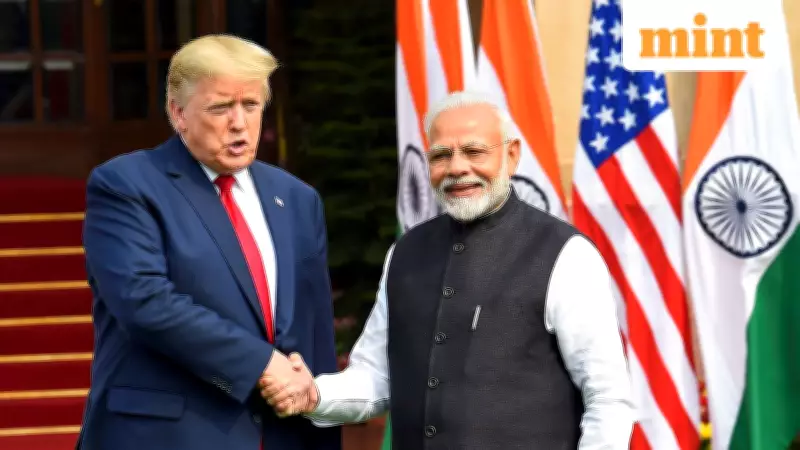
Behind the Scenes: How India and US Mended Ties to Reach Trade Agreement
In early September, shortly after Indian Prime Minister Narendra Modi's cordial meeting with Vladimir Putin and Xi Jinping in China, a significant diplomatic maneuver unfolded. Modi dispatched National Security Advisor Ajit Doval to Washington with a crucial mission: to help repair the fraying relationship between India and the United States. According to officials in New Delhi familiar with the previously unreported meeting, Doval delivered a clear message to Secretary of State Marco Rubio.
The Diplomatic Message from New Delhi
Doval conveyed that India wanted to move past the recent acrimony and resume negotiations for a trade deal. However, he made it clear that India would not be intimidated by pressure from US President Donald Trump and his administration. The Indian side expressed willingness to wait out Trump's term if necessary, drawing confidence from having navigated previous challenging periods with different US administrations. Crucially, Doval requested that Trump and his aides reduce their public criticism of India to create conditions for rebuilding bilateral relations.
This diplomatic outreach came at a particularly tense moment. India was still reeling from Trump's August imposition of 50% tariffs on Indian goods and his inflammatory remarks describing India as a "dead" economy. The US president had also accused India of funding Putin's war in Ukraine through Russian oil purchases. The relationship had deteriorated significantly since May, when Trump claimed credit for resolving a brief India-Pakistan conflict—a boast that Modi strongly rejected.

The Turning Point in Relations
Following Doval's September meeting, the first signs of thaw emerged. On September 16, Trump called Modi on his birthday, praising the Indian leader for doing a "tremendous job." By year's end, the two leaders had spoken four additional times by phone as they gradually worked toward reducing tariffs. The diplomatic breakthrough culminated on Monday when Trump announced a trade agreement with Modi that would lower tariffs on Indian goods to 18%—below most Asian peers—and eliminate the punitive 25% duty imposed for purchasing Russian oil.
In exchange, Trump stated that India agreed to purchase $500 billion worth of US goods, switch to Venezuelan oil imports, and reduce tariffs on US imports to zero. While Modi's government hasn't confirmed these specific details and no formal documentation has been published, the announcement marked a significant shift from the previous year's tensions.
Surprise Announcement and Strategic Calculations
The announcement caught many officials in New Delhi by surprise. Senior bureaucrats in foreign and commerce ministries, including some directly involved in trade negotiations, were unaware that a leaders' call had been scheduled that day. Some struggled to confirm key details when contacted by reporters later in the day.
Behind this public surprise lay calculated strategic thinking in New Delhi. Indian officials viewed the US as an essential long-term partner for capital, technology, and military cooperation needed to counter China and achieve Modi's vision of making India a developed economy by 2047. From this perspective, the Trump administration represented merely a temporary challenge within a much longer timeframe.
"New Delhi was never going to sever relations with Washington following last year's downturn in bilateral relations," observed Chietigj Bajpaee, a senior research fellow for South Asia at Chatham House. "India-US relations remain 'sticky' given the plethora of institutionalized and people-to-people linkages between both countries."
Broader Diplomatic Context and Future Prospects
The rapprochement occurred alongside India's continued assertion of strategic autonomy. Modi's visible camaraderie with Putin and Xi, followed by his red-carpet welcome for Putin in December, signaled that India maintains multiple diplomatic options. Recent trade agreements with the European Union and United Kingdom, achieved after years of negotiations, demonstrated India's commitment to diversifying trade relationships amid US tensions.

December's arrival of new US Ambassador Sergio Gor, a Trump confidant close to Rubio, accelerated reconciliation efforts. In his first public speech, Gor characterized bilateral tensions as disagreements among "real friends" and announced India's invitation to join Pax Silica, a US-led supply chain alliance. Last week's meeting between Gor and External Affairs Minister Subrahmanyam Jaishankar further evidenced warming relations, with discussions spanning defense, trade, and critical minerals.
Despite the diplomatic progress, economic realities continue to bind the two nations. The US receives approximately one-fifth of India's exports, particularly mobile phones and electronics crucial to Modi's manufacturing ambitions. Recent months have seen substantial US investment commitments in India, including $52 billion from Amazon and Microsoft in December and $15 billion from Google for data centers in October. Goldman Sachs maintains its largest office outside New York in Bengaluru, highlighting India's growing importance to US finance.
"The larger geopolitical factors or strategic factors that bind India and the US together are still in place," noted Milan Vaishnav of the Carnegie Endowment for International Peace. "India requires a great amount of capital, investment, and technology transfer. So the US is critical."
As Modi prepares to host Canadian and Brazilian leaders later this month, India continues navigating a complex diplomatic landscape—strengthening ties with middle-power nations while maintaining crucial partnership with the United States. The trade agreement represents not just an economic breakthrough but a diplomatic recalibration after months of careful negotiation and strategic positioning from both capitals.





