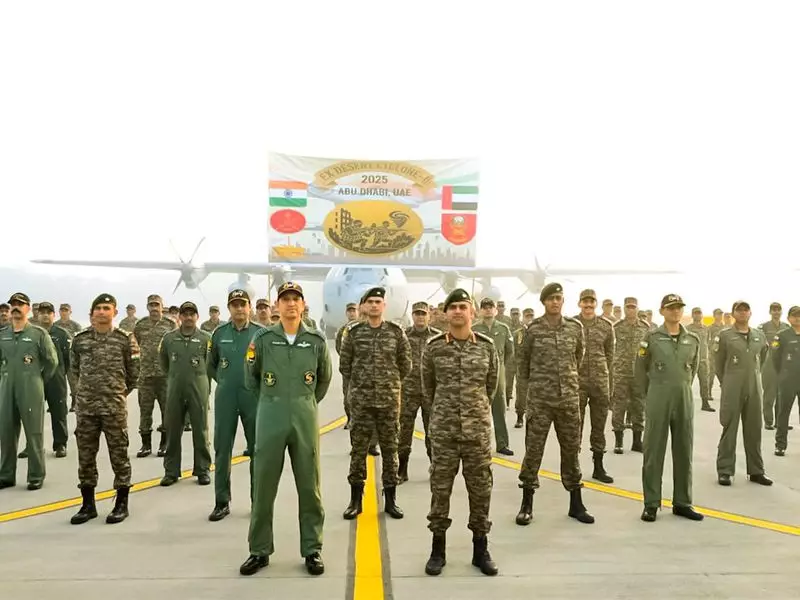
A significant step in strengthening military cooperation between India and the United Arab Emirates (UAE) was taken as a contingent from the Indian Army embarked on its journey to participate in the second edition of the bilateral exercise 'Desert Cyclone'. The exercise is scheduled to be held in the arid landscapes of Abu Dhabi from January 2 to January 15, 2025.
Contingent Composition and Strategic Objectives
The Indian delegation is a 45-strong contingent primarily drawn from the Mechanised Infantry Regiment, a key component of the army's armored fighting capabilities. This selection highlights the exercise's focus on combined arms operations in challenging desert terrain. The primary objective of 'Desert Cyclone-II' is to enhance interoperability between the two armies, allowing them to practice and refine procedures for conducting joint tactical operations in sub-conventional scenarios, including those under the umbrella of United Nations peacekeeping missions.
This joint military exercise is designed to foster a deeper understanding of each other's operational methodologies and to share best practices. The focus will be on a range of critical skills necessary for modern desert warfare and peacekeeping, including:

- Joint surveillance and reconnaissance techniques.
- Coordinated actions in counter-terrorism and counter-insurgency operations.
- Establishing and operating joint command posts.
- Conducting cordon and search operations effectively.
Building on a Foundation of Strong Defence Ties
The 'Desert Cyclone' series of exercises is a testament to the rapidly growing strategic and defence partnership between India and the UAE. The inaugural edition of this exercise was successfully conducted in India last year, setting a positive precedent for continued collaboration. This ongoing engagement is part of a broader framework of military cooperation that includes regular high-level exchanges, training collaborations, and naval port calls.
The exercise holds considerable strategic importance for regional security. Both India and the UAE view such collaborations as essential for promoting stability and security in the region. By training together, the forces of both nations enhance their collective capability to respond to common security challenges, ranging from terrorism to piracy and humanitarian crises.
Implications and Future Trajectory
The successful conduct of 'Desert Cyclone-II' is expected to further solidify the defence ties between New Delhi and Abu Dhabi. It underscores a mutual commitment to a secure and stable regional environment. Such exercises not only improve professional military skills but also build crucial interpersonal bonds and trust between the personnel of the two nations, which is invaluable during actual joint or coalition operations.
As the Indian contingent engages in rigorous training with their UAE counterparts over the next two weeks, the exercise will serve as a practical platform to validate joint operational concepts and communication systems. The knowledge and experience gained will be integrated into the standard operating procedures of both armies, enhancing their overall preparedness. This deployment reinforces India's active military diplomacy and its commitment to building robust bilateral defence relationships with key partners in the Gulf region.