

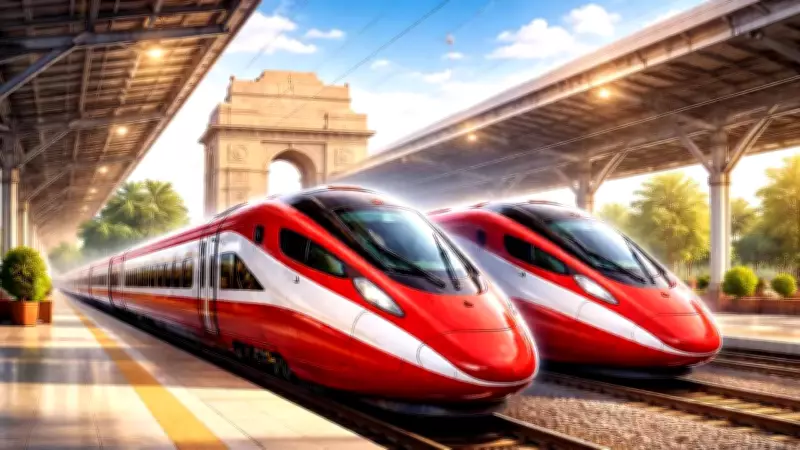
Indian Railways Advances with Seven New High-Speed Corridors for Enhanced Travel
Indian Railways is embarking on a transformative journey to upgrade its passenger train services, focusing on faster, more comfortable, and premium travel experiences. In a significant move, Finance Minister Nirmala Sitharaman announced the development of seven new high-speed rail corridors in the Union Budget, positioning them as "growth connectors" to promote environmentally sustainable passenger systems.
Strategic Rail Modernization Initiatives
This announcement aligns with ongoing efforts by Indian Railways to revolutionize overnight train travel through the launch of Vande Bharat sleeper trains, designed for faster and world-class passenger focus. Simultaneously, the introduction of Amrit Bharat trains aims to provide better amenities for the common man, ensuring broader accessibility to improved rail services.
India is already constructing its first bullet train corridor between Ahmedabad and Mumbai, with the initial stretch expected to become operational in the coming years. While bullet trains operate at speeds up to 300 kmph, high-speed rail typically includes travel at 220-250 kmph, offering a substantial reduction in journey times.

Detailed Overview of the Seven High-Speed Rail Corridors
The newly announced corridors are set to dramatically cut travel durations and boost economic connectivity across key regions:
- Mumbai–Pune: This flagship corridor in the western region will integrate major urban centres, reducing travel time to just 48 minutes. It aims to address growing passenger and freight demands through upgrades to congested routes and suburban rail services.
- Pune–Hyderabad: Linking Maharashtra with Telangana, this route will enable travel in approximately 1 hour 55 minutes, creating a continuous high-speed spine across western and southern India to benefit regional economies.
- Hyderabad–Bengaluru: As part of a southern high-speed rail "diamond," this corridor will reduce travel time to about 2 hours, enhancing mobility across IT, manufacturing, and service hubs in Karnataka and Telangana.
- Hyderabad–Chennai: Travel between these southern economic centres will take around 2 hours 55 minutes, fostering business, talent mobility, and inter-state commuting across Andhra Pradesh, Telangana, Tamil Nadu, Kerala, and Puducherry.
- Chennai–Bengaluru: This corridor will compress travel to approximately 1 hour 13 minutes, strengthening southern India's high-speed network and acting as a growth multiplier for urban centres.
- Delhi–Varanasi: Connecting the national capital with eastern Uttar Pradesh, this route will enable travel in around 3 hours 50 minutes, boosting tourism and creating a new economic belt spanning Delhi, Uttar Pradesh, Bihar, and West Bengal.
- Varanasi–Siliguri: Travel between Varanasi and Siliguri will take about 2 hours 55 minutes via Patna, connecting religious, educational, and medical centres across Uttar Pradesh, Bihar, and West Bengal. This marks the first high-speed rail service in eastern India, expanding trade and inter-regional mobility.
Expert Insights on High-Speed Rail Impact
Jagannarayan Padmanabhan, Senior Director & Global Head of Consulting at Crisil Intelligence, emphasizes that these corridors respond to rising commuter demand for faster, reliable, and energy-efficient travel. He notes they can significantly cut journey times, expand passenger capacity, and shift traffic from road and short-haul aviation, becoming cost-effective over time through higher utilization.
Anurag Gupta, Partner at Deloitte India, highlights that the corridors cover nearly 4,000 km with an estimated investment of ₹16–20 lakh crore, transforming inter-city passenger movement and acting as a key economic multiplier. Key benefits include sharp reductions in travel time, competitive pricing to shift modes from air and road, and freeing up existing railway lines for freight and conventional services.

G Raghuram, Advisor at The Infravision Foundation and former Dean of IIM Ahmedabad, supports high-speed rail for faster travel and capacity expansion, with positive externalities in technology domains like concrete and engineering. However, he raises concerns about funding and execution bandwidth, estimating that completing all seven corridors could take 25-32 years based on current spending rates.
Role of Vande Bharat Sleeper and Amrit Bharat Trains
Beyond high-speed rail, Indian Railways is investing in self-propelled semi-high-speed offerings. The Vande Bharat Express, India's first indigenously designed semi-high-speed train, combines advanced technology with improved comfort. Its sleeper variant, with advanced Kavach integration and fixed fares, aims to enhance overnight travel compared to Rajdhani Express trains. Plans include launching 260 such train sets, with a fleet target of 4,500 by 2047.
Amrit Bharat trains focus on improving interiors and amenities for the common man, though experts like G Raghuram note they do not increase speed. Jagannarayan Padmanabhan views these trains as signaling a shift towards efficient, modern rail travel, with Vande Bharat sleeper offering energy-efficient alternatives to flying and Amrit Bharat emphasizing capacity and affordability.
Future Outlook for Indian Railways
For passengers, the Budget promises shorter travel times, improved safety, modernized stations, and better last-mile connectivity. Indian Railways' long-term goals include supporting 3,000 million tonnes of freight loading through dedicated freight corridors, upgraded tracks, and advanced signaling. High-speed rail and Vande Bharat sleeper trains are poised to redefine travel options in India, marking a pivotal change in the nation's transportation landscape.





