

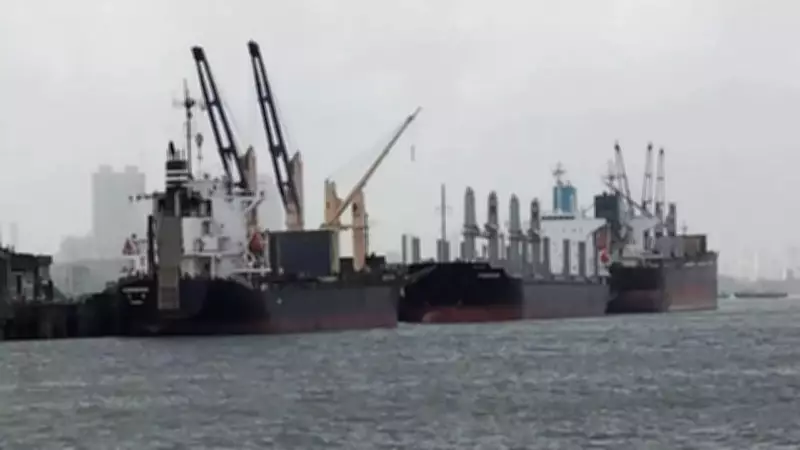
Indian-Flagged Crude Tanker Safely Navigates Strait of Hormuz to Reach Mumbai Port
In a significant development amid escalating geopolitical tensions in the Middle East, a crude oil tanker has successfully arrived at Mumbai Port after transiting the strategically vital Strait of Hormuz. The vessel, identified as the Liberia-flagged Shenlong Suezmax, became one of the first ships to reach India via this critical maritime route following recent conflicts involving the United States, Israel, and Iran.
Details of the Tanker's Journey and Iranian Clearance
According to the Mumbai Port Trust and reports from ANI, the Shenlong Suezmax tanker, captained by an Indian national and carrying crude oil loaded at Ras Tanura in Saudi Arabia, reached Mumbai on Wednesday. Authorities confirmed that Iranian officials had cleared the vessel to transit the narrow shipping corridor, where maritime activity has sharply declined due to ongoing regional hostilities.
The tanker departed Ras Tanura on March 1 and completed its journey after receiving explicit permission from Tehran to pass through the Strait of Hormuz. This clearance comes despite Iran's recent tightening of control over shipping in the area, with sources indicating that Iranian authorities have decided to allow Indian-flagged ships to move safely through the strait even as overall maritime traffic has slowed significantly.

Iran's Stricter Controls and Warnings to Shipping Vessels
Iran has intensified restrictions on shipping through the Strait of Hormuz in recent days. Alireza Tangsiri, commander of the naval arm of the Islamic Revolutionary Guard Corps, stated that vessels seeking to sail through the waterway must obtain Tehran's approval. In a post on social media platform X, he revealed that two ships that ignored Iran's warnings were targeted on Wednesday.
"Were the ships assured of safe passage through the Strait of Hormuz? This should be asked of the crews of the vessels Express Rome and Mayuree Naree, who today, trusting in empty promises, ignored the warnings and intended to cross the Strait, but were caught. Any vessel intending to pass must obtain permission from Iran," the Iranian general declared.
Iranian state media has reported that Tehran has heightened restrictions on shipping through the strait while simultaneously stating that vessels not serving the interests of the United States or Israel would be allowed safe passage.
The Strategic Importance of the Strait of Hormuz
The Strait of Hormuz remains one of the world's most critical maritime chokepoints:
- More than 20 million barrels of crude oil move through the narrow channel between Iran and Oman daily
- This represents approximately one-fifth of global oil consumption
- Nearly a quarter of all seaborne oil trade passes through this strategic waterway
Indian Government's Response and Seafarer Safety Measures
Meanwhile, the Ministry of Ports, Shipping and Waterways has provided crucial updates regarding Indian maritime operations in the region:
- Currently, 28 Indian-flagged vessels are operating in the Persian Gulf
- Of these, 24 vessels carrying 677 Indian seafarers are located west of the Strait of Hormuz
- Four vessels with 101 Indian crew members are positioned east of the strait
The ministry has established a 24-hour control room that has been operating since February 28 at both the ministry and the Directorate General of Shipping to monitor the evolving situation and coordinate assistance if required. Authorities are actively collaborating with Indian embassies, ship managers, and recruitment agencies to ensure the safety of Indian seafarers in the volatile region.
This development marks a significant moment in global shipping logistics, demonstrating how diplomatic channels and clearances continue to facilitate essential energy transportation even amid heightened international tensions and military conflicts in the Middle East.






