

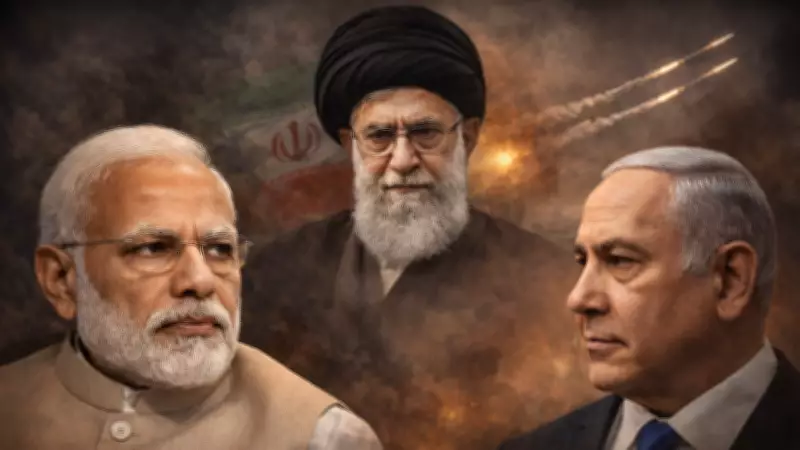
India's Cautious Approach to Iran: Analyzing the Strategic Restraint
Is New Delhi recalibrating its diplomatic strategy in West Asia? This question has gained renewed attention following India's notably cautious and measured response to the recent escalation involving Iran. When the United States and Israel launched strikes on Iran on February 28, triggering retaliatory missile attacks across the region, several global powers reacted swiftly. However, India avoided taking a clear position on Tehran, opting for a restrained approach that has sparked widespread analysis.
India's Delayed and Indirect Responses
In the crucial hours after the escalation, Prime Minister Narendra Modi did not directly comment on Iran. His first response came nearly a day later and focused instead on attacks on the United Arab Emirates. Subsequent conversations with leaders across the Gulf emphasised respect for their territorial integrity and the need for de-escalation, but again avoided directly naming Iran. Even after the death of Iran’s Supreme Leader Ali Khamenei was confirmed, New Delhi stopped short of condemning the killing, offering only a condolence gesture days later.
Experts describe this cautious approach as deliberate and calculated. “India’s policy has been very careful. Its interests are far more aligned with the US than Iran. That explains why it condoled and did not condemn Khamenei’s killing, even though it was a clear violation of international law,” said JNU professor Rajan Kumar. He noted that even though both India and Iran are BRICS members, New Delhi chose restraint over confrontation, highlighting the delicate balancing act in play.

Timeline of India's Reactions
- 28 February: US-Israel attack Iran. Prime Minister Narendra Modi makes over 15 posts on his social media X after the news of the war breaks out, but none of it on Iran situation.
- 1 March: Khamenei’s death confirmed. India sees no reaction on breach of Iran’s sovereignty or the killing of its Supreme Leader Khamenei.
- 1 March: The first post by PM Modi comes at 11.26pm, condemning “attack” on the UAE without directly naming Iran.
- 5 March: India’s reaction to Khamenei’s death came five days after the incident. Foreign secretary Vikram Misri signed the “condolence” book in the Iranian embassy.
- 12 March: PM Modi’s reaction to Iran came only when he spoke to Iranian president, focusing on safety of Indian nationals and energy transit.
Historical Context and Notable Restraint
India’s historically close engagement with Iran makes this caution particularly notable. The two countries share civilisational links stretching back centuries, which have shaped a modern partnership built on trade, culture and strategic cooperation. Diplomatic ties were formalised with a Friendship Treaty in 1950, and successive governments in New Delhi invested in maintaining strong political engagement with Tehran.
Under Prime Minister Narendra Modi, the relationship continued to see high-level outreach. Modi’s 2016 visit to Iran resulted in multiple agreements and the trilateral transit pact with Afghanistan centred on the development of Chabahar Port, a project seen as strategically important for India’s connectivity to Central Asia. So, what explains this shift away from Iran?
Key Factors Driving India's Cautious Posture
Analysts point to a mix of immediate security concerns and long-term economic dependencies that have pushed New Delhi to adopt a more cautious posture in the current West Asia crisis.

- Indian Diaspora Safety: A major factor is the safety of the large Indian diaspora across the Gulf. There are over one crore Indians who work and live in Gulf nations, making the West Asia war even more concerning for India.
- Energy Dependencies: India is significantly dependent on Gulf supplies, especially in energy sector:
- Oil: India exports nearly 40% of crude oil from Gulf, sourcing around $70 billion crude oil and petroleum products from West Asia.
- LNG: The country sourced liquefied natural gas worth $9.2 billion from West Asia, which is around 68.4% of its total LNG imports.
- LPG: LPG imports from West Asia were $13.9 billion, making up 46.9% of India’s total LPG purchases.
Recent Closeness Towards Israel
A more visible shift came after Narendra Modi became prime minister in 2014. Under his government, India’s ties with Israel grew more open and politically prominent. In 2017, PM Modi became the first Indian prime minister to visit Israel, marking a symbolic turning point in the relationship. The closeness between the two governments has continued in recent years to a point where PM Modi was in Israel merely two days before Israel attacked Iran with the US.
However, professor Rajan said that India’s policy is not “completely determined by Israel”, rather, currently, it is more concerned about “offending” the US. “India is primarily concerned about offending the US. At this time, it would not like to offend the Trump administration. And that’s exactly why it is not issuing any statements condemning of killing of Khamenei,” he said.
Is There a Shift in India's West Asia Policy?
Rajan Kumar, a professor at JNU, who teaches international relations said that currently, there is no shift in India’s policy towards the Middle East. Rather, he said, that the shift might happen after the war is over. “At the moment, I don’t see any shift happening. It is a continuation of policy where India’s preferred partner was United States and Israel. But at the same time trade ties were linked with many other countries in the region,” he said.
Experts argue that India should embrace multipolarity in West Asia, rather than a unipolar tilt toward Israel and the US. While Israel is a valuable partner, destabilizing relationships with other West Asian countries could jeopardize India’s economic and security interests in the region. “India should pursue multipolarity, rather unipolarity under the influence of Israel and US in West Asia. Although we have good ties with Israel, we cannot de-stabilise our ties with other West Asian countries, for the reason that our economic and security interests are aligned there,” he added.
In conclusion, India's cautious stance on Iran reflects a complex balancing act, driven by strategic calculations involving the US, Israel, Gulf nations, and its own economic and diaspora interests. The wait-and-watch policy underscores New Delhi's careful navigation of the volatile West Asia landscape.





