

Delhi Declaration 2026: A Comprehensive Analysis of India's Middle East Strategy
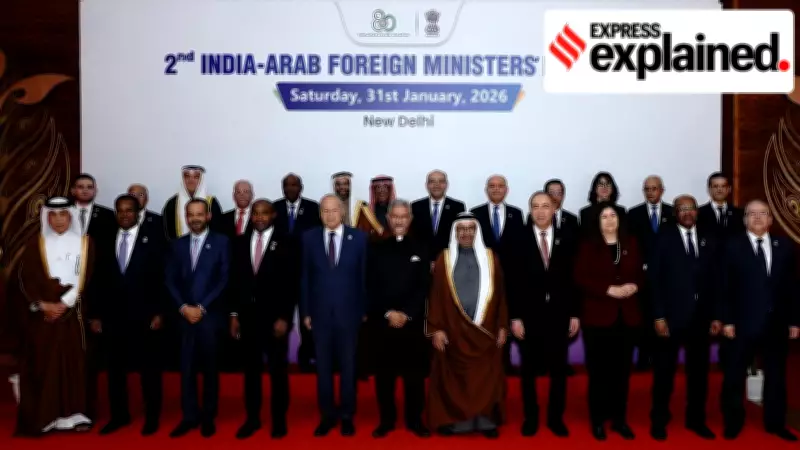
The second India-Arab Foreign Ministers Meeting in New Delhi has produced a significant diplomatic document that reveals much about India's evolving approach to Middle Eastern geopolitics. The comprehensive joint statement, released after India hosted 22 members of the League of Arab States, offers both explicit positions and telling silences that merit careful examination.
Strategic Context and Regional Dynamics
This high-level gathering occurred against a backdrop of escalating regional tensions and shifting alliances. The meeting took place as Iran-US relations grew increasingly strained, a noticeable rift emerged between traditional Gulf allies Saudi Arabia and the UAE, and the Trump administration's Board of Peace initiative attempted to reshape the Israel-Palestine conflict resolution framework. India maintains significant strategic interests in all these developing situations, making this diplomatic engagement particularly crucial.
In the days preceding the meeting, India demonstrated its nuanced diplomatic approach through several key engagements. The UAE's Mohammed bin Zayed made an unprecedented three-hour visit to New Delhi as Abu Dhabi's relations with Riyadh grew particularly strained. Simultaneously, India's Deputy National Security Advisor conducted meetings in Tehran with senior Iranian leadership amid US military movements in the region. Additionally, India reaffirmed its Palestine ties as the Palestinian Foreign Minister arrived in New Delhi on January 29, showcasing India's balanced diplomatic outreach.

Conflict Zones and Diplomatic Positions
The Delhi Declaration addresses multiple regional conflicts with carefully calibrated language. The document uniformly emphasizes the need to uphold "sovereignty, unity, and territorial integrity" of Sudan, Somalia, and Libya while explicitly rejecting external interference in their internal affairs. This position aligns India with the broader Arab League consensus supporting internationally recognized governments in these conflict-ridden states.
These three nations have become focal points in the growing divide between two emerging Middle Eastern camps. One grouping, led by Saudi Arabia and supported by most Arab League members, contrasts with another led by the UAE and Israel with US backing. Although these camps remain formally unacknowledged, their divisions manifest clearly in regional conflicts. The UAE faces accusations of supporting the Rapid Support Forces militia in Sudan, which has waged war against the Sudanese government since 2023 and established a parallel administration in April 2025.
Similarly, in Libya, the UAE has long supported Khalifa Haftar's breakaway Libyan National Army, which opposes the internationally recognized Tripoli government. While other Arab states have engaged with Haftar's forces, their primary focus remains reconciliation efforts. In Somalia, Israel stands as the only UN member recognizing the breakaway Republic of Somaliland, with the UAE beginning to recognize Somaliland passports in 2025—a position diverging from other Arab League members.
India's December rebuff of Somaliland recognition possibilities found reinforcement in the Delhi Declaration's categorical support for internationally recognized governments in Libya and Sudan. The document's condemnation of atrocities against civilians particularly aligns with this consistent position.
Yemen and Syria: Selective Emphasis
Regarding Yemen—the principal site of Abu Dhabi-Riyadh conflict—India and the Arab League explicitly condemned Houthi attacks on Red Sea navigation. This represents a subtle shift from India's previous two-year policy of condemning such actions without explicitly naming the group, especially as Houthis linked their activities to Israel's Gaza operations. India had been more vocal against Houthis before 2023 when the group targeted Emirati and Saudi oil infrastructure.

More significantly, the Declaration's support for Yemen's unity aligns with Saudi Arabia's military actions against the UAE-backed Southern Transitional Council in December and January. The document remains relatively quiet on Syria, limiting itself to appreciating Damascus's counter-terror efforts against the Islamic State. India's engagement with post-Assad Syria, led by former Al Qaeda-affiliated Ahmed al-Sharaa, has remained cautiously bureaucratic-ministerial, with diplomatic meetings occurring in July 2025 and during the New Delhi gathering.
Strategic Silences and Unmentioned Conflicts
The Delhi Declaration notably avoids mentioning the Donald Trump-led Board of Peace initiative, despite key Gulf states joining this framework. India has yet to accept the January invitation to participate. Instead, the document features support for the 2002 Arab Peace Initiative—a land-for-peace arrangement where Arab states would recognize Israel in exchange for Israeli recognition of a Palestinian state based on pre-1967 borders.
While the Declaration acknowledges outcomes from the 2025 Sharm el-Sheikh summit (which contains the only reference to America's role), the emphasis on the Arab Peace Initiative signals actual preferences of both India and the Arab League. These entities support Trump's efforts to reduce Gaza violence but avoid endorsing the new logic underlying the US President's broader Israel-Palestine framework. Both maintain support for Palestinian sovereignty as a fundamental principle.
Perhaps most tellingly, the Declaration completely avoids mentioning the US military build-up around Iran and potential wider conflict—arguably to respect bilateral approaches. Key Arab League states, led by Saudi Arabia, actively discourage US military action against Iran. India's Deputy National Security Advisor meetings in Tehran, particularly with Iran's Supreme National Security Council chief Ali Larijani, indicate New Delhi's need to maintain engagement with Iran while protecting the relationship from US sanctions pressure.
This balancing act finds reflection in India's 2026-27 budget, which contains no allocation for Chabahar Port despite India's 10-year operating agreement signed in 2024—demonstrating vulnerability to US sanctions despite strategic interests.
Broader Implications for Indian Diplomacy
Ultimately, the Delhi Declaration advances India-Arab League cooperation across five key pillars established as the highest institutional dialogue mechanism in 2002: economy, energy, education, media, and culture. The document seeks to build upon robust India-Arab trade exceeding US$240 billion while cementing India's distinctive approach to Middle Eastern engagement.
New Delhi maintains strong partnerships across geopolitical divides, but these relationships remain fundamentally transactional and deliberately siloed from India's positions on broader regional issues. Regarding regional geopolitics, India prefers longstanding normative positions that preserve stability without encouraging disruption caused by particular states. The Delhi Declaration 2026 thus represents both continuity and careful calibration in India's Middle East diplomacy—a balancing act between principle and pragmatism in one of the world's most complex regions.





