The year 2025 marked a pivotal chapter for India's armed forces, defined by decisive action, sweeping reforms, and a clear projection of power on the global stage. The nation's military posture evolved from reactive preparedness to a confident, forward-looking strategy, underpinned by record investments and hard-earned operational lessons.
Operation Sindoor: A New Template for Asymmetric Warfare
The catalyst for this shift was the terror attack on tourists in Pahalgam in April 2025. India's response, codenamed Operation Sindoor, was a calibrated, technology-heavy military strike designed to punish perpetrators without escalating into a wider conventional conflict. This operation reshaped military doctrine overnight.
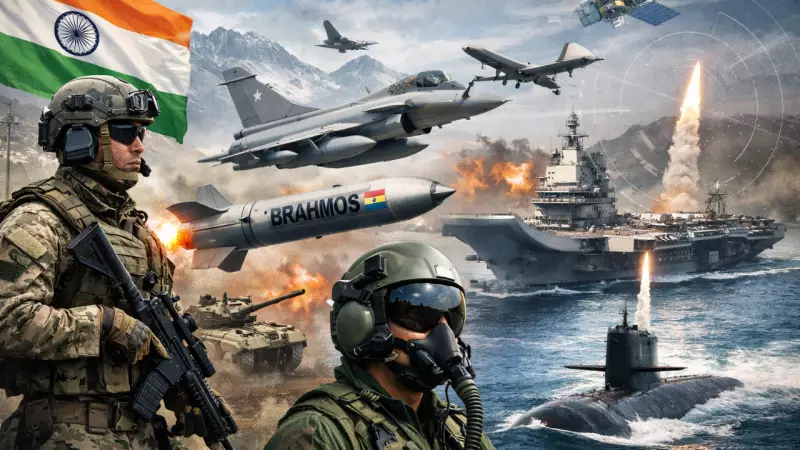
Indian forces executed precise strikes on terrorist infrastructure using stand-off weapons, drones, and electronic warfare, deliberately avoiding crossing the Line of Control. The Indian Air Force deployed a mix of advanced systems including the BrahMos supersonic cruise missile from Su-30MKIs, SCALP cruise missiles from Rafale jets, and indigenous Nagastra-1 loitering munitions. These targeted key Pakistani airbases like Noor Khan and Rahimyar Khan.

Equally critical was the robust air defence. When Pakistan attempted retaliatory strikes using drones and missiles on May 7-8, they were neutralised by India's Integrated Counter-UAS Grid and layered air defence network, which included systems like Akash and Igla-S. Electronic warfare played a decisive role, with Indian forces jamming Chinese-origin air defence systems. The operation, supported by over 10 Indian satellites, underscored a core lesson: future conflicts will be short, high-intensity, and won with drones, data, and decision speed.
Record Defence Budget Fuels Modernisation and Self-Reliance
India's strategic intent was backed by substantial financial commitment. The Union Budget 2025-26 allocated a historic Rs 6.81 lakh crore to the Ministry of Defence, a 9.53% increase. This allocation, constituting 13.45% of the total Union Budget, signalled a long-term commitment to modernisation.
A significant Rs 1.48 lakh crore was earmarked for capital acquisition, with 75% of this (Rs 1.12 lakh crore) reserved for procurement from domestic industry, strongly advancing the Aatmanirbhar Bharat agenda. A quarter of this domestic share was allocated to the private sector. Revenue expenditure for operational readiness saw a 10.24% rise to Rs 3.11 lakh crore.
The budget also prioritised future capabilities, increasing the Defence Research and Development Organisation (DRDO) allocation by 12.4% to Rs 26,816.82 crore and nearly tripling funding for innovation schemes like iDEX and ADITI to strengthen the startup pipeline.
Global Exercises and Strategic Partnerships: Projecting Power
India's military diplomacy reached new heights through a series of complex, large-scale exercises with global partners, moving beyond symbolism to integrated warfighting.
Exercise Trishul in the western desert saw around 30,000 personnel from the Army, Navy, and Air Force testing tri-service integration in multi-domain operations. Following Operation Sindoor, the armed forces planned their largest-ever drone and counter-drone exercise, testing concepts for the proposed Sudarshan Chakra air defence architecture.
Internationally, Exercise Yudh Abhyas 2025 with the US was held in the extreme cold of Alaska, while Exercise Varuna with France featured both nations' aircraft carriers, INS Vikrant and Charles de Gaulle. The Quad's Malabar 2025 exercise at Guam demonstrated high-end naval interoperability, with India represented by the indigenous INS Sahyadri. In the air, Cope India 2025 featured integration sorties with a US B-1B bomber, and Exercise Garuda in France enhanced strike coordination with the French Air Force.

Major Acquisitions and the 'Make in India' Push
Procurement decisions in 2025 were directly informed by operational needs. Key deals included an Inter-Governmental Agreement with France for 26 Rafale-Marine fighter aircraft for the Indian Navy, valued at approximately Rs 63,000 crore. India also finalised a landmark deal with the US for 31 MQ-9B Predator drones to enhance long-endurance surveillance and strike capability.
In a significant step for indigenous industry, contracts worth Rs 62,700 crore were signed for 156 Light Combat Helicopter Prachand with Hindustan Aeronautics Limited. The BrahMos missile system saw bulk domestic orders and export momentum, with a second batch delivered to the Philippines and advanced talks with Vietnam and Indonesia.
Defence production crossed Rs 1.54 lakh crore, while exports hit a record Rs 23,622 crore. The strategic use of Positive Indigenisation Lists, covering over 5,500 items, compelled domestic development, with around 3,000 items already indigenised.
The Big Picture: An Integrated, Forward-Looking Force
As articulated by Chief of Defence Staff General Anil Chauhan, 2025 reinforced the need to prepare for "short-duration, high-intensity conflicts." The Indian Navy sustained a high operational tempo, acting as a security provider from the Gulf of Aden to the western Pacific, commissioning new warships like INS Nilgiri and INS Surat.
In the strategic realm, the test of the K-4 submarine-launched ballistic missile from INS Arighaat strengthened the sea-based nuclear deterrent. Advances in air defence, like the Akash-NG missile and the Netra Mk-II AWACS programme, aimed to close critical capability gaps.
In essence, 2025 demonstrated that India's defence posture is now built on the steady alignment of jointness, indigenisation, and technological depth. It is a posture designed to deter conflict, manage escalation, and project strength in an increasingly uncertain world, marking a clear departure from the past towards a more assertive and self-reliant future.