

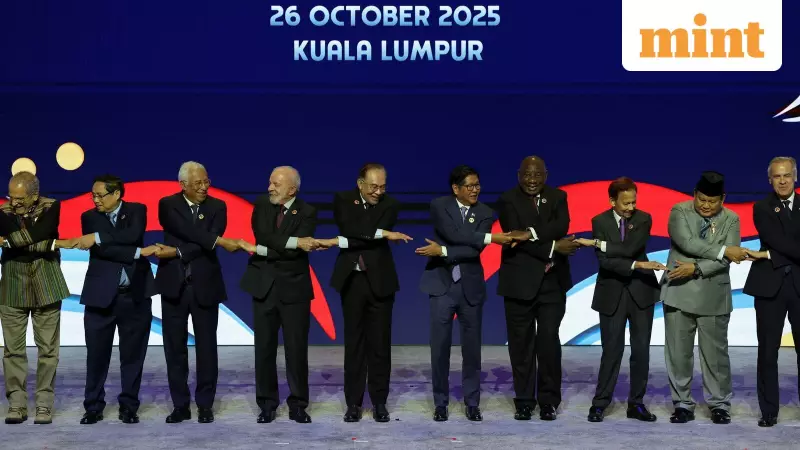
The strategic landscape of the Indo-Pacific region underwent a significant transformation in 2025, marked by a recalibration of power dynamics. The primary catalyst for this shift has been the unpredictable nature of US foreign policy under President Donald Trump's second term, which has compelled regional actors to pursue more autonomous and diversified security strategies.
The Impact of Trump's Unpredictable Engagement
The year was characterized by what analysts describe as a stark turn in America's role. The Trump administration's approach to the Indo-Pacific has been erratic, often prioritizing transactional, quid-pro-quo relationships over traditional, legacy alliances. This ambiguity was crystallized in the recently released US National Security Strategy, which offered muscular rhetoric against competitors like China but provided little doctrinal clarity on actionable commitments.
This policy fuzziness has created a climate of uncertainty, particularly regarding high-stakes issues such as Taiwan. While the US maintains deterrence rhetoric, its inconsistent signals have left partners struggling to identify clear thresholds for American action. Consequently, although formal alliances with nations like Japan, Australia, South Korea, and the Philippines have endured, their political meaning has evolved. Partner countries are now less willing to outsource their strategic calculus entirely to Washington.

The Rise of Regional Agency and Hedging Strategies
In response to this systemic uncertainty, regional powers have demonstrated remarkable agency, moving beyond a complacent 'hub-and-spokes' model centered on the US. The most consequential development of 2025 has been the proactive construction of multiple, overlapping networks of cooperation designed to mitigate overdependence on any single power.
ASEAN nations have perfected the art of hedging. Southeast Asian capitals are simultaneously deepening economic interdependence with China while engaging in strategic and defence projects with Western partners. They seek leverage, not compliance, with any single bloc. This trend is evident in the Philippines' calibrated outreach to both the US and non-traditional partners like Japan and India, and Malaysia's simultaneous engagement with China and the European Union.
Similarly, middle powers are forging new bilateral formats. The strategic partnership between Indonesia and France exemplifies this, creating alternative poles of engagement. Vietnam has significantly deepened defence ties with India, focusing on maritime capacity building and naval training.
India's Proactive and Embedded Regional Role
India has emerged as a key architect of this new, fluid order. In 2025, New Delhi significantly strengthened and expanded its bilateral partnerships across Southeast Asia as a core component of its broader Indo-Pacific vision. Engagement with Thailand, the Philippines, Vietnam, Singapore, and Indonesia saw substantial growth.
Cooperation spanned critical areas including defence, maritime safety, renewable energy, critical technologies, and trade. This multi-faceted approach signals that India's engagement with the region is now more proactive, institutionally embedded, and resonant with regional priorities than in previous years. Within multilateral forums like the Quad, initiatives on maritime domain awareness and critical minerals were increasingly driven by partners like New Delhi, Canberra, and Tokyo, with Washington playing a facilitative rather than directive role.
The Path Forward: A Contested Equilibrium
The emerging order in the Indo-Pacific is best described as a contested equilibrium. Nations are independently investing in deterrence, resilience, and interoperability, leading to widespread defence modernization and indigenous capacity building. The illusion of unwavering US leadership has faded, replaced by a pragmatic focus on navigating a more complex and agency-driven architecture.

The outcome is not stability in the traditional sense, but a state of managed fluidity where power is more diffused and outcomes are more contingent. As countries like Japan and South Korea position themselves as proactive norm-setters, and Taiwan diversifies its economic alliances for survival, the region is writing its own strategic future, one less dictated by the whims of distant capitals.





