

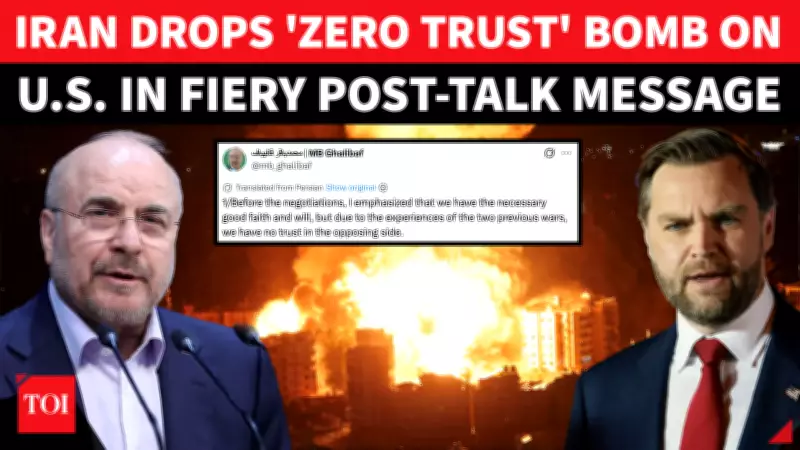
Iran Issues Fiery Statement, Challenges US to Second Round of Islamabad Talks
Following the dramatic collapse of high-stakes negotiations between Iran and the United States in Islamabad, Iran's chief negotiator has broken his silence with a powerful and revealing statement. Mohammad Bagher Qalibaf, the Speaker of Iran's Parliament and a pivotal figure in the diplomatic process, delivered his first official remarks since the talks ended, offering insight into Iran's stance and hinting at future developments.
Pre-Negotiation Position: Good Faith but Zero Trust
In a series of social media posts on April 12, Qalibaf disclosed that Iran had established its negotiating position well before the discussions even began. The core principle, as he articulated, was "good faith, but zero trust" toward the United States. This phrase underscores Iran's deep-seated skepticism regarding American intentions, a sentiment that has been exacerbated by years of geopolitical tensions and broken agreements.
"We entered these talks with a clear and unwavering stance," Qalibaf stated, emphasizing that Iran's approach was not reactive but strategically premeditated. This revelation sheds light on the underlying dynamics that likely contributed to the stalemate in Islamabad, where mutual distrust appears to have been a significant barrier to progress.

Hint at Future Negotiations with Trump Administration
Despite the failure of the initial round, Qalibaf's statement contained a crucial hint about the potential for renewed dialogue. In one of his posts, he alluded to the possibility of a second round of negotiations with the team representing former President Donald Trump. While details remain scarce, this suggestion indicates that diplomatic channels may not be entirely closed, even as both sides exchange sharp rhetoric.
The reference to Trump is particularly significant, given his administration's previous hardline policies toward Iran, including the withdrawal from the nuclear deal and the imposition of stringent sanctions. Qalibaf's mention of engaging with Trump's team suggests that Iran is preparing for various political scenarios, possibly anticipating Trump's return to power or seeking to leverage his influence in current talks.
Context of the Islamabad Talks and Broader Tensions
The Islamabad talks were convened to address escalating tensions in the Middle East, with a primary focus on disputes over the Strait of Hormuz, a critical maritime chokepoint for global oil shipments. Iran has repeatedly asserted its control over the strait, warning that any threats to its sovereignty would be met with a forceful response. This issue has been a flashpoint in US-Iran relations, complicating efforts to find common ground.
Recent events have further inflamed the situation:
- Iran has issued warnings to the US regarding "excessive demands" in negotiations.
- Pro-Iran groups, such as Hezbollah, have conducted drone attacks near Israeli borders, heightening regional instability.
- The US has deployed military assets, including destroyers, to the Strait of Hormuz, signaling a readiness to protect its interests.
These developments underscore the high stakes involved in the Islamabad talks and the challenges facing any future diplomatic initiatives. Qalibaf's statement reflects Iran's determination to maintain an upper hand in negotiations, even as it leaves the door open for continued dialogue.
Implications for Regional and Global Diplomacy
The collapse of the Islamabad talks and Iran's subsequent challenge to the US have significant implications for international relations. As both nations posture and probe for weaknesses, the risk of miscalculation or escalation remains high. Qalibaf's fiery rhetoric, labeling the US as "deceitful," highlights the deep ideological divides that must be bridged for meaningful progress.

Observers are now closely watching for signs of whether a second round of talks will materialize. If it does, the negotiations will likely require a more nuanced approach, addressing not only immediate security concerns but also broader issues of trust and verification. Iran's insistence on zero trust suggests that any agreement would need robust mechanisms to ensure compliance, a tall order given the current political climate.
In summary, Mohammad Bagher Qalibaf's statement marks a pivotal moment in the ongoing US-Iran saga. By revealing Iran's pre-negotiation stance and hinting at future talks, he has set the stage for what could be another intense chapter in this long-standing geopolitical rivalry. The world awaits to see if diplomacy can prevail over discord in the coming months.





