

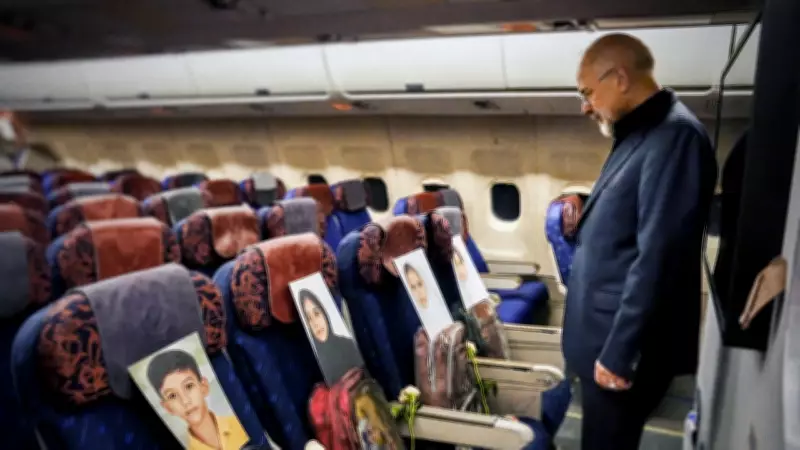
Iranian Delegation's Flight to Islamabad Carries Photos of Minab Child Victims
In a deeply symbolic and emotionally charged gesture, images of children killed in the devastating Minab incident were placed on seats aboard an Iranian government flight to Islamabad on Friday. This powerful visual statement transformed the journey of a high-level Iranian delegation into a stark reminder of recent tragedies, setting a somber tone ahead of critical regional peace negotiations.
Social Media Revelation of the Symbolic Act
Iranian Parliament Speaker Mohammad Bagher Qalibaf revealed this poignant arrangement through a social media post, sharing an image that showed photographs of the young victims placed on backpacks alongside roses. In his post, Qalibaf described these images as his "companions on the flight," emphasizing their presence throughout the diplomatic journey. The shared photograph captured the speaker viewing the children's photographs alongside their personal belongings, creating a visceral connection between the diplomatic mission and the human cost of regional conflicts.
High-Level Delegation Arrives for Crucial Talks
The Iranian delegation, led by Parliament Speaker Mohammad Bagher Qalibaf and including Foreign Minister Abbas Araghchi, arrived in Pakistan for what both sides describe as crucial negotiations aimed at stabilizing a fragile regional ceasefire framework. Upon arrival at the airport, the Iranian officials were received by an impressive Pakistani delegation including Foreign Minister Ishaq Dar, National Assembly Speaker Sardar Ayaz Sadiq, Army Chief Field Marshal Asim Munir, and Interior Minister Mohsin Naqvi.

Symbolism Amidst Diplomatic Tensions
The powerful symbolism of carrying images of child victims comes as Iran continues to assert its conditions ahead of the negotiations. Iranian officials have emphasized several key demands including:
- The release of frozen Iranian assets held internationally
- Broader ceasefire assurances across the region
- Clear security arrangements for strategic waterways
Despite the diplomatic engagement, Iranian officials have expressed significant skepticism about the negotiation process. Qalibaf reiterated upon arrival that past negotiations with the United States had "always been met with failure and breach of promise." He clarified Tehran's position by stating that while Iran maintains goodwill toward the process, it approaches these talks with "no trust" based on previous experiences.
Regional Context and Pakistani Stakes
The Islamabad talks unfold against a complex regional backdrop where the United States continues efforts to stabilize tensions following a recent ceasefire announcement. Despite these diplomatic initiatives, violence persists in various parts of the Middle East, including ongoing strikes in southern Lebanon and retaliatory fire involving Hezbollah forces.
Pakistan has characterized these negotiations as a "make-or-break" moment for regional stability. Prime Minister Shehbaz Sharif has warned that the outcome could determine whether the fragile pause in hostilities holds firm or collapses under the weight of competing demands and unresolved issues.
Persistent Diplomatic Challenges
Despite the diplomatic momentum generated by these high-level meetings, significant gaps remain between the negotiating parties. The most substantial disagreements center on several critical issues:
- Sanctions Relief: The extent and timing of sanctions removal
- Regional Security Arrangements: Mechanisms for ensuring long-term stability
- Strategic Waterway Control: Management of vital passages like the Strait of Hormuz
The Minab School Strike Incident
The Minab incident refers to an alleged precision airstrike on an elementary school in Minab, Iran, which reportedly suffered damage during coordinated strikes targeting a nearby Islamic Revolutionary Guard Corps (IRGC) naval facility. This occurred on the first day of Operation Epic Fury, with multiple media reports and satellite-based analyses indicating the school's proximity to a military complex that was directly hit.
Conflicting accounts have emerged regarding the nature of the damage:

- Some reports suggest collateral damage from strikes on the IRGC base
- Others indicate a potential targeting error during military operations
The attack reportedly resulted in at least 165 fatalities, including numerous students, though these figures have not been independently verified as representing a deliberate strike on the educational facility. Both US and Israeli officials have yet to formally claim responsibility for the incident while acknowledging they are reviewing reports of civilian casualties.
Iran's Accusations and International Response
Iranian authorities have directly blamed the United States for the Minab school strike. Last month, Iranian officials specifically named US Navy officers Commander Leigh R. Tate and Executive Officer Jeffrey E. York of the USS Spruance, alleging they ordered multiple Tomahawk missile launches that struck the school and killed 168 civilians, including children. Tehran has consistently described the strike as a joint US-Israeli operation, while Israel has repeatedly denied any involvement.
International media reports have provided additional context:
- The New York Times pointed to American strikes on nearby naval facilities near the Strait of Hormuz as the likely operational context
- CBC News analysis of satellite imagery and video suggested the school was damaged in a precision strike on an adjacent military complex
- A preliminary US military assessment has reportedly raised the possibility of a targeting error during operations against IRGC-linked infrastructure
This tragic incident and its symbolic representation during the Islamabad talks underscore the human dimension of regional conflicts and the emotional weight carried into diplomatic negotiations aimed at preventing future tragedies.





