

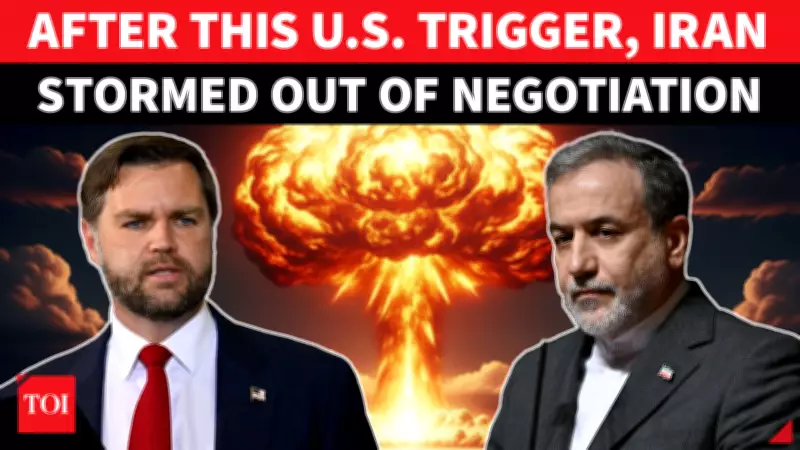
Iranian Officials Abruptly Exit Islamabad Talks Following US 'Trigger' by Vance Team
In a dramatic diplomatic development, Iran's Foreign Minister Abbas Araghchi has disclosed that a landmark agreement with the United States was "inches away" during intensive negotiations in Islamabad before completely collapsing at the final moment. The revelation comes as Tehran officials have now exited the talks, citing what they describe as a critical "trigger" action by the US delegation led by Secretary of State J.D. Vance.
Breakthrough Agreement Within Reach Before Sudden Collapse
According to Araghchi, the marathon discussions in Pakistan's capital represented the highest-level diplomatic engagement between Iran and the United States in several decades. Both sides had reportedly made significant progress on multiple fronts, bringing them tantalizingly close to a comprehensive agreement that could have reshaped Middle Eastern geopolitics.
"We were literally inches away from a breakthrough that would have benefited regional stability," Araghchi stated in his assessment of the negotiations. "The framework was there, the willingness seemed present, but then everything unraveled at the last possible moment."

Tehran Accuses Washington of 'Maximalist Demands' and Shifting Positions
Iranian officials have leveled serious accusations against their American counterparts, claiming the Vance-led team imposed what they characterize as "maximalist demands" that went beyond previously discussed parameters. Tehran asserts that Washington unexpectedly shifted negotiating positions and moved goalposts during the final stages of dialogue.
"What began as a good-faith negotiation turned into an exercise in diplomatic brinkmanship," an Iranian diplomatic source explained. "The American team introduced new conditions that were simply unacceptable and represented a fundamental departure from earlier understandings."
US Defends Its Position as Necessary for Security Concerns
The United States has defended its negotiating stance, insisting that the conditions presented were essential for regional security and non-negotiable from Washington's perspective. American officials maintain that their demands were consistent with long-standing security priorities and represented reasonable safeguards.
"Our position has always been clear and consistent," a State Department spokesperson commented. "The security requirements we outlined are fundamental to any sustainable agreement. We cannot compromise on matters that affect regional stability and global security."
Deepening Diplomatic Crisis with Serious Geopolitical Consequences
The collapse of the Islamabad talks has created a significant diplomatic crisis with potentially far-reaching geopolitical implications. With neither side showing willingness to back down from their respective positions, tensions have escalated dramatically, raising genuine concerns about the possibility of renewed conflict in an already volatile region.
The failed negotiations represent more than just a diplomatic setback—they signal a profound deterioration in US-Iran relations at a time when regional stability hangs in the balance. Observers note that the inability to reach agreement despite coming so close suggests fundamental disagreements that may prove difficult to bridge in future engagements.
Regional and Global Implications of the Negotiation Breakdown
The breakdown has immediate consequences for several critical areas:

- Nuclear negotiations: Prospects for reviving or replacing the nuclear deal have suffered a major setback
- Regional security: Tensions in the Persian Gulf and surrounding areas are expected to increase
- Energy markets: The instability could affect global oil prices and supply chains
- Alliance dynamics: Both countries' relationships with regional partners may undergo significant adjustments
As both Tehran and Washington dig in their heels, the international community watches with growing apprehension. The Islamabad talks were seen by many as perhaps the last best chance for diplomatic resolution of longstanding disputes, and their failure leaves few obvious paths forward for constructive engagement between the two nations.





