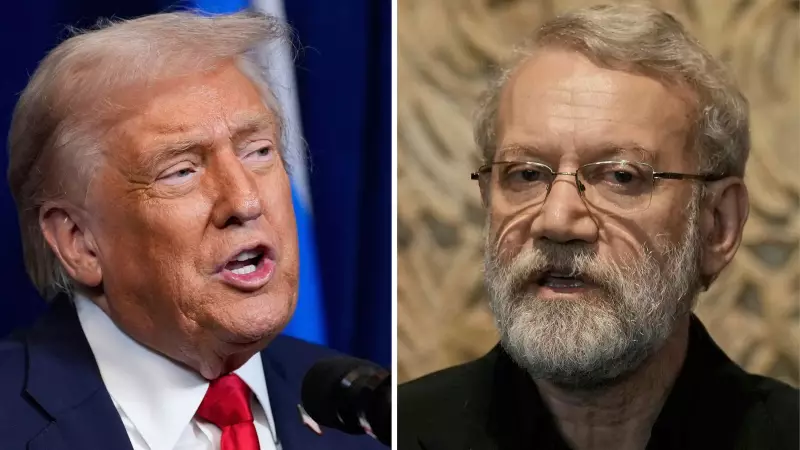
Iran has issued a sharp warning to former US President Donald Trump, declaring his recent threat to intervene and 'rescue' protesters in the country as a clear crossing of a 'red line'. The warning came from senior Iranian officials, including Foreign Minister Hossein Amir-Abdollahian, following a social media post by Trump that has escalated diplomatic tensions.
Trump's Provocative Social Media Post
The incident was triggered by a post on Trump's Truth Social platform on Tuesday. In the post, the former president and current presidential candidate claimed that the Iranian leadership was 'killing protesters' who were demonstrating against the government. He then made a bold declaration, stating, 'If I were President, they wouldn't be killing protesters. I would rescue them in 24 hours.' This statement was perceived in Tehran as a direct threat of foreign intervention in Iran's domestic affairs.
Trump's comments appeared to be referencing the recent protests in Iran, which were sparked by a tragic building collapse in the city of Abadan in May 2022. The disaster, which killed at least 37 people, led to public outrage and demonstrations against alleged government corruption and negligence.

Iran's Firm and Swift Diplomatic Response
The response from Tehran was swift and unequivocal. Foreign Minister Hossein Amir-Abdollahian addressed the media, delivering a clear message. He stated that Trump's remarks were 'interfering and against international law'. The minister emphasized that such threats from an American presidential candidate were unacceptable and represented a violation of Iran's sovereignty.
Amir-Abdollahian further elaborated on Iran's stance, drawing a firm boundary. 'We consider Trump's threat as a red line for the Islamic Republic of Iran,' he declared. He warned that any action based on such threats would be met with a decisive and powerful response from Iran. The foreign minister's comments underscore the sensitivity of the issue and Iran's readiness to confront any perceived external meddling.
Historical Context and Ongoing Tensions
This exchange adds another layer of complexity to the already strained relationship between the United States and Iran. The tensions have deep roots, notably exacerbated during Trump's presidency when he unilaterally withdrew the US from the landmark 2015 nuclear deal, known as the Joint Comprehensive Plan of Action (JCPOA). His administration subsequently re-imposed harsh economic sanctions on Iran under a policy of 'maximum pressure'.
The current warning from Iranian officials is not just aimed at Trump as an individual but serves as a signal to the broader American political establishment. It highlights Tehran's consistent position of rejecting any form of foreign interference, especially concerning its internal political and social matters. The use of the term 'red line' is particularly significant in diplomatic language, indicating a boundary that, if crossed, could trigger a serious escalation or retaliation.
The warning comes at a politically charged time in both nations. In the United States, Trump is a leading figure in the Republican party and a potential candidate in the next presidential election. In Iran, the government continues to navigate domestic challenges and international isolation. The firm rebuttal from Iran's foreign ministry aims to solidify its sovereign stance for both domestic and international audiences, making it clear that calls for regime change or internal upheaval backed by foreign powers will not be tolerated.
As the war of words continues, the international community watches closely. The incident highlights the fragile state of US-Iran relations and the potential for verbal sparring to influence broader geopolitical dynamics in the Middle East. For now, Iran has laid down its marker, defining Trump's rhetoric as a provocation that crosses a critical line.