

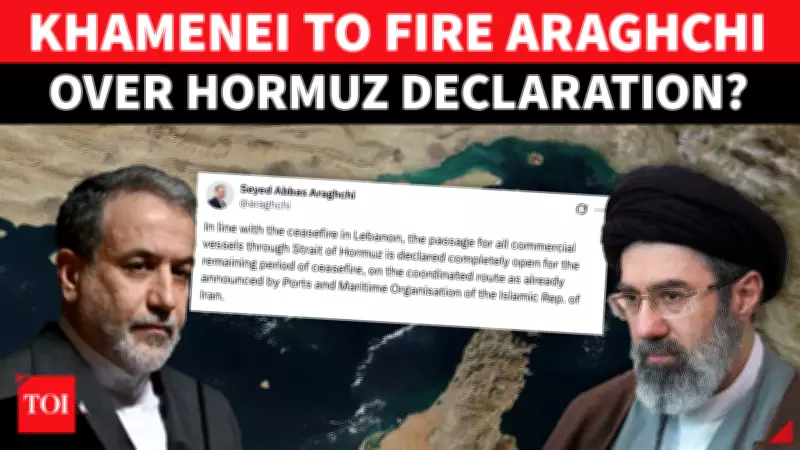
Iranian Foreign Minister Faces Internal Criticism Over Strait of Hormuz Statement
In a surprising development, Iranian Foreign Minister Seyed Abbas Araghchi finds himself at the center of controversy following his recent social media announcement regarding the Strait of Hormuz. The minister's X post, which went viral, declared that vessels would now pass through pre-coordinated routes in the strategic waterway, suggesting a return to stability in one of the world's most critical maritime chokepoints.
State Media Launches Unprecedented Attack
The Iranian Revolutionary Guard Corps (IRGC)-affiliated Tasnim News Agency has launched a rare public criticism of the foreign minister, directly questioning his announcement with the pointed headline: 'Where Is The Explanation?' The media outlet characterized Araghchi's social media post as 'bad and incomplete', marking an unusual public rebuke of a senior government official by state-controlled media.
This internal criticism comes at a sensitive time for Iran's diplomatic positioning. The Strait of Hormuz serves as a vital passage for approximately one-fifth of the world's petroleum liquids, making any announcement about its operational status a matter of global significance. Araghchi's declaration was likely intended to project confidence and control over this crucial maritime corridor.

Broader Regional Tensions Provide Context
The controversy unfolds against a backdrop of heightened regional tensions. Recent developments include:
- Mojtaba Khamenei's warning to the United States about potential 'new defeats'
- Russian statements characterizing current conflicts as 'World War III'
- Iran's release of a new maritime map for the Strait of Hormuz
- Former US President Donald Trump reiterating support for naval blockade options
- Increased US naval presence in the Middle East with multiple aircraft carriers
These developments suggest that Araghchi's announcement may have been part of a broader diplomatic strategy that has now encountered unexpected internal resistance. The public nature of the criticism from Tasnim News Agency, which typically aligns with government positions, indicates significant divisions within Iran's power structure regarding how to manage the sensitive Hormuz situation.
Implications for Iranian Foreign Policy
The public criticism of Foreign Minister Araghchi raises important questions about the consistency and coordination of Iranian foreign policy messaging. When a state-affiliated media outlet directly challenges a foreign minister's public statements, it suggests potential disagreements within the Iranian establishment about how to approach international diplomacy regarding the strategically vital Strait of Hormuz.
This incident also highlights the complex relationship between different power centers within Iran, particularly between diplomatic channels represented by the Foreign Ministry and more hardline elements associated with the IRGC and its media outlets. The public nature of the criticism may force Araghchi to provide additional clarification or justification for his original announcement, potentially complicating Iran's diplomatic positioning on this sensitive issue.
As regional tensions continue to simmer around the Strait of Hormuz, this internal disagreement within Iranian leadership structures adds another layer of complexity to an already volatile situation. The international community will be watching closely to see how Iran resolves these internal differences while managing one of the world's most strategically important maritime passages.






