

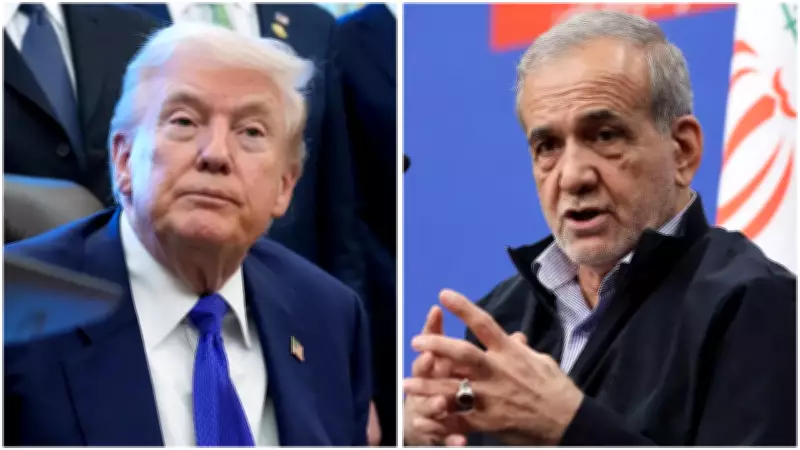
In a significant diplomatic development, Iran's President Masoud Pezeshkian announced on Tuesday that he has directed the initiation of talks with the United States. This move represents Tehran's most explicit indication to date of a readiness to re-engage with Washington diplomatically, occurring against a backdrop of escalating regional tensions.
Conditions for Negotiations Set by Tehran
President Pezeshkian emphasized that any discussions must take place in an environment "free from threats and unreasonable expectations." He conveyed this directive through a post on the social media platform X, stating, "I have instructed my minister of foreign affairs, provided that a suitable environment exists — one free from threats and unreasonable expectations — to pursue fair and equitable negotiations."
He further noted that this decision followed requests "from friendly governments" and asserted that "These negotiations shall be conducted within the framework of our national interests."

Potential Venue and Regional Mediation
While Iran has not officially confirmed the location for the proposed talks, reports from an Arab official cited by AFP suggest that negotiations are likely to be held in Turkey this Friday. This arrangement follows diplomatic interventions by Ankara, alongside efforts from Egypt, Oman, and Qatar.
Qatar has indicated that diplomacy with Iran is continuing "very intensively" in coordination with regional partners. Similarly, UAE presidential adviser Anwar Gargash commented on the necessity for Iran to reach an agreement and "rebuild their relationship with the United States."
US Pressure and Trump's Stance
The announcement comes amid heightened pressure from the United States. President Donald Trump has issued a warning, stating that "bad things would happen" if a deal is not reached, though he expressed hope that Washington and Tehran could "work something out." According to AP, Trump remarked, "We have talks going on with Iran… and if we could work something out, that’d be great. And if we can’t, probably bad things would happen."
Since resuming office, Trump has reinstated his "maximum pressure" sanctions policy on Iran, further straining the Iranian economy. Concurrently, the US has deployed an aircraft carrier strike group to the Middle East following Iran's violent crackdown on nationwide anti-government protests last month.
Iran's Red Lines and Nuclear Focus
Tehran has clearly outlined its conditions for the talks, insisting that discussions must remain strictly focused on the nuclear issue. Iranian officials have explicitly rejected negotiations over its missile program or defense capabilities.
Iranian Foreign Minister Abbas Araghchi told CNN that while Tehran has lost trust in Washington as a negotiating partner, a deal remains possible. He stated, "So I see the possibility of another talk if the US negotiation team follows what President Trump said: to come to a fair and equitable deal to ensure that there is no nuclear weapons."
Ali Shamkhani, a top adviser to Supreme Leader Ayatollah Ali Khamenei, suggested that talks could begin indirectly before progressing to direct engagement if initial progress is made. He affirmed, "Iran does not seek nuclear weapons, will not seek a nuclear weapon and will never stockpile nuclear weapons."
Background of Unrest and Regional Tensions
This diplomatic opening follows weeks of unrest in Iran, triggered by rising living costs, which evolved into widespread anti-government protests. Iranian authorities have acknowledged over 3,000 deaths, claiming most were security personnel or bystanders. In contrast, a US-based NGO has reported the death toll at 6,854, predominantly protesters, with more than 50,000 arrests recorded.
Supreme Leader Ayatollah Ali Khamenei has attributed the unrest to the US and Israel, likening it to a "coup" attempt and warning of a "regional war" if Iran is attacked.

Uncertainty and Long-Standing Mistrust
Despite the renewed diplomatic efforts, significant uncertainty persists regarding whether the talks will materialize and if the two sides can overcome deep-seated mistrust. This distrust has been exacerbated by last year's 12-day war between Iran and Israel, which involved US strikes on Iranian nuclear sites and retaliatory missile attacks by Tehran.
The international community watches closely as these developments unfold, recognizing the potential implications for regional stability and global nuclear non-proliferation efforts.





