

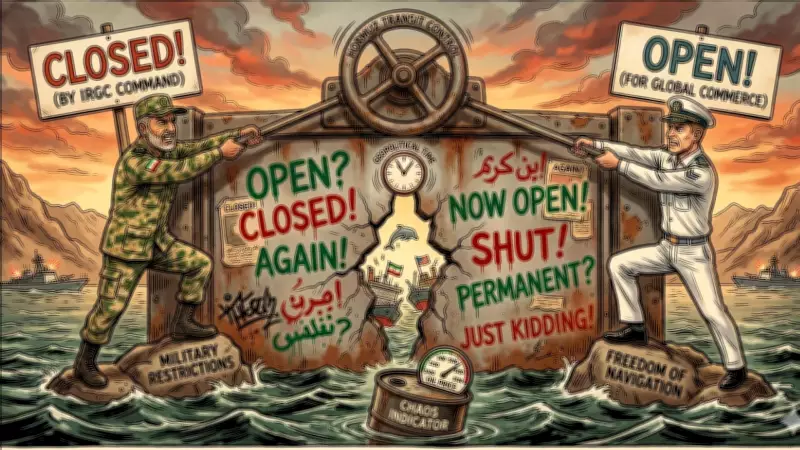
Iran Reinstates Military Control Over Strait of Hormuz Amid US Blockade Dispute
In a significant escalation of geopolitical tensions, Iran has reimposed stringent restrictions on the strategic Strait of Hormuz. This decision comes directly in response to the United States' refusal to end its naval blockade targeting Iranian-linked vessels attempting to navigate this crucial maritime passage.
Iranian Military Issues Firm Warning to United States
The Islamic Revolutionary Guard Corps (IRGC) Naval Command announced the move, vowing to take firm action against what it termed US "bad-faith violations" of prior understandings. A statement from Iran's joint military command declared, "control of the Strait of Hormuz has returned to its previous state under strict management and control of the armed forces." The restrictions will remain enforced until all threats to vessels heading to and from Iranian ports are fully removed, specifically citing the ongoing US blockade.
This announcement followed a statement by former US President Donald Trump on his Truth Social platform. Trump asserted that while the strait was open for general commerce, the naval blockade on Iranian ships would persist "until such time as our transaction with Iran is 100% complete."

Reversal After Brief Reopening Linked to Ceasefire
The reinstatement of restrictions marks a sharp reversal. Just days prior, Iran had declared the strait fully reopened to commercial vessels. This reopening was tied to a 10-day truce between Israel and the Iranian-backed Hezbollah militant group in Lebanon. Iran's Foreign Minister, Abbas Araghchi, announced the reopening on social media, stating it was "in line with the ceasefire in Lebanon."
However, citing the continued US blockade, Iran's parliament subsequently scrapped that agreement. Ebrahim Azizi, Head of Iran's National Security Committee, outlined a new maritime regime. Under this system, only commercial vessels authorized by the IRGC Navy and having paid required tolls are permitted to use designated routes. Azizi warned, "As long as the traffic of vessels to and from Iran is threatened by the US, the status of the Strait of Hormuz will be as before, more restricted."
Accusations of Breach of Trust and Piracy
Iranian state media reported statements from military spokespersons accusing the United States of a "breach of trust." One statement confirmed full Iranian naval supervision over ship passage, declaring any passage "null and void" if the US blockade continues. It further accused the US of engaging in "piracy and maritime theft under the so-called title of blockade."
Global Oil Supply at Risk
The strategic implications are profound. Roughly one-fifth of the world's oil supply transits through the Strait of Hormuz. Further restrictions threaten to squeeze already constrained global supplies, potentially driving energy prices higher and destabilizing markets.
Timeline of the Evolving Hormuz Crisis
The current standoff is the latest chapter in a tense months-long crisis:
- Late February: Iran initially closed the strait following US-Israeli military operations and the assassination of Supreme Leader Ali Khamenei, deploying sea mines and targeting merchant vessels.
- Early March: Shipping traffic halted as Tehran formalized the closure for vessels from "hostile nations," including the US and Israel, causing oil prices to soar.
- Mid-March: The US claimed the strait was open, but Iran introduced a toll system charging up to $2 million per vessel, while exempting allies like India, China, and Russia.
- Early April: The US issued an ultimatum and began mine-clearing operations. A fragile ceasefire brokered by Pakistan briefly raised hopes.
- Mid-April: The US announced a naval blockade on ships to and from Iranian ports. Iran initially linked a strait reopening to an Israel-Lebanon truce but reversed course days later, reinstating full military control as the crisis continues.
The situation remains volatile, with Iran asserting sovereign control over the waterway and the US maintaining its pressure campaign, setting the stage for continued international friction.






