

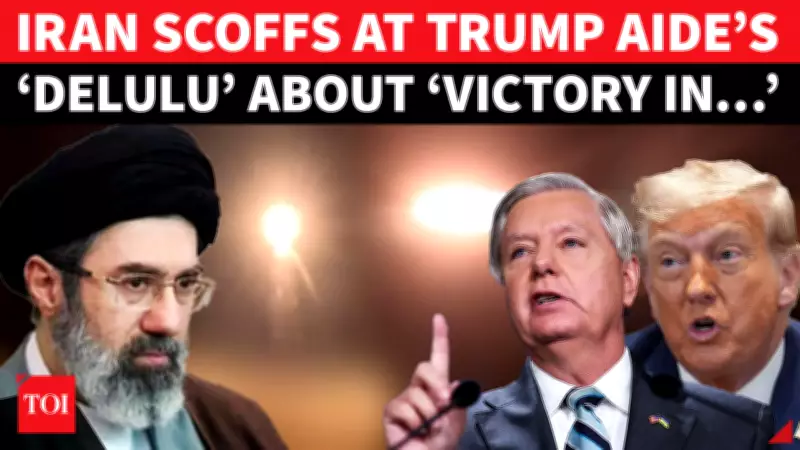
Iran Condemns US Senator's Controversial War Remarks
Iran has issued a sharp rebuke to US Senator Lindsey Graham over his recent comments suggesting that the ongoing 2026 conflict could potentially conclude a "2,000-year conflict." The Iranian government has openly questioned the consistency of Washington's earlier justification, which cited an "imminent threat" as a basis for military engagement. This diplomatic confrontation highlights the deepening tensions between the two nations as verbal exchanges and military maneuvers continue to escalate.
Contradiction in US Justification Exposed
Tehran's response specifically targets what it perceives as a glaring contradiction in the United States' narrative. Initially, US authorities justified their actions by pointing to an "imminent threat" from Iran. However, Senator Graham's statement about ending a millennia-old conflict has prompted Iranian officials to challenge the coherence of this rationale. This development underscores the complex and often conflicting narratives that shape international conflicts, where public statements can significantly influence diplomatic and military strategies.
Graham's Call for Seizing Kharg Island
Amidst this war of words, Senator Lindsey Graham has advocated for the seizure of Kharg Island, a critical Iranian oil hub located in the Persian Gulf. This strategic location is vital for Iran's oil exports and energy infrastructure, making it a potential flashpoint in the conflict. The proposal to capture Kharg Island reflects the high stakes involved in the geopolitical struggle, as control over such assets could dramatically alter the balance of power and economic dynamics in the region.

IRGC's Ongoing Military Operations
Concurrently, the Islamic Revolutionary Guard Corps (IRGC) is actively conducting retaliatory strikes as part of Operation True Promise 4. This military campaign involves the launch of missiles and drones targeting US and Israeli interests. The IRGC's actions are framed as a direct response to perceived aggressions, further fueling the cycle of retaliation and escalation. These operations demonstrate Iran's commitment to a robust military response, even as diplomatic channels remain strained.
Escalating Conflict and Narrative Battle
The situation is rapidly evolving into a multifaceted conflict where military actions are paralleled by a fierce battle of narratives. Both sides are leveraging media and public statements to shape international perceptions and justify their positions. This dual approach complicates resolution efforts, as each escalation in rhetoric or warfare prompts countermeasures, creating a volatile environment with significant implications for global stability.
- Iran challenges the US over inconsistent war justifications.
- Senator Graham's Kharg Island seizure proposal raises strategic concerns.
- IRGC continues Operation True Promise 4 with missile and drone strikes.
- The conflict intensifies as narratives and military actions expand.
As tensions mount, the international community watches closely, aware that the outcomes could reshape Middle Eastern geopolitics and influence global security frameworks. The interplay between diplomatic rhetoric and military strategy remains a critical factor in determining the trajectory of this high-stakes confrontation.






