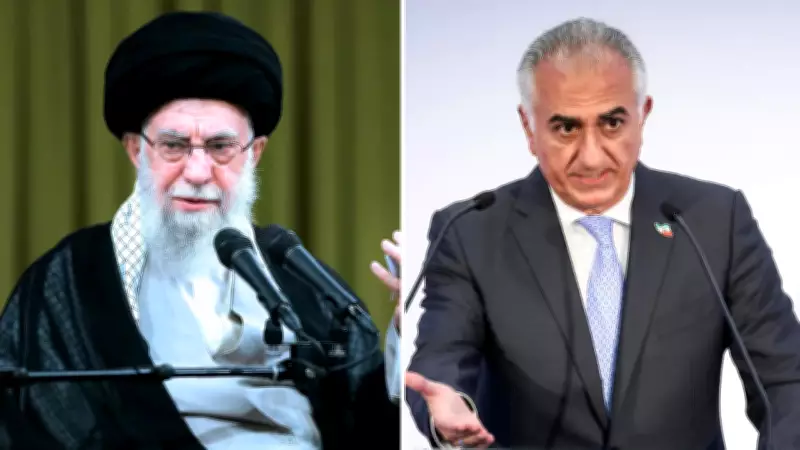
Iran's Exiled Prince Reza Pahlavi Launches Scathing Attack on Supreme Leader Ali Khamenei
In a powerful and provocative address, Iran's exiled prince Reza Pahlavi has delivered a sweeping condemnation of Supreme Leader Ali Khamenei's rule, accusing the Islamic Republic of fundamentally betraying both its citizens and their religious faith. Positioning his message during a period of escalating unrest within Iran, Pahlavi framed his appeal as both political and spiritual, directly challenging the clerical establishment that has governed Iran for decades.
Religious and Political Rebuke of the Islamic Republic
Casting his critique in deeply evocative religious terms, Pahlavi began his address with the words "my devout Shia compatriots" and proceeded to describe Khamenei as the "false prophet of our time." He argued that the Islamic Republic has consistently ruled in the name of religion while delivering only hardship, poverty, and systematic repression to the Iranian people.
"From the very first day, the Islamic Republic seized power in your name and in the name of your religion, and to this day it has produced nothing but poverty, misery, and crimes against humanity," Pahlavi declared in his statement.

Accusations of Religious Justification for Violence
In a detailed post on social media platform X, Pahlavi accused Supreme Leader Ali Khamenei of systematically misusing religion to justify brutal violence against Iranian citizens. He referenced recent uprisings, including what he termed the "national Lion-and-Sun Revolution," to illustrate his claims.
"You yourselves witnessed that the Islamic Republic and Ali Khamenei personally, in the name of religion and with the support of clerics, refrained from no crime: from shooting innocent citizens with live ammunition—including children and school students—to delivering final shots to the wounded in hospitals, and from the torture, murder, and rape of detainees," Pahlavi wrote.
He further elaborated: "All of this has been and continues to be done in the name of Shia Islam. They have turned mosques into bases of repression, chant 'Haydar Haydar' while aiming at their fellow countrymen's heads, and perform their prayers on blood-soaked prayer rugs."
Call to Reclaim Faith from Political Islam
Pahlavi issued a direct appeal to Iran's Shia community, urging them to oppose what he described as the politicization of Islam under Khamenei's "illegitimate regime." His message specifically targeted faithful Shia who oppose the concept of Velayat-e Faqih (Guardianship of the Islamic Jurist) and political Islam.
"My message to faithful Shia who oppose the Velayat-e Faqih and political Islam is this: If you care about the faith and wish, in the future Iran, to practice your religious rites peacefully, in a non-political and individual manner, then stand at the forefront of the struggle against this illegitimate regime and its criminal leaders," Pahlavi stated.
He continued with a powerful exhortation: "Reclaim your religion and faith from the false prophet of our time. Do not allow the crimes of the Islamic Republic and the terrorist Islamic Revolutionary Guard Corps to be written in the name of your religion."
Appeal for Unity Across Religious Lines
In a significant expansion of his message, Pahlavi expressed solidarity with Iran's Sunni minority and other religious communities, calling for unified opposition against the regime. He acknowledged that many devout individuals are already engaged in resistance against the Islamic Republic.
"Today, a large number of the devout are already in the trenches fighting the Islamic Republic. To those who have not yet joined this sacred struggle, I urge you—before it is too late—to stand alongside your Sunni brothers and sisters and the followers of other religions, denominations, and beliefs; join the ocean that is the Iranian nation; and reclaim your faith from the despot Zahhak and his cohort," Pahlavi wrote, concluding his X post with a reference to a tyrannical figure from Persian mythology.
He added: "This will better serve both you personally and the future of Shia Islam and the Islamic faith in Iran."

Context of Recent Unrest and International Reactions
Pahlavi's remarks come against the backdrop of significant political turmoil in Iran. The country witnessed large-scale demonstrations in late 2025 and early 2026, with widespread protests erupting against the Khamenei-led regime. Citizens took to the streets across multiple Iranian cities, expressing profound anger over several critical issues:
- Rampant inflation and severe economic hardship
- Systematic political repression and human rights violations
- Corruption within the ruling establishment
What began as protests over rising prices and economic conditions evolved into one of the largest waves of unrest in recent years. Demonstrators targeted symbols of the Islamic Republic and burned images of Supreme Leader Khamenei, indicating deep-seated discontent with the current leadership.
Internationally, former US President Donald Trump weighed in during these demonstrations, expressing strong support for the Iranian people while sharply criticizing the Khamenei regime. Trump has repeatedly called for regime change in Iran, with the exiled Pahlavi family viewed by some political observers as a potential alternative in any future political transition.
The United States has also reinforced its military presence in the region surrounding Iran, deploying additional fighter jets, naval assets, and strategic weapon systems. These moves have been interpreted as stern warnings to Tehran amid escalating tensions.
Pahlavi's comprehensive critique represents a significant development in the ongoing political discourse surrounding Iran's future, blending religious rhetoric with political opposition in a manner that directly challenges the theological foundations of the current regime.