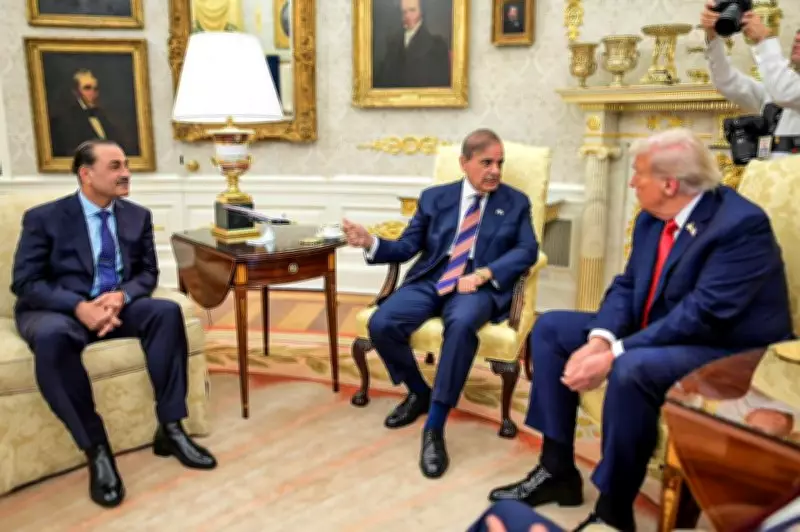
Pakistan Prime Minister Shehbaz Sharif addressed the National Assembly in the early hours of June 15, celebrating what he described as Pakistan's successful mediation between Iran and the United States. The two nations had agreed to extend their ceasefire for an additional 60 days. More significantly, the Strait of Hormuz was set to reopen, and the US naval blockade of the Sea of Oman was to be lifted, which had previously prevented maritime traffic from Iranian ports and along Iran's coastline.
Sharif's Address and Praise for Army Chief
Sharif's office posted highlights of his speech on X, emphasizing that "the prestige and honour Allah has bestowed upon Pakistan today is something nations seek for centuries." He expressed "deep gratitude" to the leaders of Qatar, Saudi Arabia, Turkey, China, the US, and Iran for "demonstrating immense wisdom, prudence, and patience under extremely difficult circumstances." Congratulating the "Pakistani nation," Sharif particularly highlighted the role of Army Chief Field Marshal Asim Munir. His office stated that he "particularly praised the extraordinary role played by Field Marshal Syed Asim Munir, who devoted day and night to bring an end to the war and securing peace." Sharif noted that "there were some critical moments when negotiations seemed close to falling apart, but the Field Marshal remained steadfast which ensured this monumental success."
Omission of UAE and Strained Ties
It is noteworthy that Shehbaz Sharif omitted the UAE from the list of countries he thanked. This omission reflects both the particularly strained relations between Iran and the UAE and a rough phase in Pakistan-UAE ties. Reports suggesting that the UAE recalled a $3.5-billion oil facility loan from Pakistan during the Iran war illustrate mutual difficulties. While there have been reports of the UAE pledging to fund Iran's reconstruction, recent contacts between the two countries have not erased the bitterness Pakistan feels toward the UAE. Additionally, Pakistan stands firmly with Saudi Arabia, and Saudi-UAE difficulties cast a shadow on UAE-Pakistan relations.

Signing Ceremony and Munir's Rising Stock
Many countries have thanked Pakistan and other states that helped mediate the Iran-US Memorandum of Understanding (MoU), which is to be signed in Switzerland on June 19. Interestingly, Sharif claimed in his speech that the MoU's signing ceremony would be hosted by Pakistan, though no other country has endorsed this claim. In any event, Sharif, Foreign Minister Ishaq Dar, Interior Minister Mohsin Naqvi—who frequently visited Tehran during these weeks—and Field Marshal Asim Munir are expected to attend the ceremony. Many Pakistani and foreign observers will be watching Trump's favorite Field Marshal, and it is possible that Trump will personally praise him before or during the event.
Munir's stock has risen both domestically and internationally. Sharif's obsequiousness toward him reflects the attitude of the broader political class. As Munir's reputation soars, the greatest loser is Pakistan Tehreek-e-Insaf (PTI) leader and former Prime Minister Imran Khan, who has been in jail since the May 9, 2023 unrest involving PTI members. The judiciary has not shown the courage to release him, and his chances of leaving prison in the foreseeable future are now remote.
Pakistan's Army and Economic Prospects
Pakistan has seen many army chiefs who have held the country in their grip. Most—Ayub Khan, Yahya Khan, Zia-ul Haq, and Pervez Musharraf—ruled directly, while others governed from behind a civilian facade, with varying degrees of effectiveness and ruthlessness. Munir, who fancies himself a man of destiny, will now unhesitatingly seek to shape Pakistan according to his beliefs. These include a passion for the Islamic faith and a staunch commitment to the two-nation theory, which has instilled animosity toward India. Therefore, a strategic shift in Pakistan toward India or an abandonment of its reliance on calibrated terror against India is not on the cards.

The real question for Pakistan is whether it can convert the goodwill it has garnered into transforming its economy. This is unlikely because it requires structural changes that must begin with the Pakistan army becoming less extractive. The army is the biggest obstacle to Pakistan becoming economically stable and prosperous. It pursues confrontation against both external and internal adversaries and has shunned reconciliation. Moreover, it has never allowed democratic processes to consolidate, as that would erode its corporate interests. As scholar Ayesha Siddiqa has shown, the army is Pakistan's largest business and industrial conglomerate, and Munir will comprehensively consolidate its interests.
India's Response and Strategic Considerations
Some sections in India may experience heartburn if the US-Iran signing ceremony proceeds as announced by Sharif, especially given the bitterness from the Pahalgam terrorist attack and India's Operation Sindoor. A more mature way to handle Pakistan's mediation success would be to focus on the advantages accruing to India and the world from the opening of the Strait of Hormuz, rather than deriding Pakistan. As a major power, India must remain strong-willed but never appear churlish. Indian strategic analysts could point out that international goodwill might encourage Pakistan's leadership to steer the country toward a modern and progressive direction.
There is a slim possibility that Munir, like some predecessors, may ask Trump to intervene in India-Pakistan ties, especially on Jammu and Kashmir. Pakistan has already earned Trump's goodwill for praising his intervention during the May 2025 India-Pakistan conflict. It would be prudent for India to quietly caution the US against involving itself in India-Pakistan matters and to inform it that if Pakistan seeks to provoke India, it will meet with a firm response.