

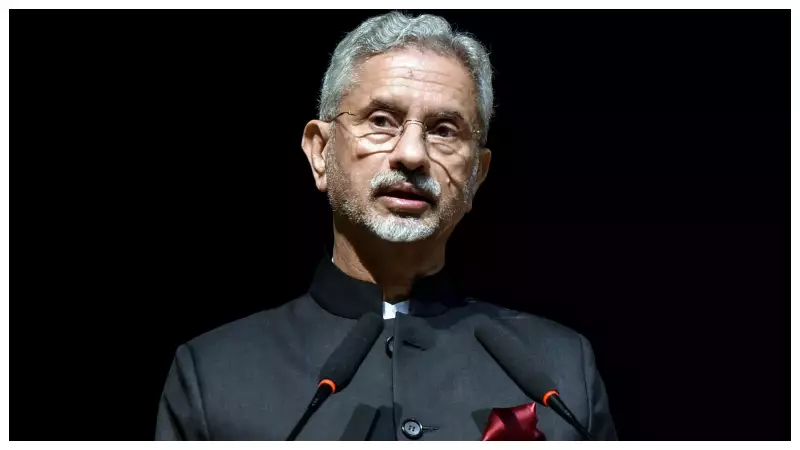
External Affairs Minister S Jaishankar addressed key foreign policy issues, including the case of former Bangladeshi Prime Minister Sheikh Hasina and India's steadfast relationship with Russia, during his appearance at the Hindustan Times Leadership Summit on Saturday.
On Sheikh Hasina's Stay in India: A Matter of Personal Choice
Amid persistent calls from the Bangladesh government for the extradition of ex-Prime Minister Sheikh Hasina, Jaishankar clarified that her continued stay in India is a personal decision. He stated that this choice is heavily influenced by the circumstances that unfolded in her home country last year. India has not yet agreed to Dhaka's demand for her handover, following her sentencing to death last month for crimes against humanity.
When questioned if Hasina could remain in India indefinitely, the minister indicated that was a separate issue. "She came here in a certain circumstance, and I think that circumstance clearly is a factor in what happens to her. But again, that is something in which she has to make up her mind," Jaishankar explained. He reiterated India's position as a well-wisher of Bangladesh, expressing hope for a peaceful democratic process. "As a democratic country... we would like to see the will of the people ascertained. I’m quite confident that whatever comes out... would have a balanced and mature view about the relationship," he added.

Defending Strategic Autonomy: India's Stance on Russia and the US
Shifting focus to global diplomacy, Jaishankar robustly defended India's foreign policy independence. He dismissed suggestions that Russian President Vladimir Putin's recent visit could complicate ongoing trade negotiations with the United States. "I think for any country to expect to have a veto or a say in how we develop our relations with others is not a reasonable proposition," he asserted.
He highlighted that the India-Russia partnership has been one of the "steadiest big relationships" over the past 70-80 years. The minister emphasized India's right to maintain multiple relationships based on its national interest and the principle of strategic autonomy. "We have a freedom of choice... I cannot imagine why anybody would have reason to expect the contrary," Jaishankar stated.
Navigating Trade Tensions with the United States
Addressing the strained trade talks with the US, Jaishankar acknowledged that trade is the central focus of the Trump administration. He confirmed that India is prepared to engage but strictly on reasonable terms that protect its domestic interests. "To me, [diplomacy] is about defending our national interests," he declared.
The minister pointed out that the India-US relationship is currently facing significant challenges, marked by the US imposing tariffs as high as 50% on some Indian goods. He stressed that any trade deal must be negotiated judiciously, keeping the welfare of Indian workers, farmers, and the middle class at the forefront. "We believe that there can be a landing point for our respective trade interests," he concluded, underscoring the importance of protecting livelihoods in India.






