

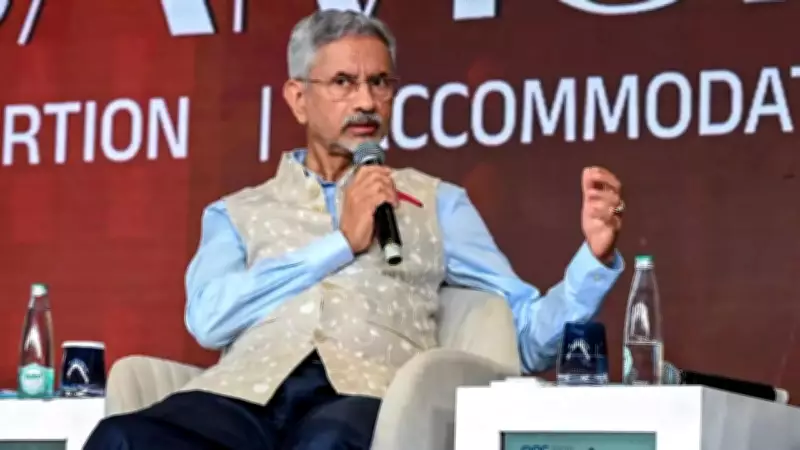
Jaishankar Declares India's Rise Unstoppable and Self-Determined
External Affairs Minister S Jaishankar emphatically stated on Saturday that India's ascent on the global stage is "unstoppable" and will be determined solely by India's own strengths and actions, not by the errors of other nations. He made these remarks during an interactive session at the prestigious Raisina Dialogue in New Delhi, a premier geopolitical forum.
Asserting Sovereignty in Response to US Comments
Jaishankar's comments came shortly after US Deputy Secretary of State Christopher Landau addressed the same event, suggesting that Washington would not permit India to grow powerful enough to rival the United States by repeating the mistakes made with China's rise. Without directly naming any country, Jaishankar countered this perspective by emphasizing India's autonomous path.
"When we speak today about the rise of countries, the rise of countries is determined by the countries. The rise of India will be determined by India," Jaishankar declared. "It will be determined by our strength, not by the mistakes of others," he added, reinforcing the message of self-reliance and national resolve.

Humanitarian Gesture: Docking of Iranian Warship IRIS LAVAN
In a significant revelation, Jaishankar officially confirmed that India had approved the docking of an Iranian warship, IRIS LAVAN, at the port of Kochi on humanitarian grounds. This decision was made just days before another Iranian vessel, DENA, was torpedoed and sunk by a US submarine on March 4, escalating tensions in the region.
The IRIS LAVAN had urgently requested docking in Kochi on February 28, citing technical issues, coinciding with the outbreak of conflict in West Asia. Indian authorities granted the request the following day, March 1, allowing the ship to sail in and dock with its 183 crew members, who remain in India.
"They were coming in for a fleet review and then they got in a way caught on the wrong side of events," Jaishankar explained, noting the changed circumstances since the ship's departure. "We approached the situation from the point of view of humanity, other than whatever the legal issues were and I think we did the right thing."
India's Role in the Indian Ocean Region
Addressing India's strategic position, Jaishankar highlighted the importance of the Indian Ocean, stating that those who collaborate with India will reap greater benefits. He acknowledged challenges but remained confident in India's trajectory. "I'm not saying there are no challenges to India's rise; there are. But the direction of India's rise is very clear. In a way, it's unstoppable," he affirmed.
When questioned about India's role as a security provider following the DENA sinking, Jaishankar pointed to the complex reality of the Indian Ocean, where multiple powers, including the US and China, maintain a presence. He cited historical and recent developments to illustrate this dynamic.
- Diego Garcia: A US military base that has been operational in the Indian Ocean for over five decades.
- Djibouti: Hosts foreign military forces, established in the early 2000s.
- Hambantota: A port in Sri Lanka that has gained strategic significance in recent years.
Jaishankar also referenced a similar situation in Sri Lanka, where decisions led to different outcomes, underscoring India's humanitarian approach. "One obviously had a similar situation in Sri Lanka, they took the decision which they did and one of them unfortunately didn't make it," he said, alluding to the broader regional context.
Overall, Jaishankar's statements at the Raisina Dialogue reinforce India's commitment to an independent foreign policy, humanitarian principles, and a confident vision for its future growth, firmly rooted in national capabilities rather than external factors.






