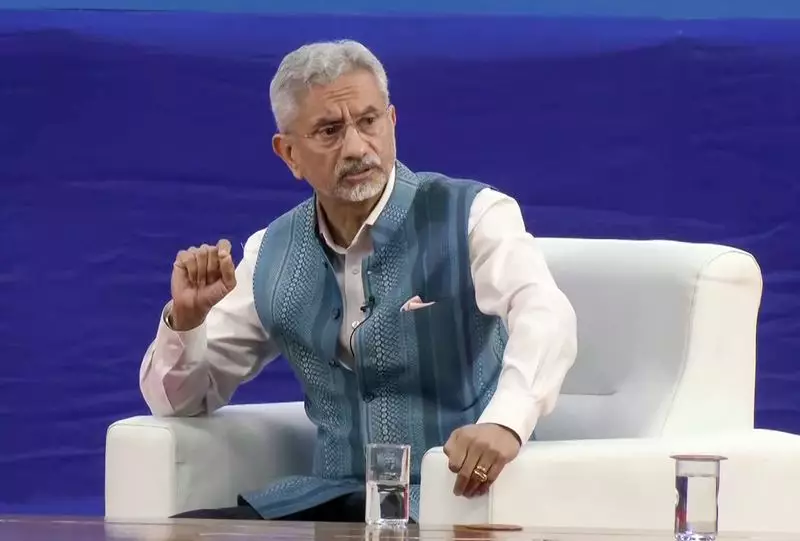
In a powerful and unequivocal statement, India's External Affairs Minister, Dr. S. Jaishankar, has launched a scathing critique of Pakistan, directly linking the contentious issue of water-sharing to Islamabad's alleged role as a sponsor of terrorism. The minister's remarks underscore a hardened diplomatic stance, framing Pakistan's behavior as that of a "bad neighbour" undeserving of standard bilateral courtesies.
A Firm Stance on Water and Terrorism
Dr. Jaishankar articulated India's position with stark clarity, asserting that a nation which actively sponsors and practices terrorism against its neighbor cannot expect normal cooperation on vital resources like water. The minister's comments were made during a public event, though the specific location was not detailed in the initial report. He emphasized that Pakistan's long-standing strategy of using cross-border terrorism as a tool of state policy has fundamentally poisoned the well of bilateral relations.
The core of Jaishankar's argument hinges on the principle of reciprocity and good faith. He pointedly questioned how India could be expected to adhere to agreements, such as the Indus Waters Treaty (IWT), with a country that consistently engages in hostile acts. The 1960 treaty, brokered by the World Bank, governs the sharing of the waters of the Indus river system between the two nations.

The Indus Waters Treaty Under Scrutiny
Jaishankar's statement brings the future of the Indus Waters Treaty into sharp focus. While India has historically adhered to the treaty's provisions, the minister's rhetoric signals a potential shift, where compliance is explicitly tied to Pakistan's behavior on terrorism. This represents a significant escalation in India's diplomatic language, moving the water dispute from a technical or legal domain squarely into the realm of national security and consequence.
The minister did not mince words in describing Pakistan's actions, labeling it a state that sponsors terrorism. This accusation is not new but gains fresh potency when directly connected to a critical resource like water. For a largely arid country like Pakistan, the threat to its water supply from upstream India is an existential concern, making Jaishankar's linkage a potent diplomatic pressure point.
Broader Implications for India-Pakistan Relations
This public dressing-down by India's top diplomat reflects the deep and persistent freeze in relations between the two nuclear-armed rivals. Dialogue has been suspended for years, primarily over the terrorism issue. Jaishankar's remarks solidify India's position that terrorism and talks cannot coexist, and now, by extension, neither can terrorism and unqualified resource-sharing.
The strategy appears to be one of imposing tangible costs for Pakistan's alleged support of militant groups operating in India, particularly in Jammu and Kashmir. By explicitly connecting water rights to counter-terrorism, India is attempting to reframe the narrative and present Pakistan with a stark choice: curb terrorism or face potential resource insecurity.
This approach also serves a domestic purpose, showcasing a strong, uncompromising government stance to the Indian public. It aligns with the current administration's image of taking a hard line on national security and not shying away from confronting Pakistan on the global stage.
International Context and Future Trajectory
Internationally, Jaishankar's statement is likely intended to further isolate Pakistan on the terrorism issue. By publicly declaring Pakistan a "sponsor of terror" in the context of breaking from neighborly norms, India reinforces its long-standing campaign to hold Islamabad accountable in forums like the Financial Action Task Force (FATF).
The immediate future of the Indus Waters Treaty remains uncertain. While an outright abrogation is a complex and drastic legal step, Jaishankar's comments suggest India may explore more aggressive interpretations or leverage its control over the western rivers (Jhelum, Chenab, Indus) to which Pakistan has largely unrestricted use under the treaty. The possibility of increased water infrastructure projects on the Indian side, fully within the treaty's provisions but maximizing usage, is now framed as a justified response to Pakistani hostility.

In conclusion, External Affairs Minister S. Jaishankar's blunt message marks a new chapter in the fraught India-Pakistan relationship. It moves the discourse from periodic accusations to a declared policy of conditional engagement, where Pakistan's access to a critical natural resource is made contingent on its abandonment of terrorism. The ball, as per India's new public stance, is now firmly in Pakistan's court.