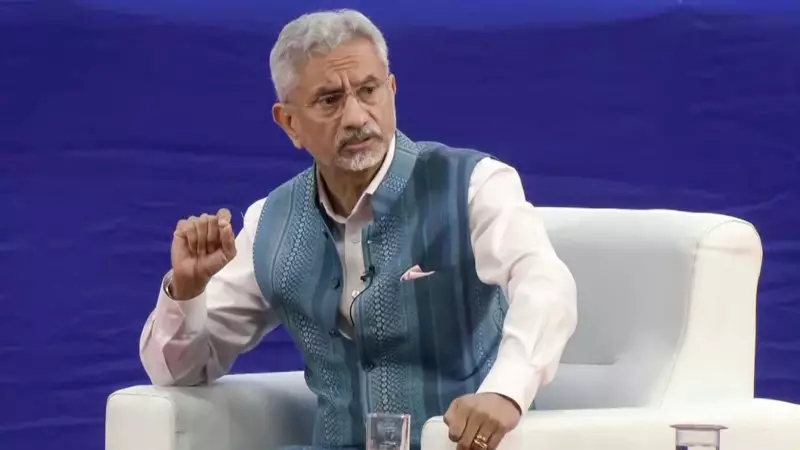
External Affairs Minister Dr. S. Jaishankar delivered a pointed message on Friday, firmly linking India's willingness to share vital resources like water with its neighbours to their commitment against terrorism. Speaking at IIT Madras in Chennai, the minister set a decisive tone for Indian foreign policy in the new year.
A Clear Message on 'Bad Neighbours'
While not explicitly naming Pakistan, the context of Dr. Jaishankar's remarks was unmistakable. He asserted India's fundamental right to protect its citizens from threats posed by "bad neighbours". The minister drew a direct line between cooperation and conduct, stating that a country cannot expect to receive shared water resources while simultaneously supporting cross-border terrorism.
"You cannot request us to share our water with you and also spread terrorism in our country," Jaishankar told students during the interaction on January 2, 2026. This stance powerfully echoes Prime Minister Narendra Modi's earlier principle that "blood and water cannot flow together."

Continuity in Foreign Policy Post-Pahalgam
This policy position was concretely demonstrated last year following the Pahalgam terror attack on April 22. In its aftermath, India moved to put the longstanding Indus Waters Treaty with Pakistan "in abeyance," a significant diplomatic and strategic step. Jaishankar's latest comments indicate a continuation of this firm, consequence-based approach to foreign relations.
The minister's address reinforced that India's posture is not one of isolation but of conditional engagement based on mutual respect and security.
Contrast with Support for 'Good Neighbours'
Dr. Jaishankar contrasted the approach towards recalcitrant neighbours with India's record of generosity towards "good neighbours." He cited multiple instances where India acted as a regional pillar of support:
- Providing vaccines globally and to neighbours during the Covid-19 pandemic.
- Extending fuel and food support during the Ukraine conflict.
- Offering a substantial financial assistance package of USD four billion to Sri Lanka during its severe economic crisis.
"India's growth is a lifting tide for the region, and most of our neighbours recognise that if India grows, they grow with us," he stated, highlighting the benefits of positive relations.
Defining India's Strategic Doctrine
The minister's speech effectively outlines a dual-track foreign policy doctrine for the region. For nations that engage constructively, India promises investment, help, and sharing. For those that persist in using terrorism as a state policy, the response will be unequivocal and defensive.
"But when it comes to bad neighbours who persist with terrorism, India has every right to defend its people and will do whatever is necessary," Jaishankar asserted. This clear demarcation underscores that security concerns will remain paramount in shaping India's engagement with its immediate neighbourhood in the foreseeable future.