

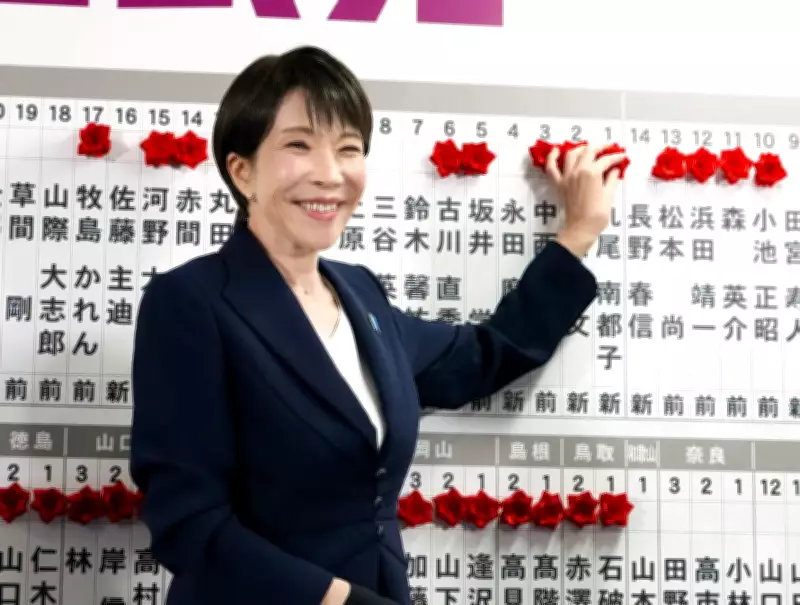
Japan's Takaichi Secures Historic Supermajority in Landslide Election Victory
Prime Minister Sanae Takaichi of Japan has achieved a remarkable political triumph, securing a once-in-a-generation mandate that promises to fundamentally reshape Tokyo's strategic posture in the Indo-Pacific region. Her Liberal Democratic Party (LDP) captured an impressive 316 seats in the 465-seat lower house of parliament. Combined with coalition partner Japan Innovation Party (Ishin), this grants Takaichi a commanding two-thirds supermajority, enabling her to push through legislation even if faced with resistance from the upper chamber.
A Calculated Gamble That Paid Off Spectacularly
The snap election, a rare mid-winter political gamble, was called to capitalize on Takaichi's early popularity and her reputation as a blunt, hard-driving conservative leader. Despite heavy snowfall disrupting parts of the country, the bet paid off handsomely, resulting in a decisive landslide victory. The immediate market reaction was overwhelmingly positive, with Japanese equities surging to record highs as investors embraced what financial analysts have termed a renewed "Takaichi trade." This reflects a widespread belief that political clarity and continuity under her strengthened leadership will outweigh concerns about potential fiscal slippage.
Strategic Implications: A New Reality for Global Powers
Takaichi's supermajority creates a new strategic reality that China, India, and the United States cannot afford to ignore. Japan now possesses a leader with the political runway to accelerate initiatives on defense, industrial policy, and alliance management, facing significantly fewer domestic constraints.

For China, this likely translates into a hardened Japanese deterrence posture and reduced willingness from Tokyo to self-censor discussions about Taiwan contingencies, even as diplomatic channels remain open to prevent escalation. "Beijing will not welcome Takaichi’s victory. China now faces the reality that she is firmly in place—and that its efforts to isolate her completely failed," stated David Boling, principal at the Asia Group, in comments to Reuters.
For India, the outcome represents a substantial opportunity. A more confident and politically stable Japan emerges as a stronger partner within the Quad framework and in shared agendas concerning supply-chain resilience and technology cooperation, both designed to reduce dependence on China.
For the United States, the benefits are evident—a treaty ally prepared to increase defense spending and deepen industrial cooperation. However, the relationship introduces a significant variable: the transactional style of President Donald Trump and the extent of Washington's expectations regarding Japanese budgets, military basing, and investment commitments.
In essence, Takaichi's victory does more than stabilize Japan's domestic politics. It shifts the center of gravity in Indo-Pacific strategy, compelling regional capitals to recalibrate their approaches to a Japan that is both more predictable in its strategic direction and more forceful in execution.
Zooming In: China's Dilemma—Deterrence Takes Precedence
Beijing's core issue with Takaichi extends beyond ideological differences. It stems from her demonstrated willingness to publicly articulate scenarios that previous Japanese leaders typically kept implicit, especially concerning Taiwan and Japan's potential role should conflict erupt. Early in her tenure, she departed from Japan's long-standing tradition of careful ambiguity by outlining possible responses to a Chinese attack on Taiwan, triggering what multiple international outlets described as the sharpest Sino-Japanese dispute in years.
The Chinese response was not merely rhetorical. Beijing signaled its displeasure through a combination of diplomatic pressure and practical retaliation, including tougher official messaging and measures discouraging tourism. This tension is likely to persist as long as Takaichi frames defense planning around Taiwan-linked contingencies.

What changes now is not her worldview but her political leverage. The two-thirds lower-house majority provides powerful momentum for policies Beijing opposes most strongly: increased defense spending, expanded defense-industrial capacity, and potential constitutional debates regarding Japan's military posture. Investors are already anticipating this direction, with post-election trading highlighting defense-related sectors and policy clarity as key expectations attached to her strengthened mandate, even as markets remain attentive to fiscal considerations.
Nevertheless, Takaichi's robust mandate also affords her an off-ramp if desired. A politically secure leader can sometimes afford to "take a deep breath" and de-escalate tensions without appearing weak—a point raised by analysts cited by AFP, who see post-election room for recalibration. The most probable path forward involves a blend: steady capability-building paired with controlled diplomacy. This would mirror Japan's recent pattern—building deterrence while maintaining a functional working relationship with Beijing to safeguard trade and prevent miscalculations.
However, the risk of escalation rises if Beijing interprets Japan's moves as part of a broader encirclement strategy, particularly if Tokyo's defense reforms expand beyond budgets into areas like export rules, joint production, and tighter intelligence and operational integration with the United States.
Between the Lines: India Emerges as the Quiet Strategic Winner
While India is rarely the loudest voice in coverage of Japanese elections, it may emerge as the most quietly advantaged by Takaichi's result. A Japan characterized by political stability and a leader willing to act decisively is an ideal partner for New Delhi's long-term strategy: building resilient supply chains, scaling high-tech manufacturing, and balancing Chinese influence without formal alliances.
Takaichi's domestic agenda—focusing on industrial policy, technology investment, and defense production—creates natural synergies with India's priorities. As investors anticipate increased support for semiconductors and strategic sectors, the same policy toolkit can be applied externally through co-development projects, trusted supply networks, and infrastructure finance that competes with Chinese state-backed capital.
Her political style also aligns well with Indian preferences. New Delhi tends to value predictable, leader-driven decision-making in strategic partnerships. Takaichi's large mandate reduces the likelihood that coalition fragility or frequent leadership turnover will disrupt multi-year initiatives—whether in connectivity, maritime cooperation, or technology frameworks with Quad partners.
There is also a defensive logic at play: Japan's sharper focus on Taiwan contingencies and the East China Sea allows India to coordinate without being the primary "frontline" balancer in Asia. The more Japan and the US can credibly deter in the Western Pacific, the more bandwidth India retains to address its own border pressures and Indian Ocean priorities while still participating in shared initiatives.
One caveat exists: Takaichi's nationalism and emphasis on traditional values may gradually narrow Japan's flexibility on immigration and labor policy, potentially constraining economic growth and industrial expansion. This could indirectly affect the scale of Japan's outward economic commitments. For India, however, the overall direction remains favorable: greater strategic convergence, enhanced industrial cooperation, and a stronger Quad backbone.
Voices from the Global Stage
Reactions to the election outcome have been varied and telling:
- US Treasury Secretary Scott Bessent posted on X: "When Japan is strong, the US is strong in Asia."
- Chinese Foreign Ministry spokesman Lin Jian stated: "China’s policy toward Japan will not change because of any single election."
- An analysis in Bloomberg noted that Chinese leaders must now decide whether to maintain economic pressure on Tokyo or seek an off-ramp to the dispute. Takaichi has expressed a desire for stable relations with Beijing, but retracting her previous comments on security matters remains politically untenable without appearing to compromise Japan's defense posture.
The Road Ahead: Key Tests and Turning Points
Three near-term milestones will determine whether Takaichi's mandate translates into transformative regional change or a more incremental shift:
- Washington Dynamics: President Trump has publicly embraced Takaichi's win, posting a message wishing her "Great Success in passing your Conservative, Peace Through Strength Agenda." This language signals ideological alignment but also hints at expectations regarding defense spending and alliance posture. The core question for Tokyo is whether Trump provides reassurance on regional security while demanding greater financial and industrial commitments—a tradeoff that could tighten US-Japan integration but complicate Japan's budget politics.
- The Fiscal Equation: Takaichi campaigned on economic relief measures that initially unsettled some investors. The post-election difference is that markets appear temporarily willing to assume her supermajority enables "policy clarity" rather than unchecked spending. Bloomberg's reporting emphasized that investors are granting her "the benefit of the doubt," with bond and yen movements calmer than initially feared.
- Beijing's Counterplay: China's options range from diplomatic freezing and targeted economic pressure to selective engagement aimed at driving a wedge between Japan and US strategy. Early signs from previous flare-ups suggest Beijing is willing to employ both symbolic and material tools—tourism messaging, commercial frictions, and political signaling—to influence Tokyo's behavior. The new difficulty for Beijing is the political reality: isolating Takaichi becomes far harder when voters have just locked her in with a historically large lower-house majority. This encourages a potentially different Chinese approach: testing Japan's thresholds, probing for economic vulnerabilities, and waiting for fiscal strain or political fatigue to erode public support.
Bottom Line: Strengthened Hand, Higher Stakes
Takaichi's landslide victory undeniably strengthens Japan's strategic hand, but it simultaneously raises the stakes across the Indo-Pacific. A bolder Japan can anchor deterrence efforts and deepen partnerships with India and the United States. It can also accelerate a cycle of pressure and response with China, particularly if planning around Taiwan becomes more explicit. The coming months will reveal whether Prime Minister Takaichi utilizes her historic mandate to sprint forward ambitiously or to consolidate gains cautiously.





