

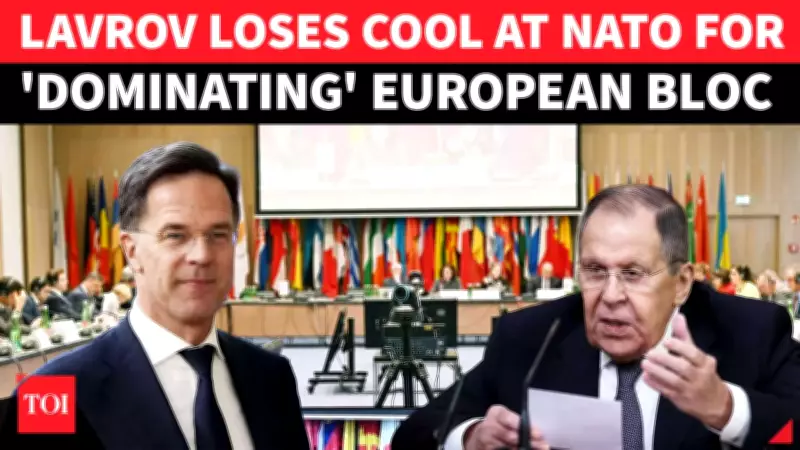
Russian FM Lavrov Condemns NATO for Rule-Breaking in Eurasian Security Architecture
In a sharp escalation of diplomatic rhetoric, Russian Foreign Minister Sergey Lavrov has launched a blistering critique against NATO, accusing the military alliance of systematically violating foundational principles to assert dominance across the Organization for Security and Co-operation in Europe (OSCE) space. Speaking against a backdrop of heightened tensions between Russia and Western nations, Lavrov emphasized that no single country or bloc possesses the legitimate authority to monopolize the shared European security framework.
Violation of Indivisible Security Principle
Lavrov asserted that NATO is engaging in actions that directly contravene the OSCE's core tenets, particularly the principle of indivisible security, which mandates that no state should strengthen its security at the expense of others. He warned that the alliance's maneuvers are creating a precarious imbalance, undermining collective stability in the region. "NATO is doing exactly what the organization's founding principles prohibit," Lavrov stated, highlighting a perceived hypocrisy in the alliance's conduct.
Ukraine as a Strategic Tool in East-West Confrontation
The Russian Foreign Minister implicated Ukraine as a central element in NATO's strategy, suggesting that the alliance is leveraging the ongoing conflict to advance its geopolitical interests. This accusation comes as the OSCE faces significant paralysis, struggling to address critical issues such as:

- The protracted Ukraine crisis and its implications for regional security.
- Stalled arms control negotiations amid escalating military posturing.
- The deepening East-West confrontation that threatens to fragment European unity.
Lavrov's remarks underscore a growing rift in international diplomacy, with Russia positioning itself as a defender of multilateral security norms against what it views as NATO's unilateral overreach.
Future of Europe's Security Order in Question
The ongoing stalemate within the OSCE, compounded by Lavrov's allegations, raises profound questions about the future trajectory of Europe's security architecture. Analysts note that the inability to forge consensus on key issues like Ukraine and arms control could lead to a more fragmented and volatile security environment. Lavrov's intervention signals Moscow's intent to challenge NATO's influence, advocating for a return to principles of equal and indivisible security as outlined in OSCE documents.
As tensions simmer, the international community watches closely, with Lavrov's accusations adding fuel to an already complex geopolitical landscape. The outcome of this diplomatic standoff will likely shape Eurasian security dynamics for years to come, testing the resilience of existing international frameworks and the commitment of major powers to cooperative security measures.






