

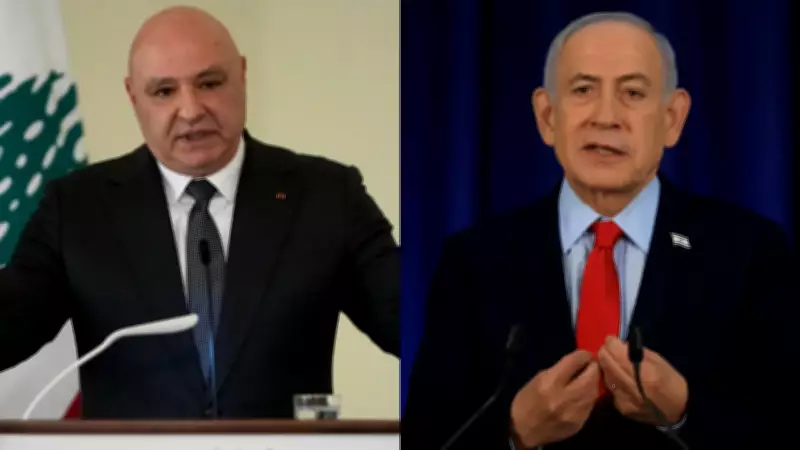
Lebanon's President Rejects Proposed Talks with Israeli Counterpart
In a significant diplomatic development, Lebanese President Joseph Aoun has reportedly declined to engage in discussions with Israeli Prime Minister Benjamin Netanyahu. This decision was confirmed by a Lebanese official, highlighting a firm stance amid ongoing regional tensions.
US Mediation Efforts and Lebanese Response
The refusal comes after former US President Donald Trump suggested that the two leaders were poised to hold historic talks. According to reports, Lebanese authorities communicated to the United States that they are not prepared to take this step at this time. "We told America we aren't ready to take that step," an official stated in an interview with CNN, underscoring the cautious approach from Beirut.
Ceasefire as a Prerequisite for Further Negotiations
Officials in Lebanon have explicitly informed both Israel and the United States that they will not pursue any additional negotiations until a ceasefire is established between Lebanon and Hezbollah. This condition sets a clear barrier to progress, as fighting between Israeli forces and Hezbollah militants has persisted despite recent diplomatic efforts.

Background of Recent Diplomatic Engagements
Earlier this week, Israel and Lebanon conducted their first direct talks in over four decades, held in Washington, DC. These discussions were seen as a breakthrough, yet they have not translated into a reduction in hostilities. Israeli officials had previously indicated that Netanyahu and Aoun were expected to hold follow-up talks, but this now appears unlikely given Lebanon's current position.
Escalating Military Actions and Humanitarian Impact
Concurrently, military actions have intensified on the ground. The Israeli military demolished the final crossing over the Litani River, which bisects Lebanon, effectively cutting off tens of thousands of residents in the southern region from critical aid routes. Lebanese state media reported that Israeli forces executed "two consecutive airstrikes" on the Qasmiyeh Bridge, linking the coastal city of Sidon to Tyre, resulting in its complete destruction.
Hezbollah's Continued Engagement in Conflict
Meanwhile, Hezbollah announced that it "engaged in direct fire clashes" with Israeli soldiers in southern Lebanon near the town of Qantara on Thursday morning. This statement, posted on Telegram and cited by CNN, indicates that the militant group remains actively involved in the conflict, further complicating efforts towards de-escalation.
Analysis of the Stalemate
The refusal by President Aoun to engage in talks underscores the deep-seated issues that persist between Lebanon and Israel. While diplomatic channels have been reopened after decades, the ongoing violence and lack of a ceasefire agreement present significant obstacles. The destruction of vital infrastructure, such as the Qasmiyeh Bridge, exacerbates humanitarian concerns and may hinder future negotiation prospects.
As the situation evolves, international observers are closely monitoring whether external mediation, particularly from the United States, can bridge the gap between the two nations. For now, Lebanon's insistence on a ceasefire as a precondition for dialogue remains a pivotal point in this complex geopolitical landscape.






