Architect's Descendant Decries Removal of Lutyens Bust from Presidential Palace
The great-grandson of renowned British architect Sir Edwin Lutyens has publicly criticized the Indian government's decision to remove his ancestor's bust from Rashtrapati Bhavan, the iconic presidential palace in New Delhi that Lutyens himself designed. Matt Ridley, a prominent science writer and direct descendant, expressed his disappointment following President Droupadi Murmu's unveiling of a replacement bust honoring Chakravarti Rajagopalachari, the first and last Indian governor-general of independent India, on Monday.
Personal Connection and Historical Preservation
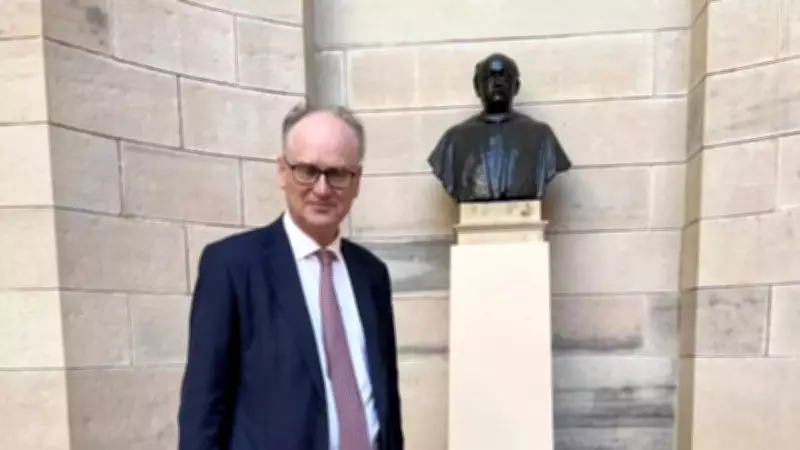
Ridley took to social media platform X to share his sentiments, posting a photograph of himself standing beside Lutyens' bust during a visit last year. "Sad to read that the bust of Lutyens (my great grandfather) is to be removed from the presidential palace he designed in Delhi," he wrote. "Here I am with it last year. I wondered at the time why his name had been removed from the plinth."
In a subsequent post, Ridley revealed he already possesses a replica of the bust, sculpted by Sir William Reid-Dick, which overlooks his workspace. "For those suggesting I offer a home for Lutyens's bust from Delhi, I already have a copy of it," he explained. "It looks down on my desk as I write this. I understand India's wish to remove colonial statues but he was an architect, not a viceroy."

Architectural Praise and Political Reactions
The removal has ignited a broader conversation about colonial legacy and historical preservation. X user Oliver Lewis commented, "This is genuinely appalling by the Govt of India. Lutyens designed the building and built for India probably the most fantastic Head of State 'HQ' anywhere in the world." Ridley concurred, praising Rashtrapati Bhavan's design: "Agreed. Rashtrapati Bhavan is a more elegant, ingenious and imaginative building than Buckingham Palace, the White House, the Quai d'Orsay, the Kremlin or the presidential palace in Beijing. It carefully incorporates Buddhist, Hindu, Jain and Muslim architectural themes."
Shiv Sena (UBT) MP Priyanka Chaturvedi joined the discourse, writing on X: "Many countries preserve the heritage and legacy of their nation's lived history for generations to remember — the good, the bad and the ugly included to learn from — but in new India we are hell-bent on replacing it with shiny new glass domes or convention centres with no soul or cultural context."
International Comparisons and Contrasting Views
Drawing parallels to other nations, X user Palash referenced Singapore's approach: "Lee Kuan Yew chose NOT to remove Sir Stamford Raffles' statue from Singapore despite pressure from many leaders in 1965. His rationale was simple — 'Singapore cannot enter a new future with anger towards the past.'"
Former CBI director Mannem Nageswara Rao offered an apology to Ridley, stating on X: "This zero-sum act is not decolonisation; it is petty vandalism of history."
However, not all responses were sympathetic. X user SagasofBharat countered: "Your grandfather Edwin Lutyens wasn't just an 'architect', he was a nasty racist. You should be happy Indians didn't knock that bust of your grandfather off with a hammer."
Broader Implications and Cultural Context
The replacement of Lutyens' bust with that of Rajagopalachari symbolizes India's ongoing efforts to reassess its colonial past and highlight indigenous contributions. Rajagopalachari, a key figure in India's independence movement, served as the last governor-general before the position was abolished, making his commemoration particularly significant.
This incident reflects a global trend where nations grapple with how to memorialize complex historical figures. While some advocate for complete removal of colonial symbols, others argue for contextual preservation as educational tools. The debate surrounding Rashtrapati Bhavan's busts underscores the tension between honoring architectural heritage and addressing colonial injustices.
As India continues to navigate its post-colonial identity, decisions like these will likely remain contentious, balancing national pride with historical accuracy and cultural sensitivity.