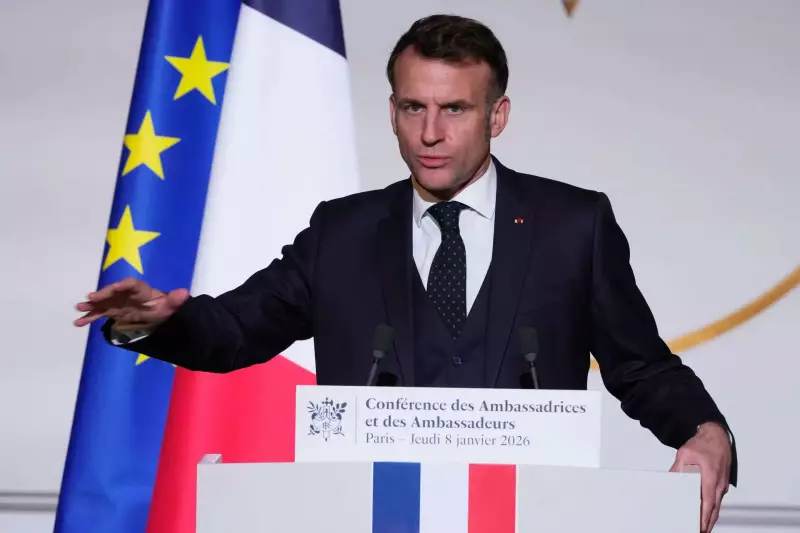
In a striking critique of a key ally, French President Emmanuel Macron has accused the United States under its second Trump administration of turning its back on the international order it once championed. Macron delivered this sharp warning during his annual address to French ambassadors in Paris on Thursday, highlighting a growing rift in transatlantic relations.
A Stark Warning from Paris
According to reports from the AFP news agency, Macron told the assembled diplomats that the United States, while an established power, is "gradually turning away from some of its allies and breaking free from international rules." He painted a picture of a world where great powers are tempted to carve it into spheres of influence. This criticism comes just days after a controversial US military operation on January 3rd, where American special forces captured Venezuelan President Nicolas Maduro and his wife, Cilia Flores, taking them to New York to face narcoterrorism charges.
While European allies have largely refrained from condemning the US for the Venezuela mission—choosing instead to criticise Maduro's dictatorial rule—Macron's comments represent a significant public rebuke of Washington's methods. He urged his diplomats to move beyond mere commentary, stating emphatically, "We're not here to comment. We're here to act!"

The UN Crisis and Greenland Tensions
Macron pointed to the declining effectiveness of multilateral institutions like the United Nations as a core part of the problem. He stated that these bodies are "functioning less and less effectively," creating a climate of uncertainty. The French leader directly linked this decline to the stance of its largest shareholder, the United States, which he implied has lost faith in the system.
He illustrated the volatility by referencing recent statements from US President Donald Trump, who began his second term last year. Since the Venezuela operation, Trump has renewed his interest in taking "control" of Greenland, an autonomous territory of Denmark. Macron noted the pervasive anxiety this causes, saying, "Every day, people wonder whether Greenland is going to be invaded and whether Canada will face the threat of becoming the 51st state."
Trump's refusal to rule out using force to seize the strategic Arctic island has provoked shock and anger in Europe, particularly in Denmark. The Danish government has warned that any such attack would mean the end of the NATO alliance, underscoring the severe strain on traditional partnerships.
A Call for Diplomatic Reinvestment
Faced with this challenging landscape, President Macron called for a strategic response. He framed the current moment as the right time for a "renewed commitment" and to "reinvest fully in the United Nations." His address served as a rallying cry for European and French diplomacy to assert itself actively in a world where the old guarantor of the rules-based order is stepping back.
The capture of Maduro, which sparked international criticism about the undermining of international law, combined with the rhetoric on Greenland, has provided Macron with concrete examples to support his broader argument about American unilateralism. His speech signals a potential pivot in European foreign policy thinking, moving from passive alliance to more assertive, independent action in global affairs.