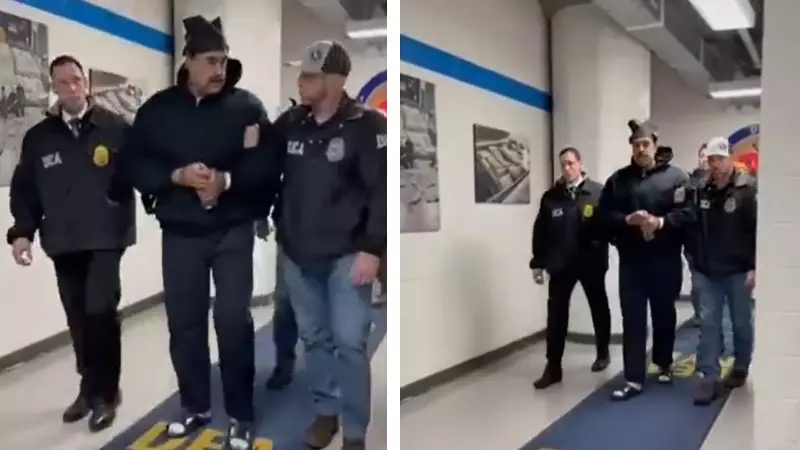
A startling video capturing Venezuelan President Nicolas Maduro in handcuffs has ignited a firestorm of controversy and speculation. The footage, filmed by a bystander in New York City, shows the socialist leader being detained by security personnel, offering a rare and undignified glimpse of a head of state.
The Viral Incident: A Bystander's Camera Captures the Moment
The incident unfolded not on the streets of Caracas, but in the bustling heart of New York. According to reports, President Nicolas Maduro was visiting the city for the United Nations General Assembly. The now-viral video, shot by an onlooker, shows Maduro dressed in a dark suit, his hands secured behind his back with what appear to be plastic flex-cuffs.
He is surrounded by a team of serious-looking security agents, who guide him through what seems to be a hotel corridor or a similar indoor space. The Venezuelan leader's expression is one of visible discomfort and tension, a stark contrast to his usual public demeanour. The individual filming the scene can be heard in the background, adding a layer of raw, real-time documentation to the event.

Context and Conflicting Narratives
The video quickly spread across social media platforms, leaving viewers to piece together the circumstances. Official statements from the Venezuelan government and the security team involved have been sparse, leading to a vacuum filled with theories. Some sources suggest the detention was a brief security procedure, possibly related to protocol or a threat assessment upon entering or leaving a secured venue.
Others have interpreted the handcuffing as a more deliberate and symbolic act, given the deeply strained relations between Venezuela and the United States. The US has not recognized Maduro's presidency since 2019, imposing severe sanctions on his government and recognizing opposition leader Juan Guaidó as the legitimate interim president. This political backdrop turns a simple security clip into a potent international incident.
The date of the incident remains unclear from the initial reports, though it is linked to a UNGA session. The lack of an official, detailed explanation from either the US Secret Service, NYPD, or Maduro's own security detail has only fueled further speculation and debate about the treatment of a sitting president on foreign soil.
Repercussions and Diplomatic Ramifications
The publication of the video has significant implications. For Maduro's domestic audience, the imagery of their president in handcuffs could be portrayed as an act of humiliation by a foreign power, potentially used to galvanize nationalist sentiment. Conversely, his opponents may view it as a form of accountability for a leader accused by many Western nations of authoritarianism and human rights abuses.
Internationally, the event raises delicate questions about diplomatic protocols and the treatment of heads of state, even those who are politically contentious. The incident is likely to further sour the already non-existent relationship between Caracas and Washington. It also sets a complex precedent for how security forces interact with leaders from nations with which the host country has profound disagreements.
In the age of smartphones and instant sharing, the episode underscores how a single, unverified clip can alter public perception and escalate diplomatic tensions. The video from New York has moved beyond a local security scene to become a global talking point, reflecting the deep political fissures surrounding Venezuela's leadership and its place in the world order.