

Odisha Delegation Heads to Chhattisgarh in Bid to Resolve Mahanadi River Dispute
A crucial team from Odisha is set to visit Chhattisgarh to determine the future course of the contentious Mahanadi River dispute, with indications suggesting that a resolution may be closer than ever before. This development marks a potential turning point in a conflict that has historically been characterized by bitter rivalry and legal stalemates.
Historical Context and Escalation of the Conflict
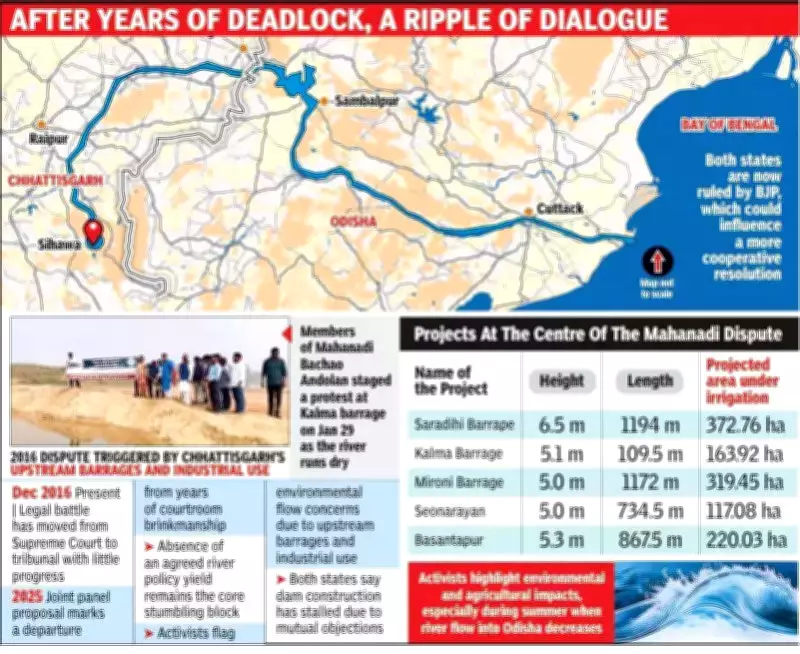
The Mahanadi River dispute, while rooted in historical tensions, gained its current form in 2016 when Odisha raised concerns about Chhattisgarh's construction of barrages across the river. Odisha urgently requested central government intervention to halt these projects, arguing that the dams and barrages would pose significant socio-economic and ecological threats. The state maintained that reduced water flow would jeopardize agricultural supplies and environmental stability, a contention that persists to some extent today.
Both Odisha and Chhattisgarh regard the Mahanadi as their lifeline, with experts, farmers, and various stakeholders from both states consistently advocating for a sustainable solution. The situation intensified in December 2016 when negotiations facilitated by the central government failed to yield results, prompting Odisha to approach the Supreme Court. The state sought the establishment of a tribunal under Article 131 of the Indian Constitution to adjudicate the matter.

Political Standpoints and Legal Proceedings
At the time, Naveen Patnaik, the Chief Minister of Odisha and leader of the Biju Janata Dal (BJD), informed the state assembly about filing the suit in the Supreme Court. Conversely, Raman Singh, then Chief Minister of the BJP-led Chhattisgarh government and now the state's Speaker, defended his state's position. He asserted that Chhattisgarh utilized only 15% of the river's water, with 57% flowing into the sea, and emphasized that their projects would not adversely affect water flow into Odisha.
In 2017, the central government declined to form a tribunal in its Supreme Court affidavit, criticizing the Odisha government for failing to provide supporting data and evidence. The affidavit accused Odisha of lacking seriousness in negotiations and highlighted Chhattisgarh's efforts to resolve the issue through interstate panels rather than a tribunal—a method Odisha insisted upon for an independent investigation.
Tribunal Formation and Procedural Challenges
In January 2018, the Supreme Court directed the central government to establish a tribunal within a month, a move initially perceived as a victory for Odisha. However, the tribunal's effectiveness has been inconsistent. Proceedings faced delays due to the COVID-19 pandemic, and in 2022, efforts stalled further as the two states could not agree on a common information format.
The tribunal's term was extended multiple times, and members visited Chhattisgarh in April 2023 without making substantial progress. In 2024, only one witness was examined, and the tribunal operated without a chairperson for eight to nine months until Retired Supreme Court Judge Bela Trivedi was appointed in December 2024. Additionally, the central government cited a procedural oversight—Odisha's failure to formally include it in the complaint—as grounds for not participating in the dispute.
Recent Developments and Public Advocacy
In May 2025, opposition parties and groups like the Mahanadi Bachao Andolan in Odisha appealed to the Prime Minister to address the issue, claiming that dam constructions by Chhattisgarh in the upper catchment area cause the Mahanadi to run dry during summer months in Odisha. This public pressure underscores the urgency of finding a resolution.
The upcoming visit by the Odisha team to Chhattisgarh represents a renewed effort to break the deadlock. While the path to resolution has been fraught with legal complexities and partisan interpretations, this initiative signals a collaborative approach that could pave the way for a mutually acceptable solution to one of India's most protracted interstate water disputes.






