The Rise and Fall of Manhattan's Rooftop Helipad: A Jet Age Dream That Crashed
For a fleeting period in the 1960s, and again briefly in 1977, a passenger in Midtown Manhattan could experience a futuristic commute. They could enter an office tower, ride an elevator to the roof, and board a helicopter destined for the airport. This concept was born from the optimism of the jet age, where speed, altitude, and technological advancement were viewed not merely as conveniences but as the inevitable future of urban living.
A Skyscraper Built for a Different Kind of Arrival
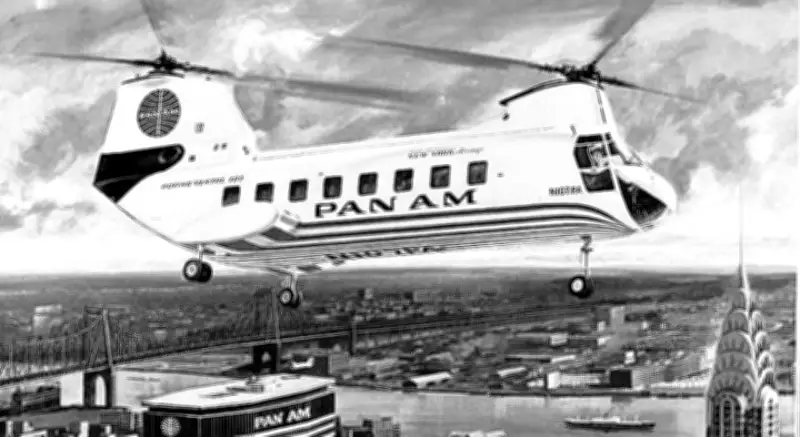
When the Pan Am Building, now known as the MetLife Building, opened its doors at 200 Park Avenue in 1963, it was envisioned as far more than a standard office block. Backed by Pan American World Airways and championed by its president, Juan Trippe, the structure was designed to function almost as an extension of the airline itself—a "city within a city" that could move people with the same efficiency that planes traversed continents.
The building's infrastructure reflected this grand ambition. It featured dozens of high-speed elevators, including innovative double-deck systems, and an upper-lobby design capable of processing thousands of workers and visitors daily. At the summit, the 57th and 58th floors housed the "Copter Club," a lounge where passengers could check in, wait, and then proceed directly to the rooftop helipad.

The idea was elegantly simple: completely bypass Manhattan's notorious traffic congestion. Instead of travelers journeying across the city to reach the airport, the airport would effectively come to Midtown.
The Helipad Begins, and Struggles to Last
Trial helicopter operations commenced in 1965, utilizing Boeing Vertol 107 aircraft operated by New York Airways. From the rooftop, passengers could fly directly to John F. Kennedy Airport and, for a time, to Teterboro Airport. For a short while, the concept proved successful. During the 1966 transit strike, when much of New York's public transportation ground to a halt, the rooftop operation reportedly handled approximately 700 passengers per day.
In moments like these, it offered a glimpse of the multi-layered city its backers had imagined—one where ground-level gridlock could be entirely avoided. However, problems emerged immediately and persisted. The helicopters generated significant noise, drawing constant complaints from both building tenants and neighboring structures. Demand also failed to meet expectations once the initial novelty faded and normal transit services resumed. By 1968, merely three years after its inception, the service was shut down.
A Second Attempt and a Fatal Flaw
Nearly a decade later, in early 1977, the helipad reopened for a second attempt. This time, New York Airways operated Sikorsky S-61 helicopters, a civilian adaptation of the military Sea King. The relaunch aimed to address earlier shortcomings and establish economic viability. A key operational change was central to this effort: a procedure known as "hot loading."
Instead of shutting down the aircraft between flights, helicopters would keep their engines running and rotor blades spinning while passengers disembarked and new passengers boarded. This approach reduced turnaround time, allowing for more daily flights, but it also substantially increased operational risk.
On May 16, 1977, that risk culminated in catastrophe. At approximately 5:35 PM, a Sikorsky S-61 helicopter landed on the rooftop with its rotors still spinning as passengers exited and others waited nearby. A structural failure occurred in the landing gear, later traced by the National Transportation Safety Board (NTSB) to metal fatigue in a critical aluminum component. As the landing gear collapsed, the helicopter tipped onto its side.
The spinning rotor blades struck the deck, breaking apart with violent force. Four individuals waiting to board on the rooftop were killed by the impact and flying debris. Several others sustained injuries. The devastation did not remain confined to the roof.

Debris Falling into the City
Fragments of the rotor blades were hurled outward with immense energy. One large section struck the building itself, reportedly hitting a window on an upper floor before splitting apart. A piece of the debris continued its descent to street level, where it struck and killed a pedestrian on Madison Avenue—a woman from the Bronx who had been waiting for a bus.
Other fragments were discovered blocks away, highlighting the scale and unpredictability of the failure. This tragic event unfolded simultaneously at two levels of the city—on the roof and on the street—graphically exposing the inherent risks of conducting active aviation operations atop densely populated urban space.
Why It Failed and What Followed
Investigators determined that the cause of the crash was not pilot error but structural failure. The NTSB found that a component in the landing gear, fabricated from 7075-T73 aluminum, had developed a crack over time due to corrosion and repeated stress. This flaw propagated unnoticed until it catastrophically failed under load.
The fact that the helicopter was operating under "hot loading" conditions meant the rotors were spinning at full speed when the aircraft collapsed, dramatically amplifying the incident's severity. The response was immediate and decisive, resulting in the permanent closure of the rooftop helipad that very same day. It never reopened for commercial service.
This accident effectively marked the end of an era. High-volume rooftop helicopter commuting in New York City ceased, with regulators and city officials subsequently relocating operations away from densely built areas toward waterfront heliports, where risks to people on the ground could be better mitigated.
A Vision That Didn't Survive Reality
The Pan Am Building helipad had embodied a specific moment in urban and technological thinking, shaped by the belief that cities could be layered vertically with air travel seamlessly integrated into everyday movement. In practice, the idea proved unsustainable. Noise pollution, high operational costs, safety concerns, and the harsh realities of operating aircraft in dense urban environments all conspired against it.
Today, the rooftop of the MetLife Building stands silent. The structure functions much like any other major commercial tower in New York—a high-end office address housing large corporations, with retail concourses, cafés, and everyday amenities woven into its lower levels. Interestingly, peregrine falcons have been known to nest on its upper reaches, a quieter, unintended use of a space once engineered for helicopters.
It remains one of the city's most recognizable landmarks, even if its most ambitious feature has long been dormant. The company that lent the building its original name followed a similarly dramatic trajectory. Pan American World Airways, once the defining airline of the jet age and a symbol of American global reach, entered a prolonged decline in the subsequent decades. It ultimately ceased operations in 1991, unable to overcome financial struggles and seismic industry changes.
There have since been periodic efforts to revive the Pan Am name in limited forms, trading on its storied legacy and cultural resonance. While none have restored it to its former stature, the brand continues to resurface, with recent developments even hinting at a possible return to the skies as its current owners have reportedly begun the FAA certification process.