

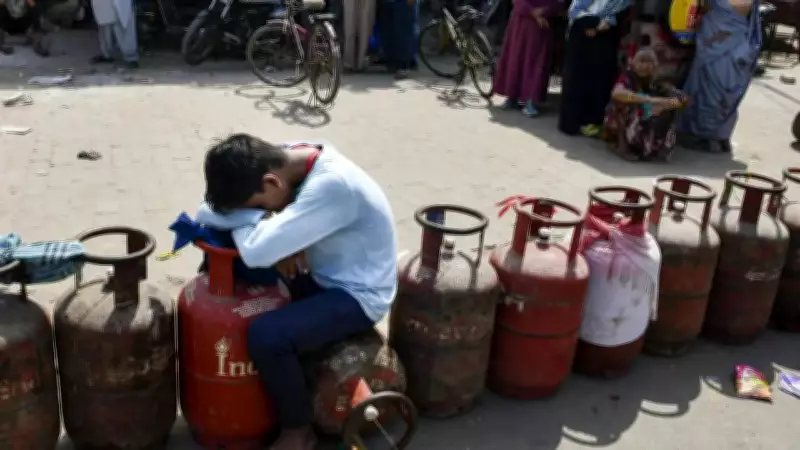
Middle East Conflict Triggers LPG Crisis in India, Disrupting Daily Life
The price of a simple cup of tea has become a stark indicator of global turmoil. Outside the Noida Sector 16A metro station, a tea stall vendor apologetically hands over a cup priced at 15 rupees, up from its previous rate. When questioned about the increase, he offers a weary explanation: "The cylinder has gone very costly." This scene is being replicated across India as the ongoing conflict in the Middle East begins to reverberate thousands of kilometers away, directly impacting the availability and affordability of Liquefied Petroleum Gas (LPG), a critical fuel for cooking and industry.
How Global Tensions Are Disrupting India's LPG Supply
The current crisis is intrinsically linked to the widening conflict involving Iran, the United States, and Israel. This geopolitical instability has disrupted vessel movement through the Strait of Hormuz, one of the world's most vital maritime energy corridors. This narrow waterway carries approximately one-fifth of global oil supplies and a significant portion of the world's LPG shipments. Any volatility in the region sends immediate shockwaves through global energy markets, which have swiftly translated into higher LPG costs and severe supply uncertainties in India.
India's dependence on imported LPG is profound. The nation imports nearly 60% of its LPG requirement, with about 90% of those shipments passing through the Strait of Hormuz. This concentration of supply routes means that geopolitical disruptions in the Gulf region can directly and acutely affect LPG availability across the Indian subcontinent. The resulting scarcity has triggered panic bookings, long queues outside gas agencies, and widespread reports of black marketing, despite government assurances of adequate supplies.

India's Growing Dependence on Imported Cooking Gas
India's reliance on LPG imports has escalated dramatically over recent decades, primarily driven by rising domestic demand that has far outpaced domestic production. LPG is produced as a byproduct during crude oil refining or natural gas processing. While India has increased imports of both crude oil and liquefied natural gas (LNG), LPG imports have seen the steepest rise.
Data reveals a startling trend: direct LPG imports surged from just 1,722 thousand metric tonnes (TMT) in 1998–99 to 20,667 TMT in 2024–25, marking a nearly 12-fold increase over 27 years. This highlights a fundamental shift in India’s energy portfolio. In 1998–99, LPG constituted only 7.2% of total petroleum product imports. By 2024–25, its share had jumped to around 40%, making it the largest imported petroleum product by volume.
The gap between domestic production and consumption further underscores this dependence. In the fiscal year 2024, India consumed 29.7 million tonnes of LPG, while domestic production stood at just 12.8 million tonnes, with the remainder met through imports. The following fiscal year saw consumption rise to 31.3 million tonnes, with production remaining stagnant at 12.8 million tonnes. Early estimates for fiscal year 2026 indicate consumption around 28 million tonnes against production of about 10.7 million tonnes, reaffirming the heavy reliance on foreign supplies.
Rising Prices and Mounting Pressure on Households
As of March 16, 2026, the price of a standard domestic 14.2 kg LPG cylinder in New Delhi has been hiked to Rs 913, up from Rs 853. Prices vary across major metropolitan areas, reflecting regional transportation costs and local taxes:
- Kolkata: Rs 939 per cylinder
- Mumbai: Rs 912.50
- Chennai: Rs 928.50
- Bengaluru: Rs 915.50
- Bhubaneswar: Rs 939
- Chandigarh: Rs 862.50
- Gurgaon: Rs 921.50
- Hyderabad: Rs 965 (the highest among major cities)
While these rates apply to domestic cylinders for household use, consumers report that availability, not just price, is the paramount issue. In several regions, commercial LPG cylinders are allegedly being sold on the black market for nearly double the standard price. Cylinders that typically cost around Rs 1,400 are reportedly being sold for as much as Rs 3,000, pushing many small businesses to the brink of collapse.

Restaurants Shutter, Street Vendors Struggle for Survival
The hospitality sector has been among the hardest hit. Hotels, restaurants, and food stalls that depend heavily on commercial LPG are facing an existential crisis. Several eateries have reduced operations or temporarily shut down due to the acute shortage. For smaller vendors like tea stalls and snack shops, the cooking gas scarcity means cutting back on production, serving cold food, or raising prices to unsustainable levels.
This crisis has a direct human cost, negatively impacting livelihoods. Workers in the hospitality sector face reduced wages or outright job losses as businesses struggle to remain operational. The strain is also extending to manufacturing. Industrial facilities that utilize LPG for specific processes and for staff canteens report growing difficulty in maintaining normal operations, forcing innovative and often regressive adaptations.
Factories Revive Firewood Stoves as a Desperate Measure
In several industrial zones, companies are resorting to alternative cooking arrangements for their workforce. Factory canteens have begun reviving firewood stoves, a practice largely abandoned years ago due to environmental and health concerns. Other companies are switching to electric cooking devices such as induction cooktops, electric rice cookers, and electric roti makers in an attempt to circumvent the gas shortage.
Menus have been drastically simplified. Meals requiring significant gas consumption have been removed, replaced by packaged foods, sandwiches, and ready-to-eat items. In some facilities, even tea supplies have been curtailed to conserve precious fuel. The shortage is beginning to affect labor mobility, with industry bodies warning that migrant workers might return to their hometowns if reliable cooking facilities remain unavailable.
Vinnie Mehta, Director General of the Automotive Component Manufacturers Association of India, highlighted the predicament: "Workers shifted to small gas-enabled burners as wood usage was discouraged due to air pollution. Now, with the LPG cylinder shortage, they are finding it difficult to cook at home, and with some factory canteens shut, they are being forced to consider leaving for their native places." He cautioned that while the situation is not yet at pandemic levels, it could escalate rapidly if not resolved.
Panic Bookings Overwhelm Digital and Physical Systems
The shortage has triggered a wave of panic buying across multiple cities. Consumers have rushed to book cylinders through mobile apps, websites, and IVRS numbers, overwhelming booking systems and causing widespread technical failures. Many reported online platforms crashing or displaying "server down" messages, forcing thousands to visit gas agency offices in person.
Outside LPG distribution outlets in Delhi, Gurgaon, Mumbai, Kolkata, Lucknow, and Chennai, long queues have become a common and distressing sight. Women carrying empty cylinders, elderly residents, and office workers who have taken time off wait for hours, often in vain. Shashi Kant Sharma, vice-president of the Federation of LPG Distributors of India, acknowledged the systemic strain: "Bookings have risen tenfold, so the system has slowed. We are working on it at the backend." Even successful orders are frequently met with cancellation alerts or significant delivery delays.
The crisis disproportionately affects vulnerable households. Radha Rani, a 60-year-old resident of Delhi’s Ajmeri Gate area, was seen standing in a queue with her grandson, stating she had been coming for three consecutive days as the agency's supply runs out before her turn arrives. Others complain that calls to gas agencies go unanswered, leaving them without recourse or information.
Hostels, PG Accommodations, and Students Hit Hard
The LPG shortage is severely affecting students and working professionals living in paying guest accommodations and hostels nationwide. Operators report immense difficulty in maintaining food services due to the scarcity of cylinders. Residents note a marked decline in food quality and a reduction in meal options, with breakfast dishes often repeated daily and food cooked in the morning sometimes reheated and served again for dinner.
K Deva Rani, a PG hostel owner in Vijayawada, described the immense pressure on operators: "Gas cylinders are not easily available, forcing us to arrange alternative cooking methods. Costs have increased sharply, and we must request students to cooperate until normal supplies are restored." This disruption adds another layer of instability to the lives of young people already navigating education and early careers.
Resurgence of Ready-to-Eat Foods and Black Market Woes
As cooking gas becomes scarce, households are increasingly turning to ready-to-cook or ready-to-eat food products. Retailers report sales of frozen snacks, instant noodles, and packaged meals have surged by nearly 20% month-on-month. Karan Ahuja, a spokesperson for premium grocery retailer Le Marche, noted, "Categories like ready meals and instant noodles have seen strong traction, leading to about a 10-12% rise. While the surge appears temporary, we are proactively stocking these categories." Food delivery companies and retailers are also promoting induction-friendly cookware and electric appliances, signaling a potential lasting shift in consumer behavior.
Simultaneously, reports of black marketing and fraudulent "ghost deliveries" have surfaced. Residents in cities like Patna complain that LPG cylinders are marked as delivered in official records without actually reaching consumers. Abdus Salam, a resident of Patna’s Bhagwanpur, detailed how his mother’s account showed a refill delivered despite no cylinder being received, alleging black-marketing by the gas agency. Such complaints raise serious concerns about systemic diversion and manipulation of digital records during the crisis.
Government Response and the Path Forward
Despite widespread public concern, government officials maintain that there is no major fuel shortage in the country. Sujata Sharma, joint secretary at the Ministry of Petroleum and Natural Gas, stated that crude oil inventories remain sufficient and refineries are operating at full capacity. She advised judicious LPG consumption and the use of alternate cooking sources, while asserting that supplies and deliveries for domestic consumers are continuing as usual, with improvements in online booking systems.
To ease pressure, authorities have activated alternative fuels like kerosene and coal for certain sectors, including restaurants. Commercial LPG sales, initially halted, have been partially restored. Consumers in cities with piped natural gas (PNG) infrastructure are being encouraged to shift to PNG connections, with distribution companies offering incentives to promote the transition.
Financial analysts warn that if the Middle East conflict persists, the consequences could extend far beyond LPG shortages. A Morgan Stanley report indicated that supply disruptions could affect multiple industries across Asia, including manufacturing, agriculture, and transport. Countries like India, Thailand, South Korea, and Taiwan are considered particularly vulnerable. The Middle East is also a critical supplier of industrial materials such as fertilizers, sulfur, and petrochemicals, which are essential inputs for various sectors.
A Glimmer of Hope and a Lasting Impact
In a small relief, reports indicate that two LPG carriers have recently crossed the Strait of Hormuz safely, with more expected to follow. Iran has reportedly allowed Indian-flagged LPG tankers to transit the region despite rising tensions. Currently, around 28 Indian vessels are operating in the Persian Gulf, with authorities closely monitoring their movement.
For now, the effects of the Middle East conflict continue to ripple through India’s kitchens, factories, and markets. What began as a distant geopolitical confrontation has rapidly transformed into an everyday struggle for millions trying to cook meals, sustain businesses, and keep the wheels of industry turning. Until energy shipments stabilize and supply chains normalize, the humble LPG cylinder stands as one of the most visible and tangible reminders of how global conflicts can reshape and disrupt daily life on a massive scale.





