

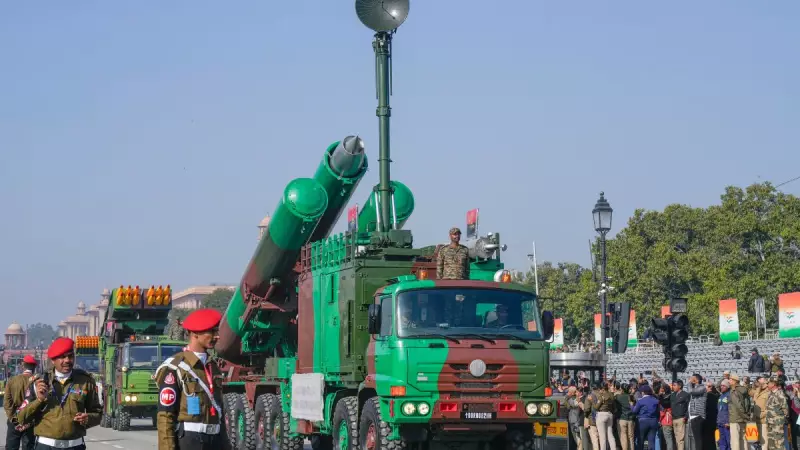
Prime Minister Narendra Modi and Russian President Vladimir Putin are scheduled to hold crucial talks in December 2025, with a significant focus on advancing the Indo-Russian defence partnership. A key agenda item will be the development of the next-generation BrahMos-NG (New Generation) supersonic cruise missile.
Strategic Talks and Defence Modernization
The high-level dialogue, set for the first week of December 2025, underscores the enduring strategic ties between New Delhi and Moscow. The discussions are expected to cover a broad spectrum of bilateral issues, but the collaboration on the BrahMos-NG project is poised to be a centerpiece. This project represents a major leap forward from the current BrahMos missile systems, which are already among the world's most formidable precision-strike weapons.
Sources indicate that the talks will aim to finalize roadmaps and accelerate joint development efforts for the new missile variant. The BrahMos-NG is designed to be lighter, faster, and more versatile than its predecessors, allowing for deployment on a wider range of platforms, including newer fighter aircraft like the Su-30MKI and potentially future indigenous platforms.

The Legacy of Operation Sindoor and Regional Deterrence
The original BrahMos missile gained legendary status in Indian military circles following its reported use in Operation Sindoor. This military action, which deeply concerned Pakistan, demonstrated the missile's pinpoint accuracy and devastating firepower. The success of the operation cemented BrahMos's role as a key deterrent and a symbol of India's conventional strike capability.
The development of the BrahMos-NG is a direct evolution of this proven technology. By incorporating advanced materials, improved propulsion, and enhanced stealth features, the next-generation missile aims to stay ahead of emerging air defence systems and maintain India's strategic edge in the region. Its development is closely watched by security analysts globally.
Implications for Indo-Russian Partnership and Security
The Modi-Putin meeting on this issue highlights the continued importance of the Russia-India defence corridor, even as New Delhi diversifies its weapons procurement. The BrahMos joint venture, established between India's DRDO and Russia's NPO Mashinostroyeniya, remains a flagship example of successful military-technical cooperation.
Advancing to the NG version involves complex technology sharing and co-production agreements, which will be a test of the partnership's depth. Successfully fielding the BrahMos-NG will not only enhance the Indian Armed Forces' capabilities but also boost the export potential of the missile system to friendly nations, generating significant revenue for both countries.
In conclusion, the December 2025 summit between the Indian Prime Minister and the Russian President is set to be a pivotal moment for defence innovation. The focus on the BrahMos-NG missile underscores a shared commitment to developing cutting-edge military technology that safeguards national security and projects power effectively. The outcome of these talks will significantly influence the future trajectory of the Indo-Russian strategic partnership and the balance of power in the region.






