

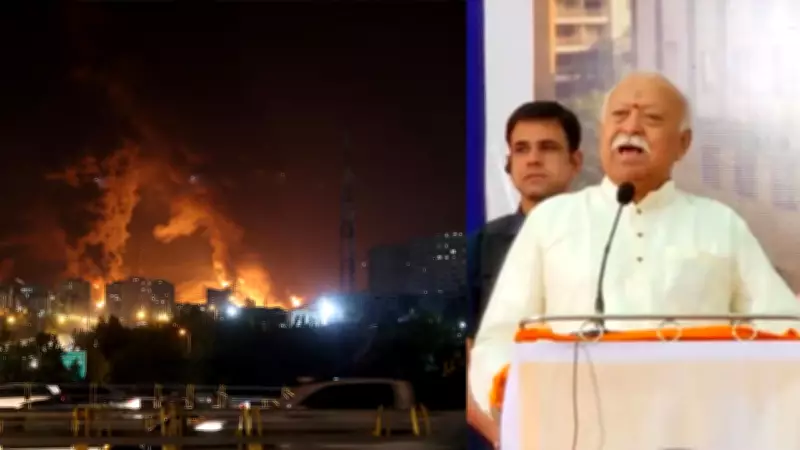
RSS Chief Mohan Bhagwat Declares India Can Be a Decisive Force in Ending Global Wars
In a significant and timely intervention amidst escalating global tensions, Rashtriya Swayamsevak Sangh (RSS) chief Mohan Bhagwat has made a bold statement, asserting that India possesses the unique capability to play a decisive role in ending ongoing wars worldwide. Addressing a gathering in Nagpur, Bhagwat emphasized the increasing global recognition of India's peace-oriented approach and its potential to act as a stabilizing force in a conflict-ridden world.
India's Civilisational Ethos as an Alternative to Conflict
Bhagwat articulated that wars fundamentally stem from ego, dominance, and narrow self-interests, which perpetuate cycles of violence and instability. In contrast, he argued that true and lasting solutions to global conflicts lie in fostering harmony, collective responsibility, and a broader sense of humanity. He highlighted India's rich civilisational ethos, which is deeply rooted in principles of unity, dharma (righteous duty), and non-violence, suggesting that this offers a viable alternative to the current conflict-driven global systems.
Drawing a sharp contrast with traditional power politics, Bhagwat stated that India follows the "law of humanity," prioritizing dialogue, restraint, and mutual respect over aggression and coercion. This perspective, he noted, aligns with India's historical and cultural legacy of promoting peace and coexistence, making it uniquely positioned to mediate and resolve international disputes.

Context of Escalating Tensions and India's Global Image
Bhagwat's remarks come at a critical juncture, with escalating tensions in regions such as West Asia highlighting the urgent need for diplomatic solutions and conflict resolution. His statement reinforces India's growing image on the world stage as a nation that advocates for restraint, dialogue, and peaceful coexistence, rather than military intervention or partisan alliances.
The RSS chief's message is clear and resonant: in a world increasingly divided by geopolitical rivalries and armed conflicts, India could emerge as a crucial stabilizing force, leveraging its moral authority and diplomatic channels to bridge divides and promote global harmony. This vision positions India not merely as a regional power but as a global leader in peacebuilding, capable of influencing international discourse and action towards more sustainable and equitable outcomes.
Implications for Global Diplomacy and India's Role
Bhagwat's assertion underscores a broader narrative about India's evolving role in global affairs. As nations grapple with complex challenges like territorial disputes, economic sanctions, and ideological clashes, India's approach—emphasizing civilisational values and human-centric policies—offers a refreshing paradigm. This could enhance India's diplomatic engagements, particularly in multilateral forums, where it can champion initiatives focused on conflict prevention, mediation, and post-conflict reconstruction.
Ultimately, Bhagwat's statement serves as a powerful reminder of India's potential to contribute meaningfully to global peace efforts. By drawing on its historical wisdom and contemporary diplomatic prowess, India can indeed play a pivotal role in ending wars and fostering a more harmonious world order, as envisioned by the RSS chief in his address from Nagpur.






