Munich Security Conference 2026: World Leaders Declare Global Order Collapse
In February 2026, the Munich Security Conference witnessed a dramatic departure from diplomatic niceties as world leaders delivered stark warnings about the disintegration of the international system. Germany's Chancellor Friedrich Merz declared that the global order "no longer exists," while French President Emmanuel Macron cautioned that Europe must prepare for potential war. These statements represented a seismic shift in international discourse, reflecting deep concerns about the stability of the post-1945 world architecture.
The Great Disorder: End of Post-WWII Framework
The Munich Security Report 2026, titled "Under Destruction," presented a sobering assessment that "more than 80 years after construction began, the US-led post-1945 international order is now under destruction." This framework, built upon American leadership, open markets, and shared international rules, faces unprecedented strain from multiple directions. Russia's ongoing war in Ukraine continues to challenge European security assumptions, while trade disputes are hardening into competing economic blocs.
US Secretary of State Marco Rubio's declaration that "the old world is gone" and Canadian Prime Minister Justin Trudeau's warning about a "rupture" in liberal democratic systems underscored a growing consensus among Western leaders. Trudeau echoed the ancient Thucydidean warning that "the strong do what they can, the weak suffer what they must," suggesting a return to power politics over principles-based governance.

Five Fronts of Modern Conflict
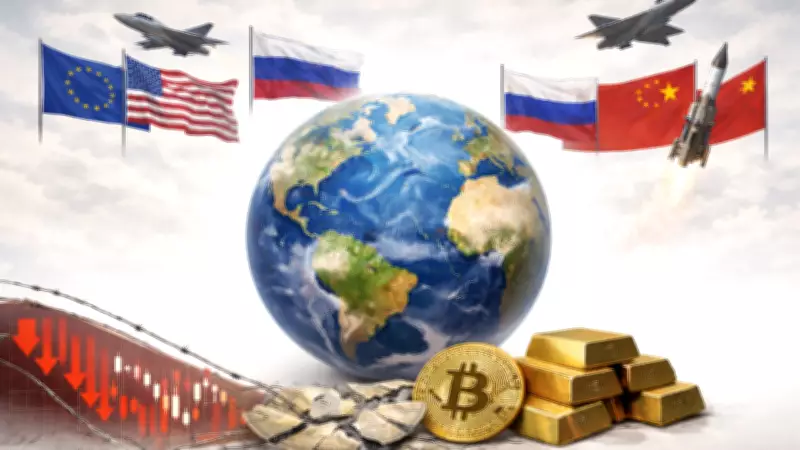
Contemporary conflicts now span five distinct domains, reflecting how geopolitical competition has evolved beyond traditional battlefields:
- Trade Wars: Rising tariffs and import bans are fracturing global supply chains, with the US-China trade dispute persisting and countries from Brazil to India implementing protectionist measures.
- Technology Competition: Governments are competing aggressively over artificial intelligence, semiconductors, and 5G networks, using export controls and industrial policy as strategic weapons.
- Financial Warfare: Targeted sanctions, capital controls, and currency manipulation have become standard tools of statecraft.
- Military Rearmament: Nations across Europe and Asia are rapidly increasing defense spending and modernizing their armed forces.
- Norm Erosion: International institutions and agreements are being bypassed when inconvenient to powerful states.
As the MSC report observed, when powerful states clash they "don't get their lawyers to plead their cases to judges" but resort to raw power dynamics. This represents a fundamental challenge to the rules-based international order that has governed relations since World War II.
Military Rearmament Across Continents
The breakdown of international stability has triggered significant military buildups worldwide. Japan's government, ending decades of pacifism, approved a record ¥9.04 trillion budget (approximately $58 billion) for fiscal year 2026—its largest defense allocation ever. This funding supports new long-range missiles and unmanned systems designed to protect Japan's islands, with Tokyo explicitly citing pressure from nuclear-armed neighbors China, North Korea, and Russia as justification.
European nations are following similar paths. France and Germany have announced multi-hundred-billion-euro rearmament plans, while NATO estimates that allies' combined defense spending has reached 3% of GDP. New air and naval bases, missile defense systems, and drone programs are being developed across the continent.
Meanwhile, Russia has deployed hypersonic missiles, and China is mass-producing long-range rockets while advancing cyber capabilities and offensive artificial intelligence systems. These developments reflect shifting strategic postures: Europe seeks "strategic autonomy," Japan aims to deter Chinese aggression over Taiwan, and even traditionally neutral EU countries like Austria and Ireland are debating their security positions.

Economic Consequences of Global Fragmentation
The erosion of international order carries profound economic implications. Confidence in cross-border finance and credit is diminishing, with government bonds—the foundation of the post-war monetary system—appearing increasingly vulnerable. Investors are fleeing uncertainty by acquiring hard assets: gold has reached new highs across multiple markets, cryptocurrency remains volatile, and real estate in perceived safe countries has become highly sought after.
Traditional fixed-income investments no longer appear secure when currencies might be debased to fund military expenditures. The global supply of trust is shrinking, with agreements reached under the old order—trade deals, investment treaties, patent protections—potentially breaking down or requiring renegotiation. Companies and investors now face significant geopolitical risk premiums, as sanctions and capital controls create barriers to cross-border legal enforcement.
Historical Parallels and Future Scenarios
Ray Dalio, founder of Bridgewater Associates, has popularized the "Big Cycle" theory suggesting that global orders rise and fall roughly every 100–150 years. The current period bears uncomfortable similarities to the 1930s, when countries turned inward during the Great Depression: the United States raised Smoot-Hawley tariffs, Britain pursued "empire free trade," and militarist governments gained power in Asia.
Today's leaders explicitly reference these historical parallels, seeing echoes of 1938 in contemporary war risks. Economists worry that the debt accumulated since the 2008 financial crisis has never been fully resolved, creating additional strain on the international system.
Looking forward, the BRICS+ grouping—Brazil, Russia, India, China, South Africa, and new members—represents a potential pole in a future multipolar world. Chinese officials have described it as the nucleus of a new global architecture, though the coalition remains more a platform for expressing dissatisfaction with Western dominance than a fully formed alternative order.
The Path Forward: Uncertainty and Transition
The world order is not experiencing a sudden collapse but rather a steady erosion of the assumptions that sustained it for decades. The US-led system that shaped the post-1945 era has not formally disintegrated, yet its authority has diminished, its guarantees are questioned, and its moral clarity has blurred. What we are witnessing represents less an obituary than a messy, anxious, and potentially dangerous transition period.
Power is dispersing across multiple centers, alliances are hardening into competing blocs, and economics is increasingly intertwined with geopolitics. A multipolar world is emerging without agreed rules or trusted referees to manage disputes. History suggests such transitional periods are rarely calm, raising urgent questions about whether today's leaders can construct a more stable framework before rivalry escalates into open rupture.