

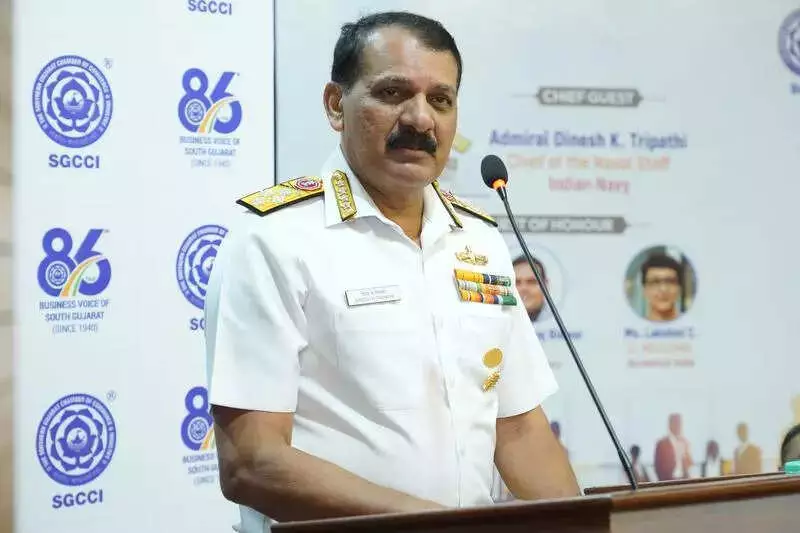
In a powerful address that charted a progressive future for the Indian Navy, Chief of Naval Staff Admiral Dinesh Kumar Tripathi declared it highly conceivable that the nation will see a woman admiral addressing a gathering in the near future. Speaking at the Southern Gujarat Chamber of Commerce's 9th National HR Conclave in Surat, Admiral Tripathi outlined the transformative journey of women in the naval forces and India's growing self-reliance in defence.
A Progressive Horizon: Women Steering the Navy's Future
Admiral Tripathi expressed strong confidence that a woman admiral leading such talks is a distinct possibility in the coming few years. He detailed the Navy's evolving approach, noting that while women have been inducted since the early 1990s, all branches and corridors are now open to them. "We have fighter pilots, and now we have helicopter pilots. We have all kinds of commanding officers of ships," he stated, highlighting the significant and growing influx of women officers.
The Navy Chief also confirmed that opening the submarine arm to women is merely "a matter of time," signaling the next frontier in gender inclusion within the force's most challenging domains.

Atmanirbharta in Defence: Ships and Submarines 'Made in India'
Shifting focus to India's strategic capabilities, Admiral Tripathi underscored a monumental achievement in indigenous defence production. He revealed that all ships and submarines for the Navy are now being constructed within the country, with nothing slated for building abroad. This, he emphasized, positions India uniquely as the only non-P5 nation globally with the capability to design, build, and operate both an aircraft carrier and a Ship Submersible Ballistic Nuclear (SSBN).
He traced this capability back to the foundational years, linking it to the establishment of the Warship Design Bureau around the same time India's iconic Ambassador car first rolled out in the early 1960s.
India's Maritime Footprint: From Ancient Heritage to Modern Trade
The Admiral eloquently connected India's contemporary maritime strength to its ancient legacy, giving special recognition to Gujarat's role. He called Gujarat the land of Lothal, the world's oldest known dock, and referenced the archaeo-astronomical marvel of the ‘Baan Sthamb’ at Somnath, aligned precisely towards the South Pole. The ancient ports of Dholavira and Dwarka were also highlighted as testaments to the region's flourishing maritime history.
On the global stage, Tripathi shared a striking statistic: India currently supplies nearly 12% of the world's seafarers, with government efforts aimed at placing the nation among the top three. "In practical terms, one in every eight people at sea in the merchant navy is an Indian, irrespective of the flag that ship is flying," he explained, showcasing India's human resource dominance in global trade.
Bringing the narrative to the host city, he linked Surat's historic identity with the sea to the Indian Navy's decision to name a warship after it. The state-of-the-art stealth destroyer, INS Surat, was commissioned by the Prime Minister in Mumbai, standing as a symbol of national pride and Surat's enduring maritime connection.






