

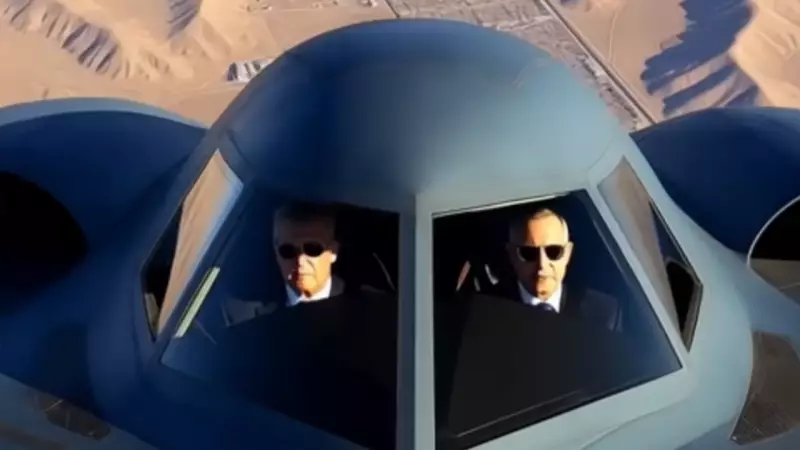
In a striking move blending diplomacy with digital innovation, Israeli Prime Minister Benjamin Netanyahu's office released an artificial intelligence-generated video featuring him and former US President Donald Trump. The 7-second clip, shared to mark six months since the end of a brief but intense conflict with Iran, shows the two leaders seated inside the cockpit of a sophisticated B-2 stealth bomber.
A Symbolic Flight: Decoding the AI Video
The video begins with a wide shot inside the aircraft before zooming in to reveal Trump as the pilot and Netanyahu as his passenger. The two exchange a knowing look, a moment loaded with political subtext. The press office shared the clip with the caption "On our victory lap. #sixmonths," directly referencing the 12-day war between Israel and Iran that concluded in June.
This digital creation was released as Prime Minister Netanyahu prepares for a year-end visit to the United States. The timing is deliberate, aiming to underscore the enduring US-Israel alliance half a year after regional hostilities. The choice of the B-2 bomber is particularly significant, as it is a strategic asset operated exclusively by the United States Air Force, symbolizing unparalleled military power and deep technological partnership.

Strategic Talks: Iran's Missiles and Nuclear Ambitions
The video sets the stage for expected high-stakes discussions during Netanyahu's US trip. Conversations with President Trump are likely to focus heavily on Iran's advances in ballistic missile capabilities and the potential consideration of further military steps to counter them.
Washington has historically shared Israel's security concerns regarding Iran, especially disputes surrounding Tehran's nuclear infrastructure. President Trump has consistently claimed that US airstrikes conducted this summer successfully destroyed key Iranian nuclear facilities. He asserts these operations crippled Iran's nuclear program and enhanced regional stability, though he has issued warnings specifically about nuclear reconstruction, not directly targeting Tehran's missile development.
Echoing this stance, White House spokeswoman Anna Kelly stated, "As President Trump has said, if Iran pursued a nuclear weapon, that site would be attacked and would be wiped out before they even got close." She made this remark when questioned about potential US support for an Israeli attack focused on Iran's missile program.
Regional Ripples: A Widespread Security Concern
The anxiety over Iran's ballistic missile program is not confined to Israel and the US. Several Gulf Arab states also perceive the program as a mounting regional threat, fearing its reach and destabilizing potential.
For Tehran, however, its missile arsenal represents a cornerstone of national defence. With a relatively weak air force and its nuclear ambitions facing significant setbacks, missiles are viewed as a critical deterrent. This perspective has been reinforced by the heavy losses suffered by its regional allies, notably Hezbollah and Hamas, after nearly two years of conflict with Israel. The missile program is thus positioned as Iran's primary lever of power and a guarantor of its security in a volatile neighbourhood.
The AI-generated video, while a brief digital snippet, encapsulates a complex geopolitical landscape. It highlights the continued focus on Iran, celebrates a military alliance, and uses cutting-edge technology to send a potent message about strength and remembrance six months after a flashpoint war.






