

NITI Aayog and Germany's GIZ Lead International Workshop to Accelerate SDG Delivery Through Enhanced Governance
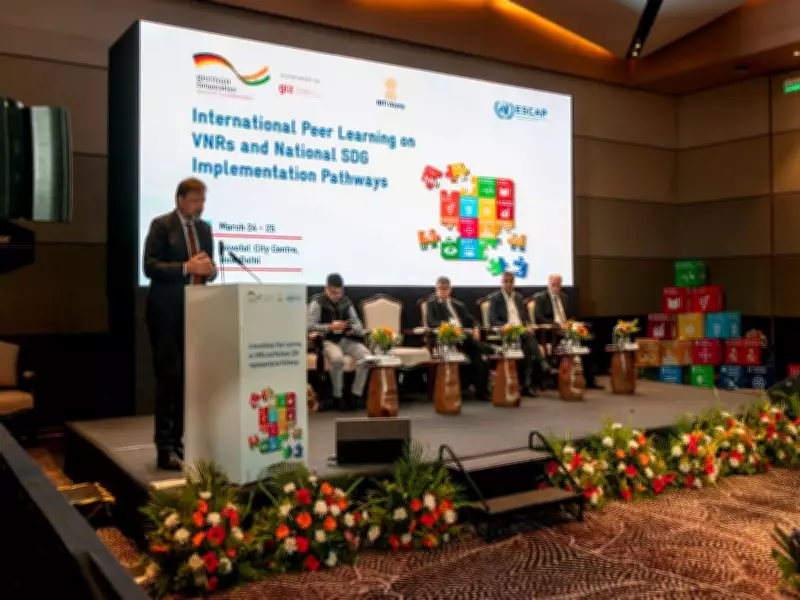
In a significant effort to reignite momentum towards the 2030 Agenda for Sustainable Development, a two-day international workshop titled 'International Peer Learning of Voluntary National Reviews (VNRs) and National Sustainable Development Goals (SDGs) Implementation Pathways' was held in New Delhi on March 24-25. The event, co-hosted by NITI Aayog, the Deutsche Gesellschaft für Internationale Zusammenarbeit (GIZ) GmbH, and the United Nations Economic and Social Commission for Asia and the Pacific (UNESCAP), brought together policymakers, practitioners, and experts from various countries to explore how stronger governance systems can fast-track the achievement of the SDGs.
Strengthening Global Partnerships for Sustainable Development
The workshop was conducted within the framework of the Indo-German Partnership for Green and Sustainable Development (GSDP), reinforcing the joint commitment of India and Germany to the 2030 Agenda and the Paris Climate Agreement. Speaking at the inauguration, Ambassador of Germany to India and Bhutan, Philipp Ackermann, emphasized the critical role of global cooperation. He stated, "At a time when global crises, from conflict and economic disruption to climate change, are demanding immediate attention, the Sustainable Development Goals remain our most important and universally accepted framework for measuring progress. But achieving them will depend not only on global commitment, but on how effectively they are translated into action at the national and local levels."
Focus on Localisation and Practical Implementation
With the 2030 deadline approaching, the workshop came at a critical juncture. In 2025, countries including India and Germany presented their VNRs on SDG implementation. This workshop built on that milestone by shifting the focus from reporting to action. Discussions centered on using VNRs and Voluntary Local Reviews (VLRs) not just as reporting mechanisms, but as catalysts for policy coherence and accelerated delivery.

In his keynote address, Vice Chairman of NITI Aayog, Suman K. Bery, highlighted the importance of localising SDGs and strengthening governance systems to translate global commitments into improved development outcomes. He noted that India's experience demonstrates how embedding SDGs into state and local planning processes can foster ownership and accelerate progress across sectors.
Key Thematic Areas and Solution Pathways
The event focused on practical pathways to enhance SDG delivery. Key thematic areas included:
- Integrating the principles of Leaving No One Behind (LNOB) and gender equality into national planning and budgeting.
- Strengthening coordination across different levels of government.
- Improving data ecosystems for evidence-based course correction.
Participants deliberated on solution pathways such as innovative governance models, financing approaches, and digital innovations, with a view towards the post-2030 agenda. The workshop brought together a diverse set of stakeholders, including representatives from international peer learning groups and countries across Asia-Pacific, Africa, and Europe. There was a particular emphasis on strengthening collaboration and knowledge exchange across the Global South, alongside participation from key partners such as the German Federal Ministry for Economic Cooperation and Development (BMZ) and the German Embassy in India.
Insights from Key Stakeholders
Stefan Priesner, United Nations Resident Coordinator for India, remarked, "Voluntary National Reviews have evolved into powerful tools not just for reporting, but for identifying gaps, strengthening institutions, and guiding policy correction. As we approach 2030, the focus must shift towards using these processes to drive implementation at scale. This requires stronger alignment between planning, financing, and data systems, alongside deeper localisation of the SDGs."

Saurabh Garg, Secretary of the Ministry of Statistics and Programme Implementation (MoSPI), highlighted the critical role of robust data and indicator frameworks in monitoring SDG progress and enabling evidence-based decision-making across national, state, and district levels.
Senior Adviser to NITI Aayog, Rajib Kumar Sen, added, "A Voluntary National Review is not just a document, it is a process of dialogue, reflection, and continuous learning. The real value lies not in what is written, but in how the insights generated are translated into action across ministries, states, and communities." He underlined that the VNR process serves as a platform for continuous dialogue, stakeholder engagement, and translating insights into coordinated action.
Expected Outcomes and Future Directions
The outcomes of this workshop are expected to provide actionable insights for countries and stakeholders to sustain momentum, strengthen accountability, and foster partnerships, ensuring that the ambitious vision of the 2030 Agenda translates into meaningful results for communities worldwide. The 2030 Agenda for Sustainable Development provides countries with a shared blueprint for achieving peace, prosperity, and environmental sustainability, guided by the 17 SDGs.
This collaborative effort underscores the importance of international cooperation in addressing global challenges and advancing sustainable development goals through enhanced governance and localised action.





