

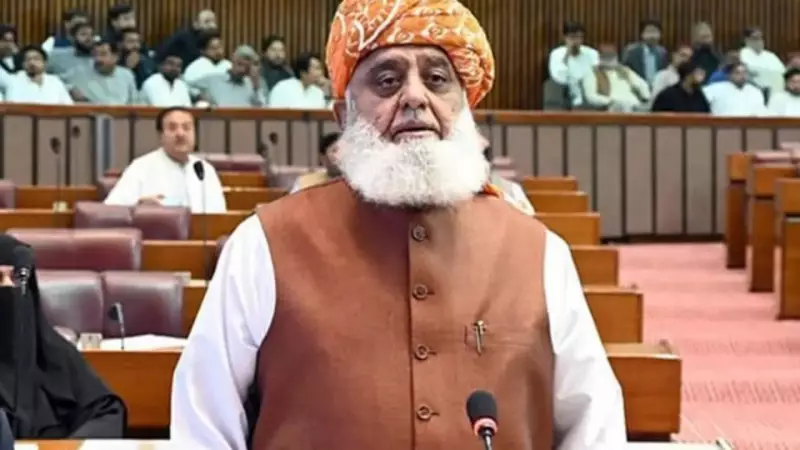
In a significant and direct critique from within Pakistan, the chief of the Jamiat Ulema-e-Islam (F), Maulana Fazlur Rehman, has launched a sharp attack on the country's powerful security establishment. The influential Deobandi cleric accused the military leadership of employing a "double standard" in its approach to cross-border military operations, questioning the very logic of Pakistan's defence policy.
The Core of the Controversy
Speaking at a recent gathering in Khyber Pakhtunkhwa, Rehman pointedly contrasted Islamabad's recent military strikes inside Afghanistan with its vehement diplomatic protests over similar actions by India within Pakistani territory. He demanded to know why India's operations should be condemned when Pakistan justifies its own strikes in Afghanistan as attacks on its enemies.
Rehman argued that if Pakistan claims a sovereign right to launch pre-emptive or retaliatory strikes against perceived threats on Afghan soil, it fundamentally weakens its moral and legal standing to object when India cites the same logic. His comments strike at a sensitive geopolitical nerve, challenging the establishment's narrative.

Pointed References to Past and Present
The cleric did not mince words, referencing Pakistan's deep historical involvement in Afghanistan. "We sent militants to Afghanistan for 20 years... from giving them Kalashnikovs to Cruise missiles... we empowered them in every way," he stated, highlighting a contentious past. He added, "When you bombed Kabul, it was as if someone had bombed your Islamabad."
Rehman then turned his focus eastward, posing a challenging question to Pakistan's military brass. He invoked specific locations within Pakistan that India has historically pointed to as hubs of militant activity. "If you say... that we have attacked the enemy's headquarters and you call this a legitimate statement, India says to you that it has attacked Bahawalpur, it has attacked Muridke, it has attacked the headquarters of those who are operating against us in Kashmir. Why are you objecting to this?" he asked.
Timing and Strategic Hypocrisy
Rehman's criticism comes at a politically charged moment. It coincides with Pakistan's Army Chief, General Asim Munir, maintaining a strong anti-India rhetoric, even claiming Pakistan received "divine help" during the military confrontation with India following the Balakot strikes in May 2019.
By asking "Why different rules for India?", Rehman has publicly highlighted what analysts often describe as a strategic contradiction. He underscored the perceived hypocrisy: justifying proactive "counterterrorism strikes" westward into Afghanistan while demanding absolute respect for territorial sanctity from India in the east. His mention of Bahawalpur and Muridke—areas long associated with groups like Jaish-e-Mohammed (JeM) and Lashkar-e-Taiba (LeT)—directly references targets that were neutralized during India's Operation Sindoor, making his analogy particularly potent.
The cleric's unprecedented public challenge forces an uncomfortable debate within Pakistan about the consistency and consequences of its national security doctrine, with clear implications for its volatile relationships with both Afghanistan and India.






