

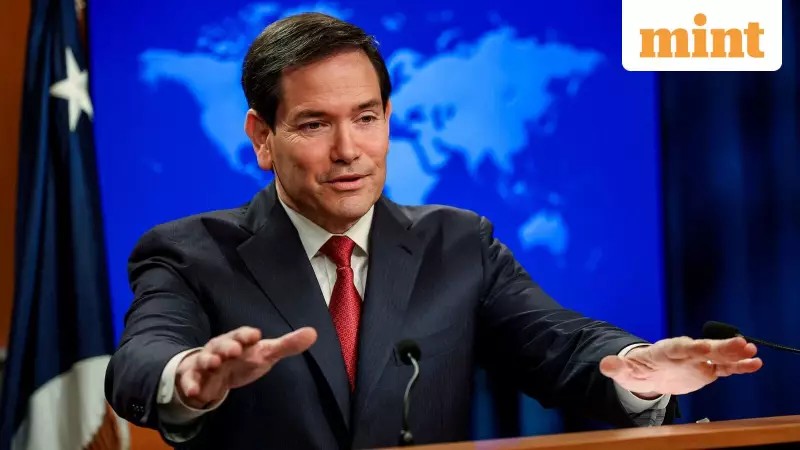
In a significant development concerning the ongoing peace efforts in Gaza, the United States has confirmed that Pakistan has expressed willingness to contribute troops to a proposed multinational security force. The revelation came from US Secretary of State Marco Rubio, highlighting a potential new role for Pakistan in the volatile region's stabilisation.
US Acknowledges Pakistan's Offer for Gaza Force
On Friday, US Secretary of State Marco Rubio stated that Pakistan had offered to send troops for the planned International Stabilisation Force (ISF) in Gaza. This force is a cornerstone of a 20-point peace plan framework championed by US President Donald Trump, aimed at building lasting peace in the conflict-ravaged area. When questioned about Pakistan's formal consent, Rubio was quoted by the ANI news agency expressing gratitude. "We're very grateful to Pakistan for their offer to be a part of it, or at least their offer to consider being a part of it," he said.
Rubio added a note of caution, indicating that more clarity was needed before any firm commitments. "I think we owe them a few more answers before we can ask anybody to firmly commit," he reportedly stated. He exuded confidence, however, that several nations acceptable to all parties in the conflict were ready to step forward. Pakistan was specifically named among the countries that had shown interest in participating in this crucial peacebuilding effort.

Pakistan's Official Stance and UN Endorsement
Contrasting the US statement, Pakistan's official position, as reported by the Dawn media house, appears more measured. During a weekly press briefing on Thursday, Pakistan's Foreign Office spokesperson, Tahir Hussain Andrabi, clarified that no final decision had been taken. "Regarding Pakistan's participation in the ISF, no decision has been taken to join the force as of now," Andrabi was quoted as saying.
This statement comes amid growing speculation that the Trump administration might be urging Pakistan to commit its soldiers. The ISF gained formal international backing when the United Nations Security Council adopted a resolution endorsing it on November 17. The resolution authorises the formation of the ISF as a temporary multinational force to assist with security, demilitarisation, and reconstruction in Gaza. Notably, while Russia and China abstained from the vote, Pakistan supported the resolution. The plan itself is credited with helping facilitate the ceasefire between Israel and Hamas in October.
Key Challenges: Disarming Hamas and Defining the Mandate
A major unresolved question central to the ISF's potential deployment is the disarmament of the Palestinian militant group Hamas, a top priority for Israel. Rubio, on Friday, did not specify which entity would be responsible for this complex task. He conceded that nations considering troop contributions, including Pakistan, are seeking clear answers about the force's specific mandate and its funding mechanisms. Countries are understandably wary that their soldiers could be drawn into combat with Hamas fighters.
Outlining the next steps, Rubio said a new governance structure for Gaza—comprising an international board and a group of Palestinian technocrats—would be established soon. The deployment of foreign troops under the ISF banner would follow, as the US aims to solidify the fragile ceasefire in Israel's war in the Palestinian enclave.
The situation remains fluid, with Pakistan's potential participation hanging in the balance as it awaits further operational details from the United States and other stakeholders involved in this ambitious international stabilisation initiative.






